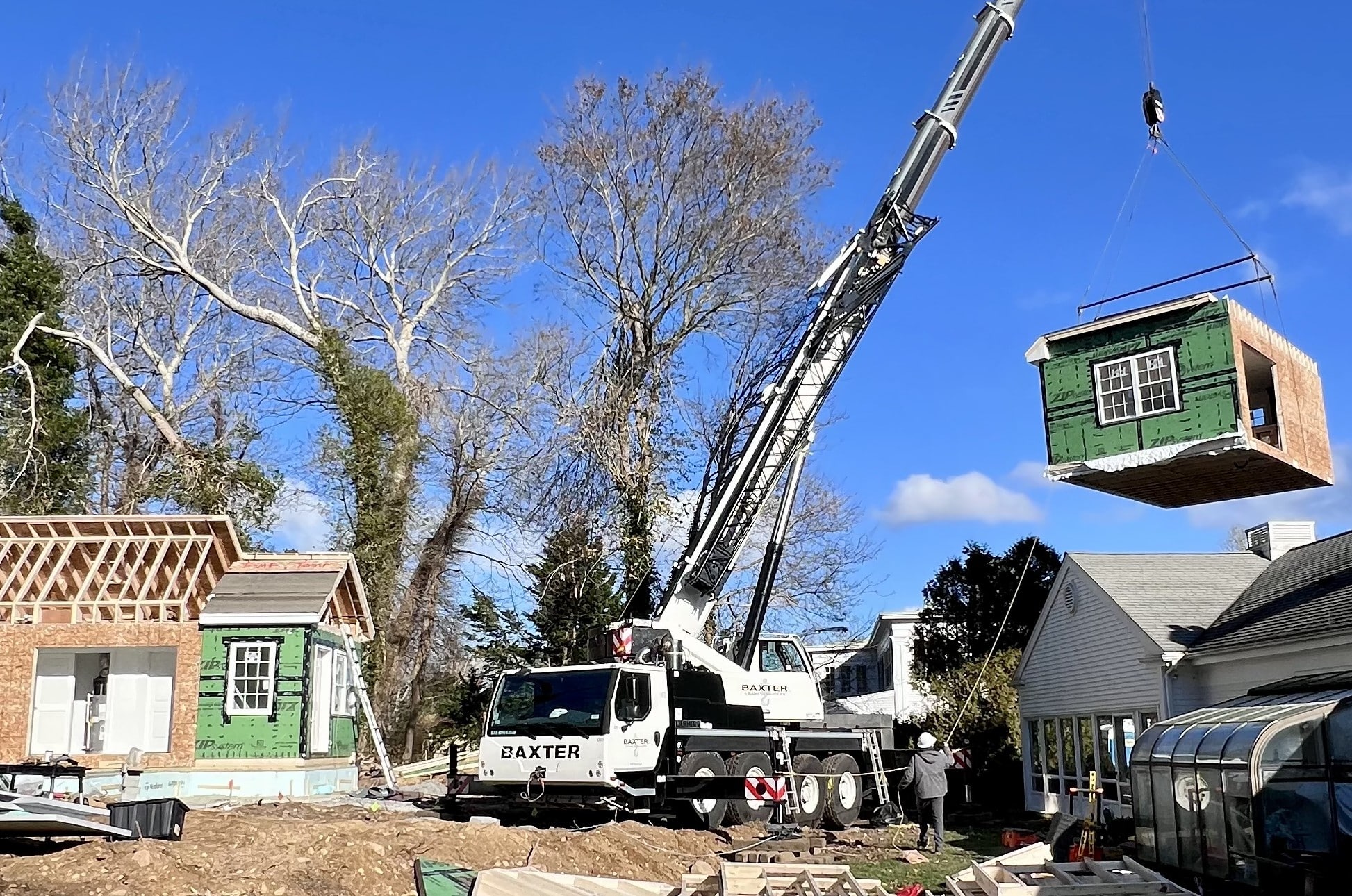
A construction worker helps guide a modular part of a Backyard ADUs home into place in a backyard in Orleans in December 2024. Photo courtesy of Backyard ADUs
Since Massachusetts formally legalized accessory dwelling units on most residential lots statewide 12 months ago, municipalities issued building permits for 1,224 projects, state officials announced Thursday morning.
ADUs were legalized as part of a 2024 housing policy and finance bill championed by Gov. Maura Healey, but regulations implementing the law weren’t released until February of last year. The rules mean ADUs smaller than 900 square feet proposed for single-family-zoned lots can skip cumbersome special permitting and zoning exemption processes. The law did not cover the city of Boston, which has its own, narrower, ADU permitting program.
The Executive Office of Housing and Livable Communities didn’t say how many of the 1,224 units had completed construction. The projects are spread among 217 towns and cities, largely concentrated in Eastern Massachusetts and Cape Cod, but 17 percent of the state’s towns and cities didn’t respond to EOHLC’s survey.
Towns and cities received applications for 1,639 ADUs in total, split 53-47 in favor of “attached” ADUs carved out of existing buildings. It was not immediately clear how many of the 415 proposed-but-not-approved units did not meet local rules for fire truck access, setbacks and other construction details, and how many were simply awaiting review from municipal building officials.
“It’s great to see so many people across Massachusetts signing up to build ADUs,” Lt. Gov. Kim Driscoll said in a statement. “By setting clear rules statewide and backing them up with real support, we’re giving families more options while helping cities and towns grow housing.”
Prior to the 2024 law, a homeowner wanting to build an ADU faced big barriers getting planning permission and financing in most communities, leading to a degree of pent-up demand, experts say. But advocates and scholars say the state’s ADU law needs additional modifications to make sure it can achieve the large-scale adoption envisioned by Healey administration officials.
Officials in California, a poster child for the idea that ADUs can make a meaningful dent in a state’s housing crisis, received applications for 7,147 ADUs in 2018, the first year they were legalized there. Massachusetts’ 2025 application rate per capita is 1.27 times that.
“The first-year data shows the Affordable Homes Act is working as intended by making ADUs simpler to permit across Massachusetts,” Housing and Livable Communities Secretary Ed Augustus said in a statement. “Now we’re capitalizing on that momentum with designs, technical assistance and affordable financing to accelerate ADU production and help relieve our housing shortage.”
Gov. Maura Healey unveiled a design competition in December to generate affordable, standardized designs, with the winner expected later this month. The state’s quasi-public housing finance agency, MassHousing, is also offering ADU construction loans to homeowners who make up to 135 percent of the area median income. MassHousing has dedicated $20 million dedicated to the program at a loan limit of $250,000 per borrower for detached ADUs, and $150,000 for an ADU that’s carved out of an existing house.
“ADUs are one of the most practical ways to add homes and lower costs. They allow older adults to age near their loved ones and young adults to live independently while starting their careers,” Healey said in a statement. “This first-year data shows homeowners are already starting to take advantage of our new law, and we’re going to keep making it easier and cheaper to build ADUs so we can bring down housing costs for everyone.”
The same survey of local building officials that produced the ADU permitting data also gathered information about barriers that homeowners face to building an ADU. High construction costs topped the list, with the need to expand septic systems to accommodate the ADU specifically called out, “especially where local requirements exceed state standards,” according to the state website summarizing the survey results.
Energy code compliance is a problem for attached ADUs, and fire code compliance is a problem for detached ADUs, but attached ADUs are sometimes challenged to meet fire separation rules, and some are being forced to add costly sprinkler systems, too. Some utilities are also requiring separate service connections for water, sewer and electric service.
State data shows Plymouth (34 ADUs), Lawrence (32 ADUs) and Nantucket (27 ADUs) lead the state in approvals for towns covered by the 2024 law. Boston officials told the state they OK’d 44 ADUs last year.
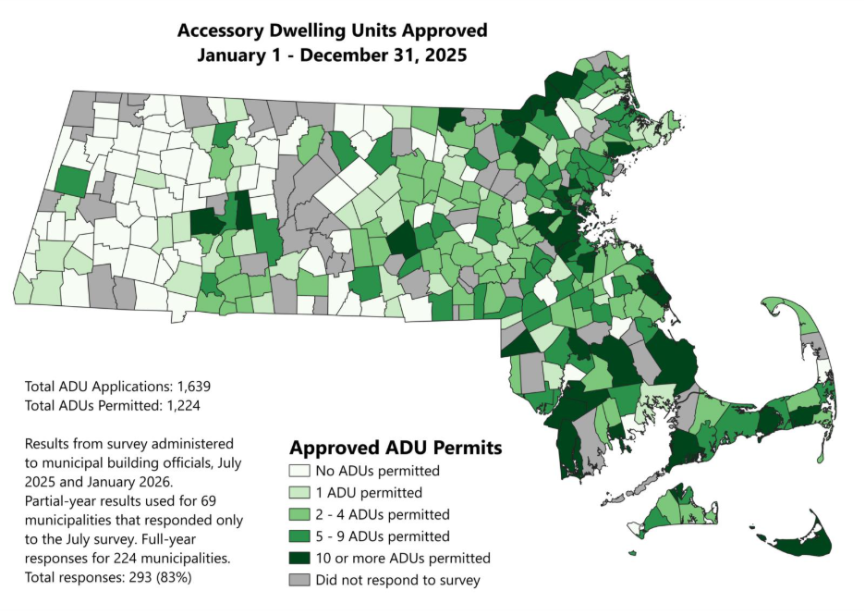
Image courtesy of the Executive Office of Housing and Livable Communities