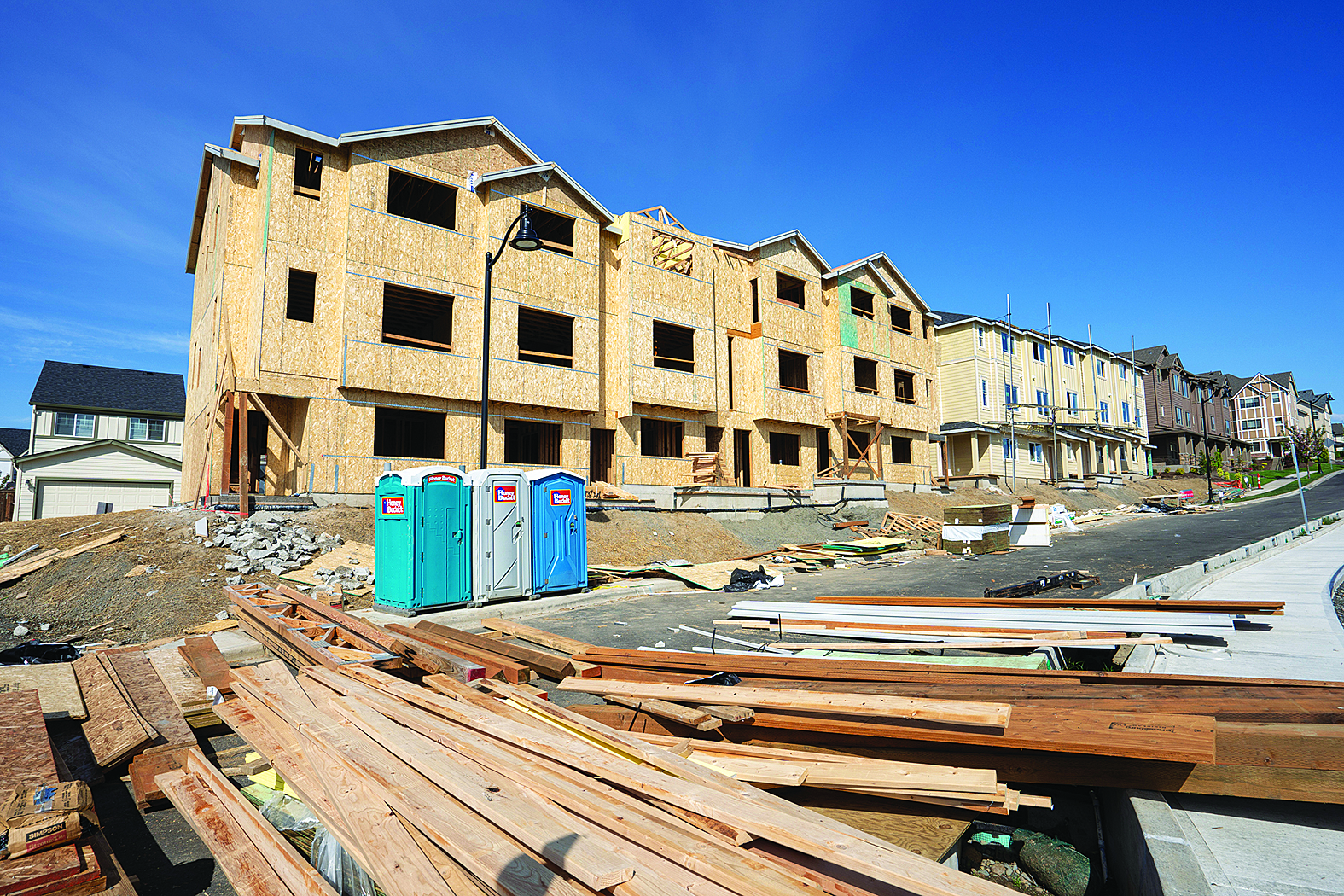
The Healey administration says over 90,000 homes of the 220,000 it needs by 2035 are already built or “in development.” But that includes projects begun long before the governor took office. iStock photo
Real progress on solving the Bay State’s housing crunch? Or happy talk from a governor facing reelection?
That’s the question in the wake of the Healey administration’s claim, first floated at the end of the summer and repeated in public appearances and press releases since then, that over 90,000 new homes, condominiums and apartments are now built or “in development” across the state.
And, according to the governor’s housing team, it’s all happened since Gov. Maura Healey took office in January 2023, with the passage last year of the governor’s signature, $5 billion-plus Affordable Homes Act.
For a state that has struggled for decades to boost new residential construction and in need of at least 220,000 new housing units between 2025 and 2035, it’s an ambitious, even astounding claim.
“Our administration is delivering on building more reasonably-priced housing,” the governor said in an August press release marking the first anniversary of the policy and housing financing law.
Lt. Gov. Kim Driscoll, who has been the administration’s point person on housing, amplified those claims.
“Just one year ago, we made a bold commitment to take on the housing shortage with the most ambitious housing package in state history,” she said in the same press release. “Today, we’re seeing the results: thousands of homes built, tens of thousands more in the pipeline.”
One of the most eye-catching assertions? Allegedly more than 63,000 new homes, condos and apartments have been proposed, permitted or completed from the start of Healey’s term in January 2023 through this July.
Those are separate from the 27,726 the administration claims are in projects proposed under the MBTA Communities law, any accessory dwelling units unlocked by a measure Healey championed, enabled by the Chapter 40B “anti-snob” zoning law or funded using some measure of state dollars.
Taking Credit for Prior Projects
Healey’s housing team, in an admirable bit of sleuthing, arrived at this number after getting access to a new U.S. Census Bureau database tracking the establishment of new addresses.
However, there is a big problem with citing all these units as evidence that the Healey administration’s housing push is already showing big results.
Many of these units – maybe even most, given that it takes about two years to build a new apartment building – were approved and broke ground back during the Baker administration.
Meanwhile, if anything, the number of new homes and apartment buildings getting underway since January 2023 has been on a precipitous decline.
Nor is it any secret why. The sharp rise in interest rates, combined with increases in construction costs, have combined to make high-process, higher-cost states like Massachusetts more difficult to build in.
Production by the Numbers
Developers across the state pulled building permits for roughly 31,000 new units so far during Healey’s term, or about 12,000 per year.
That’s well down the roughly 20,000 units a year the state was beginning to churn out by the end of the 2010s during its years-long recovery from the Great Recession and its aftermath.
Through August, local cities and towns across the state issued building permits for just 7,627 new housing units, down about 25 percent from last year, according to Census Bureau numbers.
And the drop in Greater Boston has been steep as well, according to Luc Schuster, executive director of the Boston Indicators think tank at The Boston Foundation.
During the first seven months of 2025, building permits for new housing fell 44 percent compared to the same period in 2021, when they peaked.
Does Data Undercount Production?
For its part, Healey’s housing team has raised issues with the building permit numbers collected by the feds, suggesting the numbers may actually be undercounting actual housing production.
As many as 30 percent of towns are slow to respond and don’t get their data in on time, the administration’s data analysts say.
The Census Bureau does try to account for the towns with missing data with its own estimates.
But the state Executive Office of Housing and Livable Communities, in a fact sheet laying out the methodology used in its housing production calculations, has raised questions about the accuracy of those estimates.
Instead, administration housing officials say they expect the numbers will increase when the towns that were delayed finally report their building permit numbers.

Scott Van Voorhis
We’re Still Way Behind
Yet questions about the federal building permit numbers go back years, so there is no reason to believe they are more flawed now than they were, say, five years ago.
And while there very well may be some data missing, adding even another thousand units to the woeful 7,762 building permits issued by cities and towns through the first eight months of 2025 will not do much change the larger picture, given the number for the same period in 2024 topped 10,000.
That’s to say nothing of 22,000 homes per year average the governor’s 220,000-in-a-decade goal implies – a goal that critics say will, at best, only keep us treading water instead of bringing down the high cost of living that does so much damage to Massachusetts’ competitiveness.
The Census Bureau numbers may not be perfect, but they also point to larger trends in housing production.
And despite what the Healey administration may claim, when it comes to housing production, there are more reasons to be concerned than to celebrate.
Scott Van Voorhis is Banker & Tradesman’s columnist and publisher of the Contrarian Boston newsletter; opinions expressed are his own. He may be reached at sbvanvoorhis@hotmail.com.