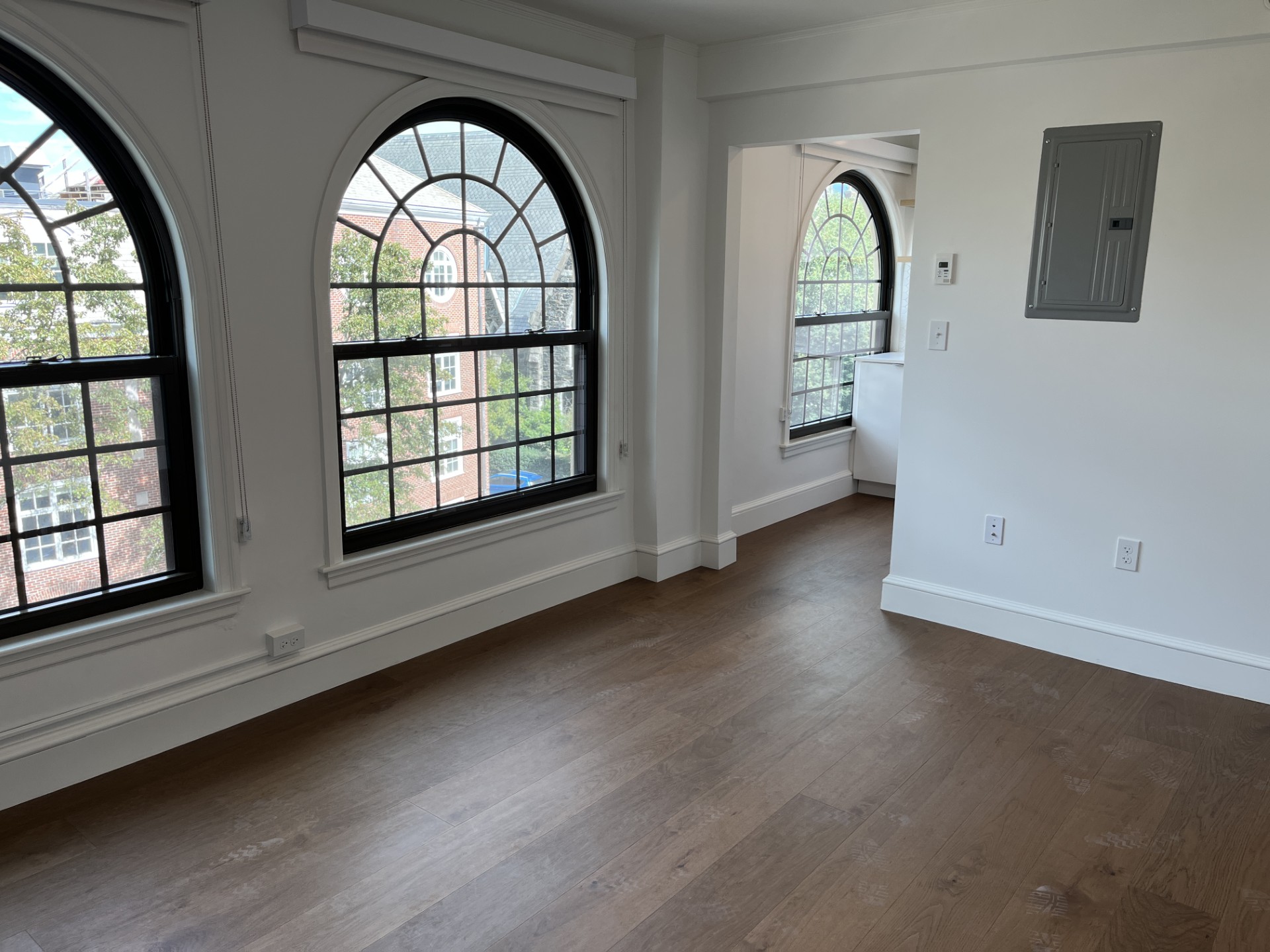
New energy-efficient aluminum windows replaced the building’s original wood-framed units while preserving muntin patterns and masonry openings. Photo courtesy of The Hamilton Company
The transformation of 1200 Massachusetts Ave. in Harvard Square blends architectural preservation, modern innovation and a reinvestment in the cultural and residential fabric of Cambridge.
Built in 1916, Longfellow Court apartments originally stood as a hallmark of early 20th-century mixed-use development. Designed in the Italian Renaissance Palazzo style, the 5-story structure featured a symmetrical façade, copper cornice, recessed main entry with ornate masonry and an open-air central courtyard. Its construction using fireproof materials – steel, concrete and terracotta block – reflected the forward-looking design and building standards of the time.
The building originally housed working families, with many of the tenants employed by the Boston Bookbinding Company that had a plant and offices on Arrow Street directly behind.
For more than a century, the building occupied a prominent position at a key entry point to Harvard Square. The building contributes significantly to the Harvard Square Historic District, listed in the National Register of Historic Places in 1982 and 1988.
Historic Rehab, Cutting-Edge Systems
Fast forward to October 2025: The Hamilton Company, which acquired the property in 1999, completed a $32 million historic rehabilitation of Longfellow Court, now called Longfellow Apartments. The project has delivered 91 fully modernized residential units, complete with cutting-edge systems and improved amenities, while meticulously preserving and restoring the building’s historical character. The effort underscores how adaptive reuse can honor a community’s past while serving its present and future needs.
Planning for the rehabilitation began in 2019, with architectural and construction teams from Hamilton Construction Management Corporation and Crossfield Engineering tackling the initial challenge: modernizing outdated HVAC systems in a historic envelope. Soon after, a more comprehensive vision emerged, one that would restore Longfellow’s architectural integrity and qualify the project for both state and federal historic preservation tax credits.
Following design approval by the Cambridge Historical Commission in 2020, construction officially began in early 2021. The project unfolded in two major phases. Phase one focused on the building’s west side apartments and exterior envelope. Phase two addressed the east side units and shared common areas, including accessibility upgrades and interior finishes.
Work was substantially completed by fall 2025, with leasing for the first phase quickly reaching full capacity. Phase one is now open to new residents.
Deep Archival Research
Central to the project’s success was the ability to balance historic authenticity with 21st-century functionality.
Under the guidance of Ryan/MacRostie Historic Advisors, Hamilton’s team pursued rigorous archival research, uncovering original blueprints from 1916 and a 1950s photograph that revealed the building’s original windows and façade details. These insights shaped many of the project’s signature preservation strategies.

Jameson Brown
New energy-efficient aluminum windows were custom-fabricated to replicate the building’s original wood-framed units, preserving muntin patterns and masonry openings. Decades of water damage were addressed using traditional stucco techniques that matched the original texture and finish. Historic doors, trims and moldings were either retained or reproduced as exact replicas.
The final phase, currently in planning, includes restoration of the Massachusetts Avenue lobby guided by uncovered architectural elements such as a beamed ceiling and decorative moldings.
Beneath the surface, the building now houses completely modern systems: state-of-the-art electrical, plumbing, HVAC and fire protection infrastructure, all discreetly integrated to maintain the building’s original aesthetics. The property is also now fully accessible, achieving compliance through a series of carefully engineered solutions and variances.

Samara Z. Tilkin
Filling a Housing Niche
Beyond the rehabilitation itself, the reimagining of 1200 Massachusetts Ave. represents a meaningful contribution to the vitality and sustainability of Harvard Square.
The Longfellow Apartments not only preserve a beloved landmark, but they also help meet critical housing demand in an area where space is at a premium and historic integrity matters deeply to both residents and preservation advocates.
Offering a range of units – from studio apartments to three-bedroom homes, between 292 and 1,132 square feet – Longfellow Apartments responds to diverse housing needs. With easy MBTA access, keyless entry via the LATCH app, pet-friendly policies, secured package delivery, bike storage and a host of modern conveniences, the building effectively combines history with contemporary urban living.
The continuation of a ground floor retail program, along with the fully restored interior courtyard, enhances the property’s role as a welcoming, community-facing asset – reinvigorating an antiquated structure into a vibrant, multipurpose destination.
Jameson Brown is chairman and CEO of The Hamilton Company and Samara Z. Tilkin is director of architecture for Hamilton Construction Management Company.