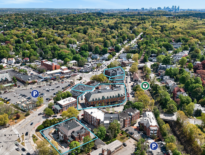
Boston's Charles F. Hurley State Office Building. Photo by James Sanna | Banker & Tradesman Staff
Redevelopment of the state-owned Hurley-Lindemann complex in Boston’s West End was envisioned as a new, billion-dollar life science cluster before economic headwinds throttled down demand for lab space.
Now the Healey administration is relaunching its efforts to find a private developer for the 6.5 acre property, with a goal of creating “hundreds of housing units” including a potential office-to-residential conversion.
The state Division of Capital Asset Management and Maintenance issued an offering memorandum this week for the Staniford Street property, nearly two years after cancelling the lab plan in 2024 by Boston-based Leggat McCall Properties.
The latest effort touts the possible reuse of vacant office space in the Hurley Building, which would qualify for property tax breaks under Boston’s office-to-residential conversion program if developers submit plans by Dec. 31.
However, DCAMM said in an statement Wednesday that it plans to select the developer in 2027.
“While it is set to expire at the end of 2026, as noted in the offering memorandum, to date the city has issued annual extensions of the program since 2023. While DCAMM can’t represent there will be another extension, we will continue to communicate closely with the city,” a DCAMM spokesperson said in an email.
The offering memorandum also mentions “potential for added density on top” of the Hurley and Lindemann Mental Health Center buildings.
The previous round touted potential to build up to a floor area ratio of 10 on the site, including a potential 400-foot-tall building.
Updated design guidelines released in January specify that new building massing and height should be “appropriately scaled” and “sensitive to adjacent residential communities such as Beacon Hill and the West End.”
“This site represents one of the most significant housing development opportunities in Boston,” Gov. Maura Healey said in a statement.
The new development will be required to retain the 115 residential beds for Lindemann Center clients, or relocate them in “close proximity.”
Potential demolition of the Brutalist buildings was ruled out in the previous round, after groups including the Boston Preservation Alliance fought for their retention.
State real estate officials previously estimated the Hurley building needs $225 million in repairs.
A call for offers is scheduled later this summer.