Hours before Boston’s new rules for affordable housing were set to kick in, developers filed notifications for a pair of residential projects in the South End and Beacon Hill.
Boston-based Related Beal plans a 300,000-square-foot residential and retail project at 370 and 380 Harrison Ave. The parcels are the former home of Quinzani’s Bakery and Ho Kong Bean Sprout Co.
And a development team notified city officials on Thursday that it plans to convert two former Suffolk University classroom and office buildings on Beacon Hill into 75 condominiums.
Earlier in the week, Boston Properties announced plans for a 1.4-million-square-foot mixed-use development including a substantial residential component above the MBTA’s Back Bay station. Detailed plans for all three projects are not expected to be submitted to the BRA for several months, according to the notification letters.
The South End project would be a located in a gentrifying neighborhood a block from National Development’s Ink Block luxury residential and retail project. It would contain retail and commercial tenants on the ground floor along with an unspecified number of residential units and parking, according to the letter from Related Beal COO Kimberly Sherman Stamler.
In Beacon Hill, JDMD Owner LLC acquired two former Suffolk University buildings in July for $43.5 million. The development team, which is managed by David Raftery, Matthew Snyder and David Ridini, includes The Architectural Team of Chelsea and EBI Consulting. The project will redevelop the 6-story building at 61 Temple St. and the Archer Building at 33-51 Temple St. into 75 condos with 60 parking spaces.
The flurry of project filings coincides with the enactment of the biggest changes in the city’s affordable housing policy since 2000.
On Dec. 10, Boston Mayor Martin Walsh approved changes to the city’s 16-year-old inclusionary development policy (IDP), which sets minimum affordable housing requirements in new developments. Typically, 13 percent of the units in a project must be set aside for income-restricted households.
To avoid that requirement, developers also have the option of paying an opt-out fee to support generation of affordable housing in the surrounding neighborhood. That fee had been set at $200,000 throughout the city.
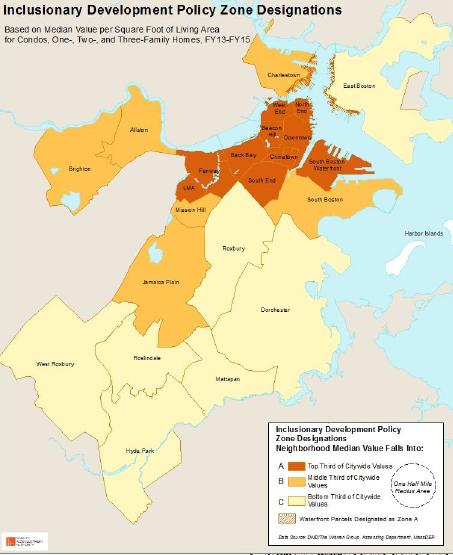
Under the new policy, the fee would rise to $380,000 in the highest-priced neighborhoods including South End and Beacon Hill, and $300,000 in areas such as Allston, Jamaica Plain and South Boston. The new guidelines also increase the percentage of units used to calculate the fee from 15 to 18 percent in the two-thirds of the city with the highest housing prices.
As long as these developers file a detailed proposal within 90 days, they will be subject to the previous IDP requirements, BRA spokesman Nicholas Martin said.
“We anticipated that some developers might try to file in order to get in under the old IDP, and we built in the 90-day safeguard as a way to ensure that only mature projects would file before Jan. 1,” Martin said.