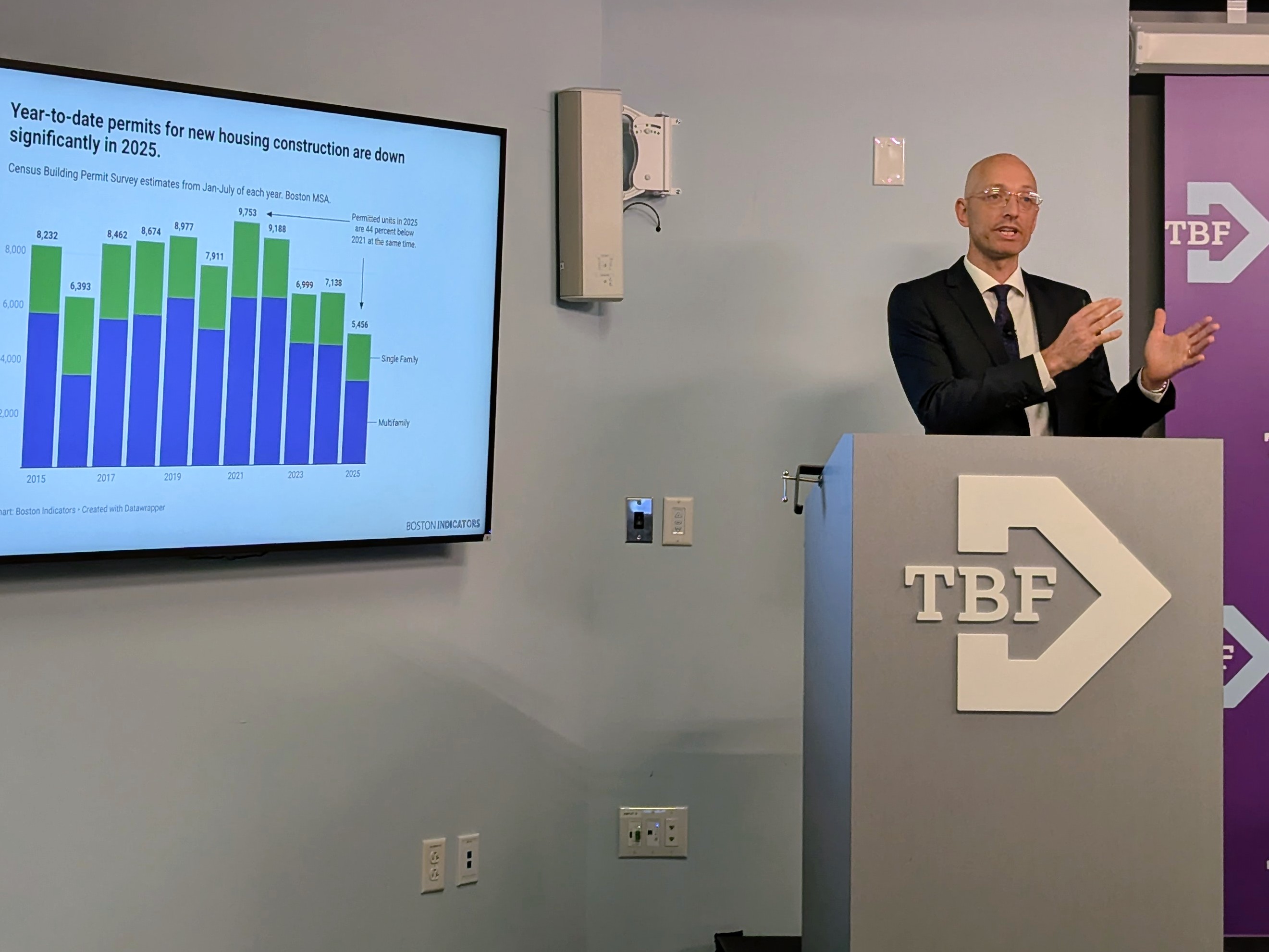
Luc Shuster, executive director of the Boston Foundation’s Boston Indicators research center. Photo by James Sanna | Banker & Tradesman Staff
Massachusetts is unlikely to meet the Healey administration’s goal for 220,000 new housing units’ completion by 2035, according to a new report analyzing the state of the residential real estate market.
The Boston Foundation and Boston University collaborated on the Greater Boston Housing Report Card report released today. While price increases have moderated, challenging development financing remains a chokepoint for new housing creation.
“The core reason we have this core affordability challenge is we’re just not building enough homes,” said Luc Shuster, executive director of the Boston Foundation’s Boston Indicators research center.
The state’s Affordable Homes Act, signed by Gov. Maura Healey in 2024, set a target of building 220,000 additional homes statewide by 2035. The state Executive Office of Housing and Livable Communities has cited the proposal or construction of more than 90,000 homes since Healey took office in 2023 as a sign of significant progress.
However, many of the projects were permitted and received financing prior to the runup in interest rates and construction costs that continue to depress construction starts.
“So, while the good news is that thousands of new homes have recently come online, Massachusetts is likely entering a period of far slower completions,” the report states. “At current permitting levels, we are unlikely to come close to building 220,000 new units statewide between 2025 and 2035.”
Lt. Gov. Kim Driscoll cited recent reforms such as the statewide legalization of accessory dwelling units, and mentioned recommendations from the Healey administration’s Unlocking Housing Production report, including legalization of so-called “single stair” multifamily buildings.
Driscoll urged a gathering of housing and business executives to take a more vocal role in local debates over development, and promised more housing reforms from the administration. Driscoll and Healey face reelection next fall.
“I’ve really found business community folks don’t typically show up at a council or zoning meeting,” Driscoll said. “When a local coffee shop owner comes in and says, `This is an important tool,’ they get a little bit more attention than just maybe our housing zealots.”
Lessons from MBTA Law
Zoning reforms such as the MBTA Communities law are having some effects in encouraging multifamily development in suburbs with regulations that previously discouraged non-single family housing.
Katherine Levine Einstein, associate director of the Initiative on Cities at Boston University, gave the MBTA Communities law mixed grades during a presentation on the report today. Some communities deliberately rezoned areas already occupied by multifamily housing in an attempt to avoid housing production, and most avoided rezoning single-family neighborhoods.
In additional obstacles to housing development, tariffs are raising prices further on construction materials, and Trump administration policies to limit immigration could lead to shortages of immigrant construction labor. While Trump’s “Big Beautiful Bill” expanded low-income housing tax credits – a key source of financing for affordable housing developments – proposals to reduce public housing and Section 8 vouchers could add pressure on low-income households’ housing budgets.
“Today’s higher borrowing costs, tariffs on key building materials, and persistent construction workforce challenges make it far harder for new projects to pencil out financially,” the report states.
Home Prices Grow Faster Than Rents
Home prices have risen faster than apartment rents in Greater Boston in recent years, with average single-family home prices topping $741,000 during the first half of 2025. The list of communities with average single-family home prices exceeding $1 million has grown to 36, led by Brookline’s $2.7 million figure. Average condominium sales were nearly $722,000 over the same period.
Listings have been depressed by interest rate increases that discouraged homeowners from placing their properties on the market.
Zillow ranks Greater Boston as the nation’s fifth priciest apartment market, with rents approaching $3,000 a month.
In the past two decades, more residents have departed Greater Boston than moved into the region domestically. The figure has been offset by the international migration which reached a two-decade high of nearly 70,000 in 2024. That contributed to positive net migration of 45,374 in 2024.
“The data confirm what many residents already know from lived experience: Housing costs continue to rise faster than incomes, housing need far exceeds production, and the gap between who can afford to stay in Greater Boston and who cannot continues to widen,” the report states.