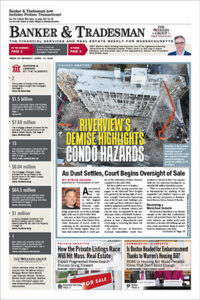
A quiet block of two- and three-story family houses, with lawn chairs on the porch and flagpoles jutting out above the walkways – it’s one of the most typical street scenes in Boston. But a new look at foreclosure data suggests it may also be the portrait of a time bomb.
The data suggests that precisely those types of houses – small multi-family residences, especially the thousands of ubiquitous “triple-decker” homes converted into condos over the past decade-plus – have been particularly prone to foreclosure during the bust.
Jeremy Robitaille, currently a presidential fellow at the Department of Housing and Urban Development, wrote his master’s thesis at Tufts University on foreclosures in Dorchester and other Boston neighborhoods. His research included foreclosure data from The Warren Group, publisher of Banker & Tradesman.
“For the areas that I looked at, the data definitely suggests” that buildings with small number of units – often only three or four units, total – were more vulnerable to foreclosure, he told Banker & Tradesman.
Unintended Consequences
Boston had its first condo boom and bust in the 1980s and early 90s, but that boom was concentrated in larger apartment buildings, many built and bought by outside investors. Though state and local laws were passed in the wake of that bust aimed at protecting tenants, smaller buildings were exempt from such rules.
When the real estate market started to heat up in the 2000s, many homeowners leapt at the chance to convert their properties into condos, hoping to sell the individual units for a profit. From 2004 to 2009, 83 percent of new condos in the city were conversions from two- or three-unit buildings, according to data from the city of Boston’s Assessing Department. The bulk of these conversions were in neighborhoods like Dorchester, Jamaica Plain and South Boston.
Most housing industry observers considered that a helpful development at the time.
“Pre-2007, it was a [valuable] form of homeownership for a lot of families,” said Sheila Dillon, housing advisor to Boston Mayor Thomas M. Menino. Often, units in smaller buildings were some of the few sub-$300,000 properties available within the city, she said.
But the past three years have brought forth a wave of problems.
Census data reveals roughly a third of Boston’s housing stock is in two- and three-story multifamily homes. But units in multi-family properties have made up approximately 80 percent of foreclosures in Suffolk County between 2008 and 2010, according to data compiled by The Warren Group, publisher of Banker & Tradesman.
That’s partly because while being small may have made such condos exempt from certain city regulations, it also made them tougher to finance. In the aftermath of the 1990s condo bust, Fannie Mae and Freddie Mac instituted rules requiring that a certain percentage of units within a building be owner-occupied before they’d purchase the mortgages used to obtain units in said buildings.
In a building with only a few units, only one unit need vary from the regulations to make the whole property ineligible. This, in turn, led purchasers in these buildings to obtain financing from private investors and subprime lenders, often with looser underwriting standards and sometimes shady practices.
Loosened underwriting standards opened the door to all sorts of unscrupulous behavior. Small condo conversions were perfect targets for criminals, who’d arrange for the units to be purchased by straw buyers while subletting the property, said Justin Green, broker/owner of InRealty in Dorchester. The loans might immediately default, but by the time the banks got around to foreclosing the scammers might have collected thousands in rent without paying a dime for mortgage or condo association fees. Once one of the units in a small building becomes distressed, it can doom a building.
“Without a functioning condo association, you couldn’t get a normal loan,” Green said. The only people willing to buy such properties were people who could pay cash – and at a heavy discount – driving down property values.
The same underwriting rules that made it tough to get a conforming loan for a condo in a small building before the crisis have since gotten even tougher. Even up-to-date owners in these buildings may still have difficulty finding qualified buyers if they need to move.
“The condo conversion mess had a terrible effect,” said Jeanne DuBois, executive director of the Dorchester Bay Economic Development Corporation. “Because the quality of the housing wasn’t up to the prices people were paying, people just walked away.”
Past Is Prologue
Though small buildings are particularly vulnerable to foreclosure, problems with them are tough to track precisely because they are so small. All that’s required to make the switch from apartment rentals to condos is for a lawyer to draw up papers creating a new condo association. The forms are filed with the tax assessor’s office, and as the units are sold, the assessor’s office updates the tax records – a process that may take years as condos are slowly converted, renovated and sold piecemeal.
The city needs to find better way to keep tabs on what’s going on with these properties, Robitallie said, “Or otherwise it will be easy to let these things fall by the wayside when the market creeps up again,” and be blindsided by another bust.
“I think the city will be taking a close look, post-this crisis, at condo conversions,” Dillon said.
A recent study undertaken by Boston’s Department of Neighborhood Development suggests that many of the foreclosed units are now being re-converted into rental housing. Of 102 condos purchased at Boston foreclosure auctions in 2009, 45 were tied to other recent purchases in the same building by the same owner, suggesting the owner plans to potentially live in one unit and lease others in the same building, or to lease all units and live off-site.
The city has been trying to reach out to these buyers, and Dillon said many are indeed beginning the process of turning their units back into rental properties.
“I was heartened to hear that they’re actually going to do the legal conversion, that was good to hear,” Dillon said. If a building has one owner, she said, it’s easier for the city to follow up if there’s a problem.