As it spirals toward ever greater unaffordability, the Bay State’s troubled housing market recently passed another milestone of sorts.
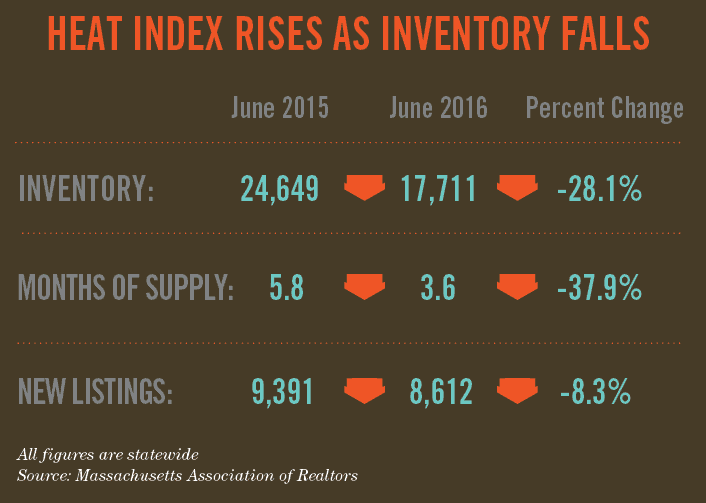
The number of homes for sale across Massachusetts plunged 28 percent in June. It was the biggest year-over-year decline since the Massachusetts Association of Realtors began tracking the number in 2004.
There were just 17,711 listings end of the month, the fewest number of homes for sale since at least 2004, when the real estate market was nearing its last, bubble-inflated peak.
While it is a problem that has been building for years, the dire shortage of homes for sale has gone from bad to worse over the past several months, especially inside the I-495 beltway, stats from the Massachusetts Association of Realtors show.
Certainly a big part of the problem is the shrinking number of single-family homes being built in the Boston area and across the state amid a byzantine tangle of NIMBY-driven local restrictions on new housing.
Yet there is another, less recognized but very significant culprit at work. There are literally thousands of homeowners who are opting to
stay put instead of moving up to something bigger or better, starving the market of badly needed listings.
Add all that construction that should be happening, but isn’t, with all those homeowners who in a more normal market, would be selling, but aren’t, and you are talking about a huge number of listings – literally tens of thousands – that have gone missing.
“Shockingly low,” is how Annie Blatz, branch executive at Kinlin Grover Real Estate in Brewster and MAR’s president, characterized the latest stats on the dwindling number of homes for sale across Massachusetts.
“In just about all areas of the state, the constant concern of Realtors is that we don’t have enough inventory to meet demand,” she noted.

Scott Van Voorhis
Bare Shelves
The severity of the state’s housing shortage is summed up nicely in a single line in MAR’s latest monthly sales report.
June was the “53rd straight month of year-over-year inventory decreases,” the organization noted, in what has become a stock line.
But the listings shortage has only intensified over the past year. June’s disturbing 28 percent decline also sent another key indicator, months of supply, plunging as well.
By the end of June, there was just 3.6 months of supply of inventory – or unsold homes – on the market. That was down from 5.8 months of supply in June 2015. That was hardly ideal either – a balanced market is roughly 8 months – but it sure beats just 3.6 months. Again, you have to go back to the mid-2000s to find months of supply at such low levels.
Voracious buyers are one big reason for the drop in inventory. With the economy rolling in the Boston area and interest rates at historic lows, buyers have been on a rampage, snapping up homes, especially listings in the more moderately priced middle of the market, as fast as they come on.
The number of homes sold in June – 6,374 – were the most of any June since 2004, MAR reports.
Yet even as buyers shattered records, they had to settle for the fewest homes to pick from in years. In a balanced market, with enough listings to prevent sellers from calling all the shots, buyers might have had more than 34,000 homes to choose from in June, not 17,711. The last time there were that many homes for sale in June was in 2006, according to MAR’s records.
Spread that out over a year, and we are talking about tens of thousands of listings that should be on the market, but simply aren’t there. Just under 80,000 homes came on the market between June 2015 and 2016, but that number could easily have been 150,000 or 160,000 if listings were actually coming on the market at a normal, healthy rate.
That’s 80,000 homes that should be on the market, but aren’t.
Unhealthy Market
 Buyers, in turn, are paying a steep price for this shortage. It is no coincidence, for example, that the median price of home in Massachusetts set a new record in June, hitting $372,000, according to The Warren Group, publisher of Banker & Tradesman.
Scarcity always drives prices up, whether it’s houses or Patriots tickets.
The listings crunch has also helped create a highly unhealthy, and frenzied, sales atmosphere for buyers, especially inside the 128 beltway. Multiple bids – even five, six offers – are now routine, with buyers pressured to drop mortgage and inspection contingencies to have a shot, notes Sam Schneiderman, vice president of Massachusetts Association of Buyer Agents and broker/owner of Greater Boston Home Team.
To its credit, MAR hasn’t attempted to sugarcoat what is a very tough – and at times rotten – situation for too many buyers.
“The competition to buy a home in Massachusetts right now is very intense,” Blatz said when the June numbers came out. “Buyers are having to use every additional dollar worth of purchasing power they are getting from these historically-low interest rates to close a deal.”
Simply put, the real estate market in Massachusetts is proving incapable of meeting sky-high demand on part of buyers for homes.
A good part of this is due to years of underbuilding when it comes to new, single-family homes, not just apartments and condos.
Towns and suburbs across Eastern Massachusetts have thrown up every barrier in the book to block new homes from being built, especially the kind that attracts families with children who are seen by too many bean-counting local officials as some sort of burden to be shunted off.
But reluctance on the part of current homeowners to sell is a major – and often overlooked – factor as well. The dwindling number of homes for sale has fallen to such perilously low levels that it has essentially created a vicious circle that is only becoming harder to break out of.
More than a few homeowners are surely tempted to sell as prices rise ever skyward. But others fear there is so little for sale that instead of moving up to something better, they might wind up with nothing at all and be stuck renting an apartment. It’s not an attractive proposition.
And there are other factors to consider. An increasing number of seniors are looking to age in place near family instead of bailing for Florida. But with assisted living communities charging outrageous prices – and with very few homes available in the Boston area that fit the needs of older owners, such as ranches and other single-story houses – many are opting to age in place, so to speak.
Still other homeowners bought during the last price peak and, well more than a decade later, are just finally seeing the value of their homes make it back into the black after years of being underwater.
Rising sales are all well and good and rising prices make headlines. But the true measure of the health of a real estate market can be found in its inventory levels, and right now, things aren’t looking too good in Massachusetts.