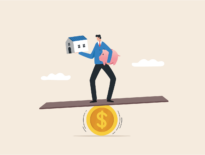
The future of the Boston economy is cloudy, with threats coming from within and without. iStock photo
Boston was a boomtown in the 2010s, with tower cranes dotting the skyline as the city’s economy added huge numbers of jobs while also reversing the population decline of decades past.
Today, though, “stagnation city” is a much an apt description for the Hub in the years following the pandemic.
It’s an outcome that maybe even her fiercest critics wouldn’t have predicted when Boston Mayor Michelle Wu took office in late 2021.
After all, with the short-but-sharp 2020 COVID-19 recession in the rearview mirror, Boston looked ready to pick up where it had left off in the roaring 2010s under the Walsh and Menino administrations.
Instead, Wu has presided over a period of sustained stagnation unlike anything seen in Boston in decades, marked by a dramatic decline in housing production, a collapse in new office and lab development and a decline in private sector jobs.
Gloomy Construction Numbers
You can find many of the numbers in the Boston Planning Department’s annual report on the city’s economy, though the report offers a much gentler interpretation of these gloomy stats than I will here.
Construction hours worked on major projects in the city are down by at least 30 percent from its pre-pandemic peak six years ago – that number was missing from the original report but is in the process of being inserted over what was likely just an oversight.
New office and lab construction is all but nonexistent, while the development of new housing, especially market-rate units, is but a shadow of what it was in the 2010s.
If anything, these trends are poised to go from bad to worse over the next few years, as construction finishes up on the dwindling number of big projects first envisioned in the Walsh and Menino eras.
Downtown office tower values have crumbled with the rise of remote work. With no new major commercial development projects rolling onto the tax rolls, City Hall faces the loss of anywhere from $1 billion to $2 billion in tax revenue over the next few years, the Boston Policy Institute has warned.
Macro Forces Buffeting City
How much of this is due to larger, macroeconomic forces? The city’s development boom screeched to a halt as interest rate hikes combined with soaring construction costs and a pullback by skittish lenders to kill plans for new housing and new commercial space across Boston.
New state numbers released late last week show Boston clocked in as the 45th-most prolific builder out of Massachusetts’ 351 cities and towns last year, based on the percentage growth in its housing stock.
For the beating heart of the state economy, that’s hardly a good showing and is probably a rosy version of the true state of housing production, as it includes the tail end of a pulse of projects that got their start when financing was much easier to come by, in 2022 and early 2023.
And let’s not forget Trump, who yanked billions in research funding for Harvard and other local universities and research institutes last year, a significant blow to a local economy based on innovation.
Boston saw a jobs boom in the 2010s under Menino and Walsh, but those days are long gone as well.
Here’s what the Boston’s Planning Department had to say in its annual report on the city’s economy:
“Payroll employment declined by approximately 1.0% in 2025, continuing a three-year period of relatively flat employment growth. Health Care and Social Assistance and Professional, Scientific, and Technical Services remain the largest industries by employment, and exceed their 2019 employment levels, although each experienced job losses during the year. Boston’s resident unemployment rate averaged 4.7% in 2025.”
What’s the Mayor’s Role?
Yet Wu is hardly blameless. Yes, she can claim credit for the controversial redevelopment of White Stadium in Franklin Park into a pro soccer palace, which has created some badly needed construction jobs. The mayor can also take a bow for some modest success with a tax break program designed to convert older downtown Boston office buildings into housing.
However, Wu has been stubbornly slow to adapt to the new and tougher times, insisting on boosting expensive affordable housing and clean energy mandates that have made it hard if not impossible for new projects to move forward in an unforgiving economic climate.
She’s toyed with the idea of a major tax break program to get stalled housing projects moving again but never pulled the trigger.
Wu also went out of her way to pick fights and jab at real estate developers when first elected, leading more than a few to write her off as an anti-growth progressive – even if she’s been sounding more friendly notes with the broader business community in her second term. She’s called a series of summits with executives as the region stares down threats to its economy, like the aforementioned Trump research funding cuts.
Those early swipes at developers appeared to be good politics for Wu, who was clearly playing to her political base early in her first term. But such grandstanding can come with a steep price tag, especially if developers and financiers cross Boston off their list of cities to invest in thanks to talk of policies like rent control.
So, is new development and economic growth in Boston just taking a breather and laying the groundwork for the next big boom? Or are we seeing a return to the stagnation that plagued Boston during the first half of the 20th century, and much of the second half as well?
Right now, the latter trajectory is looking much more likely, and that’s a problem.
Scott Van Voorhis is Banker & Tradesman’s columnist and publisher of the Contrarian Boston newsletter; opinions expressed are his own. He may be reached at sbvanvoorhis@hotmail.com.