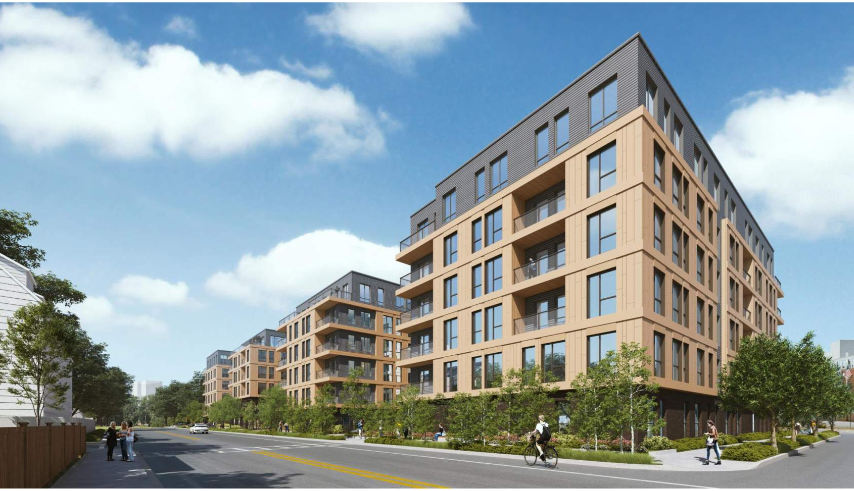
Amid a steady downturn in multifamily construction activity in Boston, Mill Creek Residential broke ground on the 240-unit Modera Allston project at 250 Everett St. in Allston. Completion is scheduled for early 2028. Image courtesy of CUBE 3
A shaky job market, domestic outmigration and immigration crackdowns are combining to continue depressing demand for rentals in Greater Boston, resulting in stagnant rents across a wide swath of the market.
Rents in Boston have trended downward since early 2025, according to data compiled by the commercial brokerage Colliers. Vacancies have risen as high as 9.2 percent in Allston-Brighton, amid new project completions and disruption to the student renter demographic.
“Vacancies have been trending up for a few quarters, and they are well above the historical norm,” said Jeff Myers, Boston research director at Colliers. “That is hurting the ability of landlords to push rent [increases].”
Vacancies across Greater Boston rose 0.3 percent to 7 percent in the fourth quarter. At 7 percent, vacancy stands over 1 percent higher than the historical average of 5.9 percent, Colliers reported.
‘Meds and Eds’ No Help
The recent tilt in favor of renters’ leverage reflects a recent apartment supply surge and macroeconomic factors in Greater Boston, industry researchers and developers say.
In past recessions, the local medical and higher-education sectors has stabilized demand amid job cuts in areas such as tech and financial services. But cuts to federal research funding for hospitals and universities have combined with job losses in the life science industry to drain demand from the apartment market as renters lose their jobs or worry about the possibility.
The two sectors had job losses in the three final months of 2025, their worst combined performance of the 21st century, Colliers’ reported.
Domestic outmigration also appears to be a factor. Massachusetts lost 33,000 more residents to other states in the year ending July 1 than it gained, according to U.S. Census Bureau data. International migration appears to be declining, according to a recent MassBenchmarks report by the UMass Donahue Institute, amid federal immigration crackdowns. In recent years, 25- to 44-year-olds have been the largest age category leaving the state, according to Boston Foundation research – a key apartment-renting demographic.
“We do see some legitimate softness in the market, especially in the more urban areas last summer and fall, and we are carrying a little more vacancy than we would like to,” said Peter Mahoney, executive vice president at John M. Corcoran & Co. in Braintree, which owns approximately 6,500 apartment units and has another 14,000 under management. “Chelsea and Everett have a ton of supply, and the markets where we have the most supply [are] where we are seeing the most modest rent growth or negative rent growth.”

Greystar is developing the 416-unit Juniper apartment complex at 1690 Revere Beach Parkway in Everett. Photo courtesy of Greystar
Economic Engine Trouble Plagues Boston
Even the high end of the marketplace is failing to keep pace with inflation.
Within the urban core, rents rose 2 percent over the past year, The Collaborative Companies of Boston reported, compared with 3 percent in the suburbs.
“Some of our economic engines are being slowed down,” TCC Managing Director Sue Hawkes said. “We saw last spring, the [student visa crackdown] definitely impacted most of the market, because you rely so heavily on the student population. We saw that slow down absorption.”
Asking rents in the urban core peaked at $5.17 per square foot in July, according to TCC data, before declining to $5.02 at year’s end, virtually unchanged from the previous year.
AvalonBay Communities Chief Operating Officer Sean Breslin singled out Boston and Denver as “outliers” in a recent conference call with analysts, blaming the Boston area’s weak rent trends on job losses. Average rents in the company’s 9,535-unit New England portfolio declined 0.6 percent in the fourth quarter to $3,462, according to AvalonBay’s fourth-quarter financial statement.
Equity Residential, which owns 6,907 apartments in Greater Boston, reported average rents dropped 0.2 percent in the fourth quarter to $3,716.

Steve Adams
Construction Pipeline Drops, Investment Sales Lull?
But multifamily construction activity continues to decline, potentially tipping the scales back in favor of landlords. Many projects that received financing prior to 2022’s interest rate hikes are nearing completion or are in lease-up, and the future development pipeline continues to shrink.
Currently, Colliers is tracking 10,339 apartments under construction in Greater Boston, down nearly 9 percent from the previous year.
Anticipation that voters may enact statewide rent control at the ballot in November is expected to depress investment sales activity even further in the multifamily sector throughout 2026.
“If you’re underwriting with rent control in place, which is where our default setting is right now, there is a bit of a bid-ask gap that is going to result in less transaction volume this year,” John M. Corcoran & Co.’s Mahoney predicted.