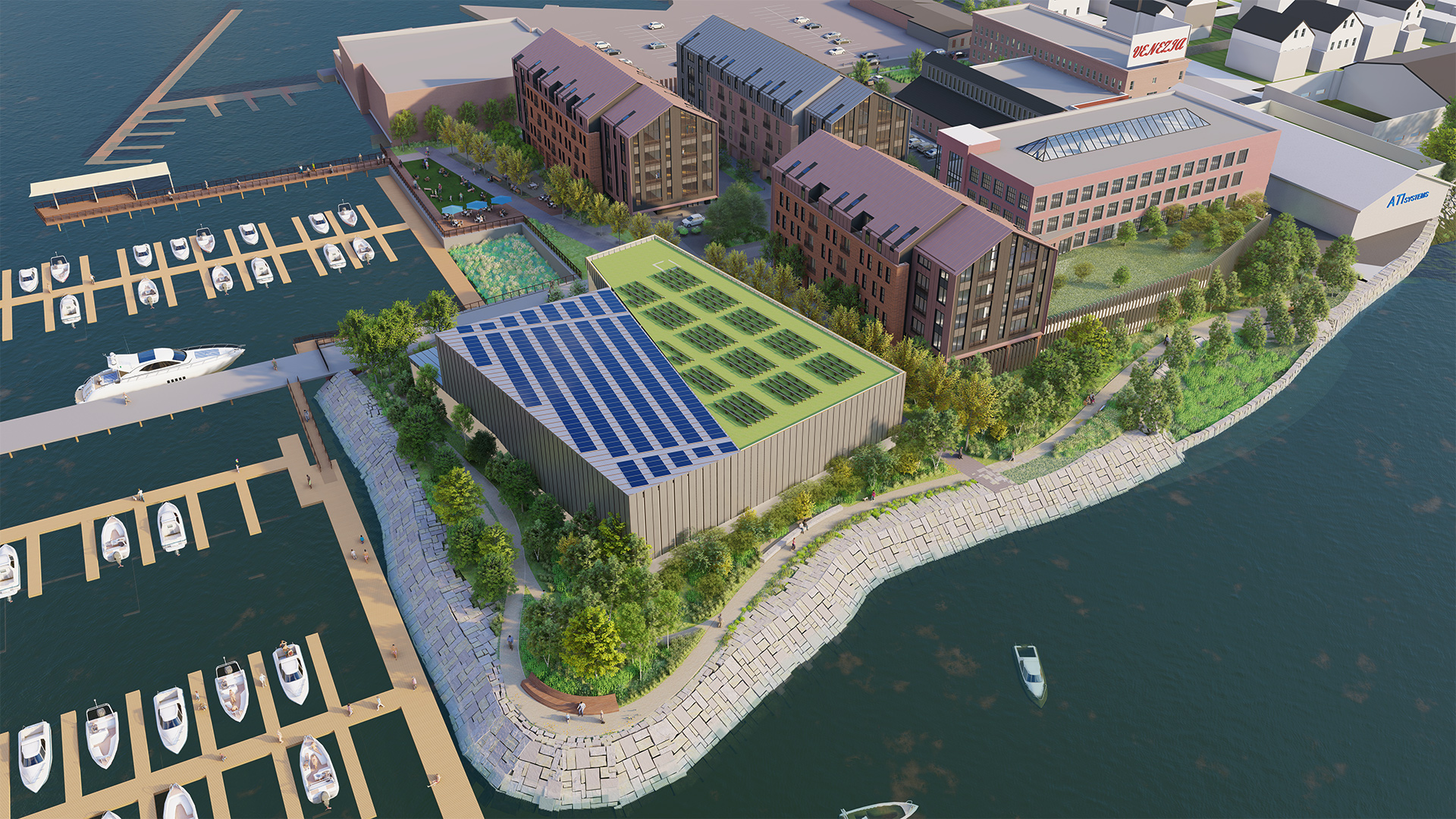
Rise Construction Management saw an opportunity on a spit of land poking out into the mouth of the Neponset River that few national developers would jump at. A run-down, flood-prone industrial lot could be reborn with housing, public green space, flood defenses and striking architecture. Image courtesy of RODE Architects
Not all that long ago, Rise Construction Management was the hottest new player on Boston’s development scene.
Hard-charging veteran industry executive Jim Grossman left a job with the region’s dominant contractor, Suffolk, in 2019 to co-launch the company.
Grossman had climbed the ladder at Suffolk over a 21-year career there, overseeing big projects like the One Dalton luxury condo tower, the Mandarin Oriental Hotel in the Back Bay, and Manulife’s new Seaport District headquarters.
He had gotten his start in construction as a teenager working for a cousin who was a homebuilder. After earning an accounting degree, decided that construction, not number-crunching, was his true passion, according to a 2022 profile in MassPlumbers, a publication of Local 12.
Grossman had certainly paid his dues and, soon enough, he was on the cusp of great things.
Working out of a nondescript Dorchester office, Grossman and financier co-founder Brian Anderson unveiled plans for a housing and lab megaproject in Boston, cut deals to build several new apartment buildings, and even embarked on a short-lived proposal for a movie studio complex in Braintree.
The two Rise Construction cofounders pitched many of those via their powerful partnership with Rise Together, a minority-owned sister company headed by friend and former Massport security official Herby Duverné. They also to bid on and won contracts managing the construction of a number of other developments.
All of that is gone now. Boston’s construction and development boom collapsed after the Fed hiked interest rates in 2022, taking with it the big projects that Rise had pinned its hopes on.
Grossman, Anderson and Rise Construction Management are even embroiled in a lawsuit with a lender, Hudson-based Avidia Bank, over the company’s never-built life science mid-rise at Medford’s Wellington Circle.
‘A Really Rough Ride’
Rise Construction Management remains in business, Grossman told me when I caught up with him the other day.
However, Rise now faces hard decisions about its future at a time when construction cranes have vanished from Boston’s skyline, putting contractors and thousands of union ironworkers, electricians and other tradespeople out of work.
“It has been a really rough ride, it really has,” Grossman said.

Jim Grossman. Photo courtesy of Jim Grossman
Rise is now focused on completing the company’s two remaining projects – apartment buildings in Everett and East Boston – and have stopped taking on new projects, not that there are lot of those around these days.
After that work winds down, Grossman said he plans to discuss Rise’s future with its dozen or so remaining employees, down from more than 70 at the firm’s height in 2022.
“We are committed to getting these projects done,” Grossman said. “Once we are done, we will look at next steps and collectively we will look at what the next steps are for all of us.”
Big Firms Gained an Edge in Boston
Another thing weighing on Grossman during these difficult times?
Whether there is still a future for small and mid-sized contractors and developers in Boston at a time when financing for projects is scarce and lining up permits from city and state agencies can take years.

Scott Van Voorhis
Major national and international real estate investors and developers like Brookfield and Blackstone are increasingly dominating the market in Greater Boston. Several mid-sized local developers, including Fan Pier builder and Seaport pioneer Joe Fallon, have shifted their focus to fast-growing and far easier to build in Sunbelt states.
That is a loss for a city like Boston, where lining up approvals for major projects can take years and be extremely challenging, Grossman contends.
Smaller and mid-sized developers with deep local roots are likely to take a more creative and flexible approach than their larger counterparts when it comes to navigating neighborhood pushback and City Hall bureaucracy.
“In any market, the regional developer is the least capitalized – they feel the pressure first,” Grossman said. “When there are fewer and fewer small developers out there, that scrappiness goes away and that creativity goes away.”
Scott Van Voorhis is Banker & Tradesman’s columnist and publisher of the Contrarian Boston newsletter; opinions expressed are his own. He may be reached at sbvanvoorhis@hotmail.com.