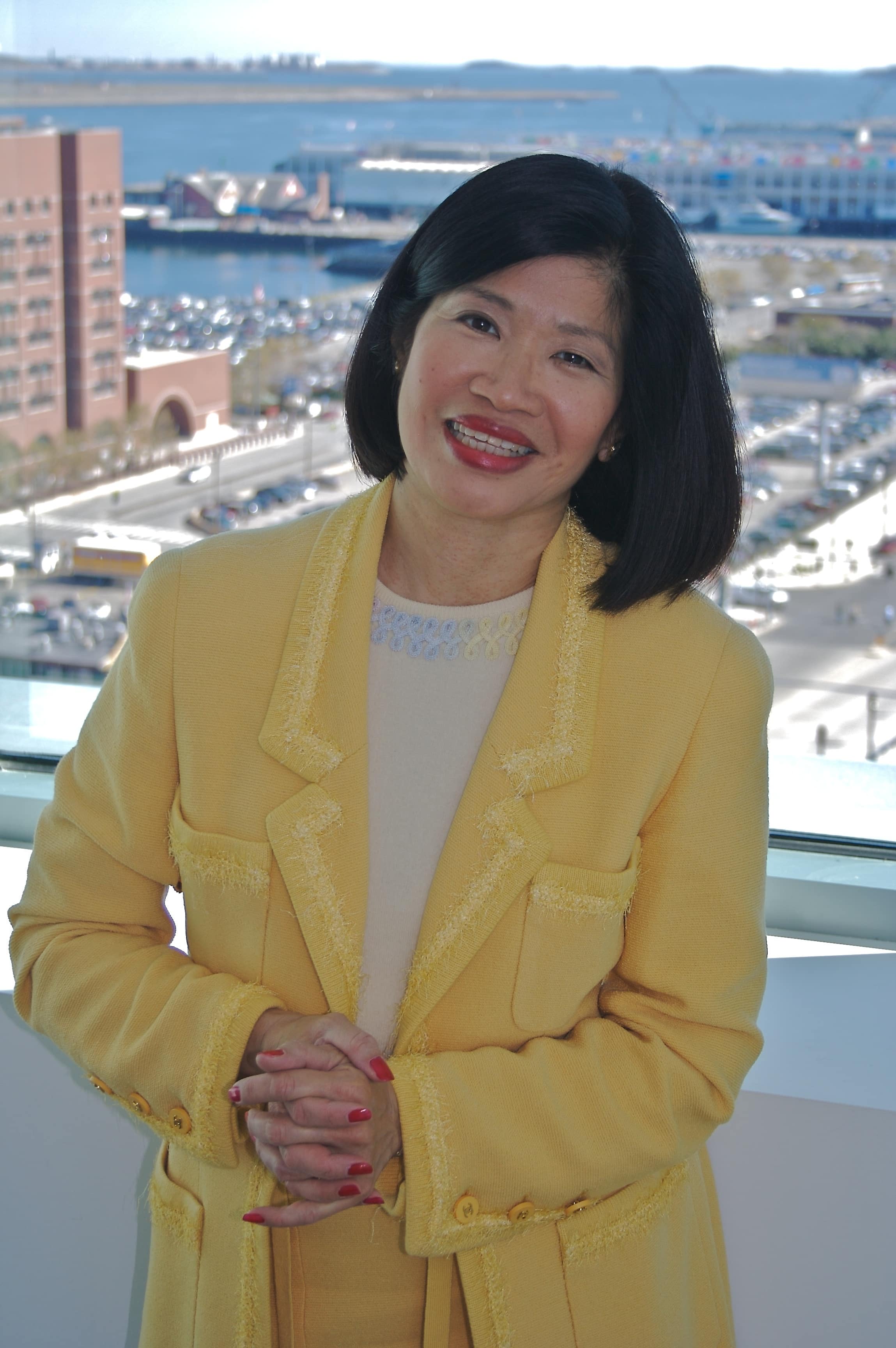
Boston’s waterfront was a national joke – ringed with rundown parcels and fouled with sewage overflows – when Vivien Li took over as president of its primary advocacy group, the Boston Harbor Association in 1991. As Li prepares to leave, it’s the focus of the city’s development boom and one Boston’s most popular warm-weather gathering spots.
“In the past, you had to convince developers that having a HarborWalk was a safe thing to do,” Li said. “It was quiet down on the waterfront. People weren’t safe. Now the waterfront is so vibrant, the concern is we don’t want it totally gentrified.”
Li will leave the organization on Sept. 30 to become head of Riverlife, a public-private partnership that is working to revitalize Pittsburgh’s system of riverfront parks and redevelop nearby parcels. Li said she was contacted by a recruiter in May and the organization put on a “full-court press” for her services.
“It seemed like many of the things we’ve tried to do in Boston is of interest to other cities, and it’s a great opportunity,” Li said. “Boston has been my home for more than 30 years, and my heart will always be in Boston.”
A New York City native who attended Barnard College, Li came to Boston in the late 1960s to take a job at the Boston Redevelopment Authority. After going to grad school for urban planning at Princeton University she returned to Boston to work for the Public Health Commission and as an advisor to former Gov. Michael Dukakis. She has been a contributor to Banker & Tradesman’s op-ed pages for more than a decade.
The Boston Harbor Association was formed in 1973 to lobby for a clean-up of the harbor, which was polluted by runoff from sewer system overflows. Lawsuits from the Conservation Law Foundation and the city of Quincy led to a court-ordered $4.5-billion project to build a new treatment plant on Deer Island and construct separate collection pipes for sewers and rainwater.
After taking over the harbor association’s leadership, Li launched the Harbor Bound program, taking inner-city students on field trips to Deer Island to witness the massive public works project.
“The young people who we brought out then are now adults and have become environmental stewards,” Li said.
Since the completion of the project, the group has focused more on making the waterfront accessible and enjoyable for the public. In the early 1980s, the group worked with former Mayor Raymond Flynn to develop a plan for the Boston HarborWalk, a network of public pathways that ring the waterfront from Dorchester to East Boston. The system continues to expand. Within the past year, new sections have opened in East Boston, at UMass Boston and Lovejoy Wharf in the North End, bringing the HarborWalk to 41 miles.
The continuing building boom in areas such as the Seaport and East Boston has created opportunities for more recreational spots set aside by developers.
“Where it used to be a 10-foot path, now we talk about free binoculars, public art and playgrounds,” Li said. “That was not on people’s agenda in the early 1990s. People said, `Why would people want to be on the waterfront?’ Now, developers don’t question it because it makes things more attractive.”
Li predicted one of the biggest challenges for her successor and other advocates will be mitigating the anticipated effects of rising seas that will put large portions of Boston and surrounding cities at risk of catastrophic flooding in major storms.