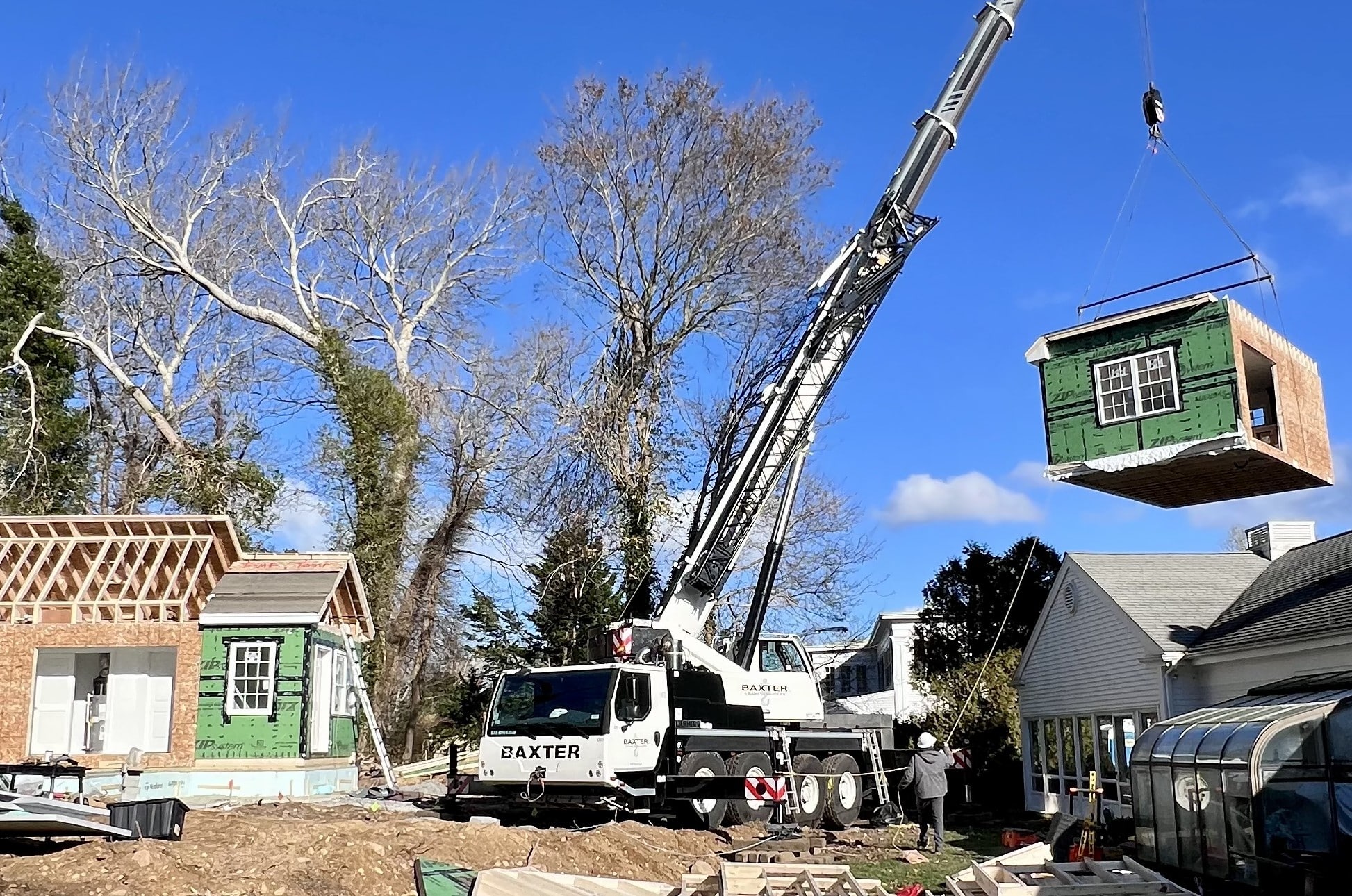
A construction worker helps guide a modular part of a Backyard ADUs home into place in a backyard in Orleans in December 2024. Photo courtesy of Backyard ADUs
One of the state’s housing finance agencies has a new program designed will help homeowners determine whether building an accessory dwelling unit is right for their property.
The program is administered by the Massachusetts Housing Partnership in collaboration with the Executive Office of Housing and Livable Communities. It will help homeowners access professional advice to understand site conditions, local permitting requirements, utility needs, preliminary design options and high-level cost estimates before investing in an ADU project.
“Homeowners are excited about ADUs, but many do not know where to start,” MHP Executive Director Rachel Heller said in a statement. “A feasibility study gives a family an objective, professional assessment of what is possible on their property, what it may cost and what hurdles need to be addressed before they invest significant time and money. MHP is proud to partner with HLC to help close that gap and make ADUs a realistic option for more households across Massachusetts.”
This program is available to any Massachusetts resident who owns property in a zoning district that allows residential use. There are no household income restrictions in order to access the feasibility studies. The only restriction is that each property may only receive one study.
There are currently 21 providers of feasibility studies listed on MHP’s ADU Incentive Program website, covering the entire state. Several entries state the provider speaks multiple languages, and five of the providers offer studies with zero out-of-pocket costs to the property owner. Others charge between $350 and $500.
“Massachusetts needs to build more homes, and ADUs are one of the fastest ways to create new housing in communities across our state,” Gov. Maura Healey said in a statement. “Our Affordable Homes Act made it easier to build ADUs, and we saw major interest from homeowners. Now we’re giving them the tools they need to turn an idea into reality, creating more housing options while helping families stay in the communities they love.”
Participation in a feasibility study does not obligate the homeowner to build an ADU and it doesn’t obligate the homeowner to use the chosen feasibility study provider for any additional services.
MHP said will use information from the feasibility studies to guide future phases of the ADU Incentive Program and identify ways to make it easier for homeowners to build ADUs. The findings will also help inform future zoning guidance, financing tools, infrastructure investments, and technical assistance.