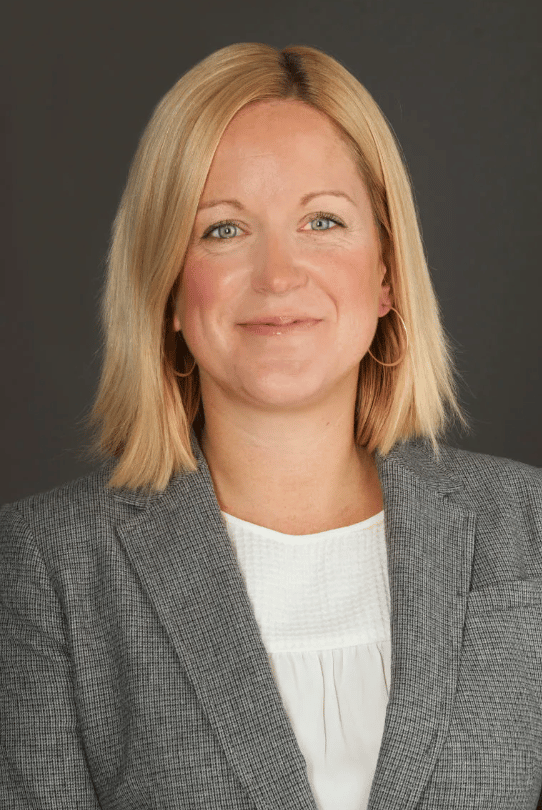
Molly Heath
Senior managing director, JLL
Industry experience: 15 years
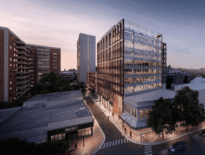
Life science brokers are adjusting to the new market fundamentals in 2022 as biotechs and their venture capital backers take a more cautious approach to expanding their real estate footprints amid rising interest rates and stock market declines. Molly Heath represents developers of some of the region’s notable large-scale developments in the hunt for anchor tenants, including 10 World Trade in Boston, University Park and 100 and 20 CambridgeSide, both in East Cambridge. After stints in community relations for O’Neill & Assoc., the Boston College graduate and Chicago-area native was introduced to the fundamentals of commercial real estate as a researcher at Trammell Crow Co., and has spent 15 years as a broker at JLL focusing on Boston, Cambridge and the fast-growing inner suburban lab markets.
Q: As life science tenants have more options and less competition for space, are they favoring new construction or converted space, or is speed to occupancy still the most important factor?
A: Lab conversions play an important role in the real estate piece of the ecosystem. Over 80 percent of the tenants still need to be in occupancy within 12 months. Conversions provide a quicker path to occupancy. That’s being impacted with supply issues right now. The schedules are going in the wrong direction. But once a company is a little bit further in their maturity, and to use a size range, once a company is out looking for 50,000 square feet and they’ve got a little bit longer horizon, they are going to be focused on purpose-built construction for the most part, now that you’ve got some available supply.
Just like office tenants, lab tenants are going to be focused on buildings where the infrastructure supports them and their science, but also locations where their people want to go and work. Good amenities, access to public transportation or parking, dynamic locations where they know they can be competitive from a recruiting standpoint: That has not changed. The shift is the loosening of availability. Companies are able to go back to their second or third choice of location, versus making the decision that wasn’t their target location because they’ve got to be in and there’s no supply.
Q: Are labs more challenging to sublease because of tenants’ specialized requirements?
A: No and it’s not that their programmatic requirements aren’t specialized. The great thing on the sublease front is it’s providing opportunities for young companies to come in and lease high-quality space. A lot of the space on the sublease market is in newly constructed or newly-converted buildings, and they can do a two- or three-year lease which complements how their fundraising works.
When we were in a more supply-constrained market, a lot of these companies were signing leases for 10 years, or taking more space than they needed because they didn’t have an alternative. As we track sublease inventory for the last six months, 75 to 80 percent of the sublease options are what we call controlled growth – companies that took on space they were planning to grow into – versus companies that had a negative business event.
Q: How many proposals does a typical listing receive now versus mid-2021?
A: A year ago, a majority of the space was getting leased before it even hit the market. Today, the biggest contrast is that when leasing space that was in shell condition and you had to build it out 15 to 18 months ago, that was completely acceptable. Now these companies are not willing to spend the capital to build out the space. If you want to get space leased today, you’re probably doing a spec suite or coming out of pocket with bigger tenant allowances than you have in the past.
We’ve seen tenant improvements increase, and also construction pricing has been super challenging. [Developers’] idea is: Not only are we going to sign a lease with a good company, but when they grow we’re 100 percent confident we’ll be able to re-lease the space after they vacate. With office suites, you’ve got to gut the whole space and redo it. The performance on second-generation [lab] space has been incredibly strong. Companies want to get in and start operations ASAP.
Q: Has the uncertainty about the future of MBTA schedules and reliability affected demand for urban transit-oriented lab sites?
A: No, life science leadership thinks about public transportation in the same way everybody else does. It’s a super important component to the location criteria and attracting and recruiting some of the younger workforce. It’s the same thing with traffic. Everybody bellyaches about it but fundamentally you live with it, because this is where you need and want to be.
Heath’s Top 5 Podcasts Right Now:
- “Re:Thinking with Adam Grant”
- “Smartless”
- “Up First” (NPR)
- “Skimm This”
- “How I Built This” (NPR)