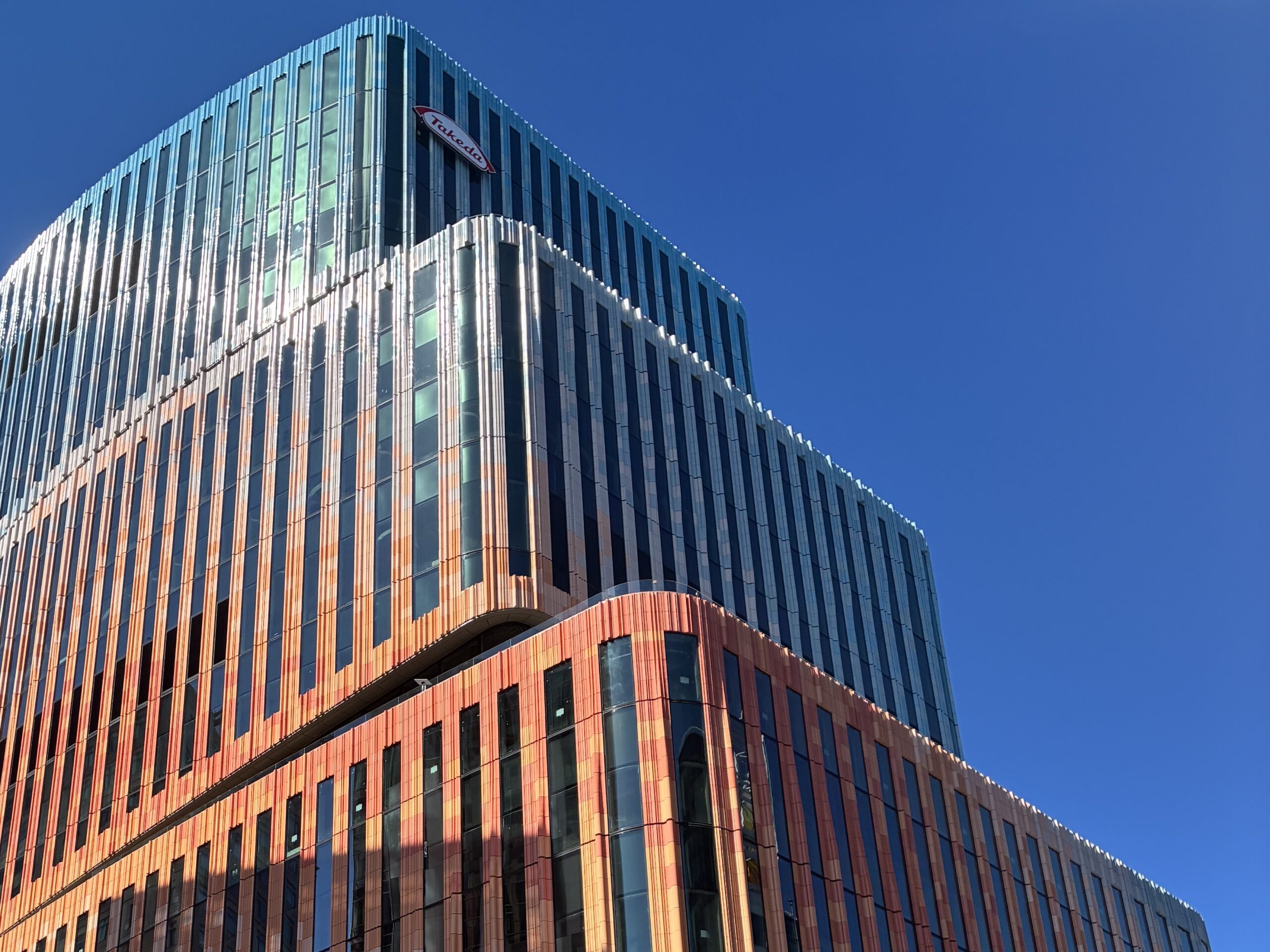
Interior fitout work is continuing at BioMed Realty’s 600,000 square-foot development at 585 Third St. in Cambridge, which is preleased to Takeda Pharmaceuticals. Photo by Steve Adams | Banker & Tradesman Staff
The view from Broadway in Cambridge’s Kendall Square shows off big pharma’s growing footprint.
In the backyard of MIT, construction continues on new towers preleased to Biogen, Takeda Pharmaceuticals and AstraZeneca totaling nearly 1.8 million million square feet. But prospects for the industry’s emerging startups to scale remain hampered by hidebound lease requirements.
Commercial landlords’ business model and small biotech companies’ needs remain at odds, with requirements for long-term leases throwing obstacles in the path of startups seeking to form the next generation of industry giants.
“Early-stage groups want the flexibility,” said Chris Gorczyca, managing director in brokerage Savills’ Boston office. “If these groups were raising a $50 million series A [venture capital round] five years ago, they had to sign a 10-year lease, which doesn’t make sense for anybody. They’re going to be out of money in 24 months, depending upon how things go.”
As lab space availabilities remain elevated even in Kendall Square, more landlords are starting to adapt. Some are agreeing to phase in rents at the beginning of a lease at a fraction of the full price, or offer shorter terms to tenants that don’t require costly lab equipment buildouts, Gorczyca said.
Difficulties Coming to Terms
The standoff highlights a common conundrum for commercial landlords and their lenders: whether to hold out for the big established tenant, or fill buildings on a piecemeal basis and begin collecting immediate income.
At first glance, biotech tenants would seem to have the upper hand. The downturn in life science funding hasn’t spared East Cambridge, which had a vacancy rate of 17.5 percent and availability rate of 24.2 percent at the midyear mark, according to Cresa data.
Historically, most landlords have sought multi-year leases, while startups and their financial backers are hesitant to make long-term commitments.
To incentivize longer-term deals, landlords have preferred to offer generous tenant improvement allowances to new tenants so they can build out systems tailor-made for their science discovery.
The offer makes sense for many biotech startups with limited cash to spend on real estate, said Tucker White, U.S. office and life sciences lead for market intelligence at Avison Young.
“They’re trying to scale their operations, and they need heavy TI dollars typically because they can’t come out of pocket for that,” White said. “I totally understand the frustration for an emerging company: you don’t want to jump into a longer-term lease in order to get those TI dollars.”
In other cases, landlords take on the up-front risk of building spec suites with basic equipment such as fume hoods.
“If it’s an early stage [company], they probably don’t have the operations and facilities team in-house to do a lot of that program management and design of the buildout,” Gorczyca said. “It’s all company-dependent, and trying to partner with the right landlord who gets it and is willing to structure the deal in the way that makes sense for the tenant.”
Short-Term Shared Spaces Offer Alternatives
Incubators and shared lab space providers provide alternatives to the traditional lab lease, and can fill an underserved role in the life science real estate ecosystem.
LabShares’ 44,000 square-foot Newton facility is occupied by more than 35 companies. The first phase of its new 66 Galen St. location in Watertown is fully occupied, CEO Philip Borden said. A second phase will open in mid-November.

Biogen’s new headquarters will occupy the first lab building at Kendall Common, MITIMCo’s redevelopment of the former Volpe National Transportation Systems Center property in Cambridge. Photo by Steve Adams | Banker & Tradesman Staff
The commercial shared lab space model provides maximum flexibility, with most companies remaining members for four years, Borden said.
“There is a significant gap in the market between the incubator and taking on a conventional laboratory lease,” Borden wrote in an email. “Too many biotech companies are pushed toward building and operating their own laboratories before it makes economic or operational sense.”
Another shared lab space provider appears to be exiting some of its local properties after a rapid expansion in recent years. SmartLabs is shutting down its 60 Guest St. location at Boston Landing in Brighton, the Boston Business Journal reported this month. Last fall, SmartLabs terminated a 140,000 square-foot lease at the Cambridgeside mall, where it planned to occupy former third-floor retail space.
Traditional incubators such as Kendall Square’s 13-year-old LabCentral also have been forced to adapt to the new financial realities of the life science industry funding downturn.
LabCentral reduced its monthly fee to rent an entry-level lab bench by more than 25 percent this year to $3,000, reflecting the downturn in grant funding from the National Institutes for Health and Small Business Innovation Research program, CEO Maggie O’Toole said.

Steve Adams
“We understood the funding was not there for the grants,” O’Toole said. Currently, LabCentral’s 200,000 square feet of incubator space at five locations in Cambridge is 85-90 percent occupied, O’Toole said.
“You can come in with 30 days notice and be able to leave in the next month, and you won’t have invested in any equipment or infrastructure,” she said.
Kendall Maintains Rent Leadership
Despite competition from vacant lab developments in Boston and the suburbs, East Cambridge still leads the region with average asking rents of just over $100 per square foot, according to CBRE’s second-quarter lab report.
“There’s a select market segment that’s going to be able to maintain rents in some key pockets in East Cambridge,” White said. “But outside of that, it’s really downward pressure on rents. We’re seeing more in those emerging clusters like Watertown, Allston-Brighton and 128 West.”
Landlords in those secondary markets under pressure to generate income are competing aggressively to lure tenants from East Cambridge, White said. Approximately 15 tenants are in the market in Greater Boston for over 100,000 square feet, representing a significant increase from recent years’ tepid demand. Approximately half of those have been “tiptoeing around the market for some time, and the other half are new,” White said.