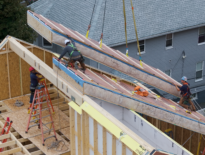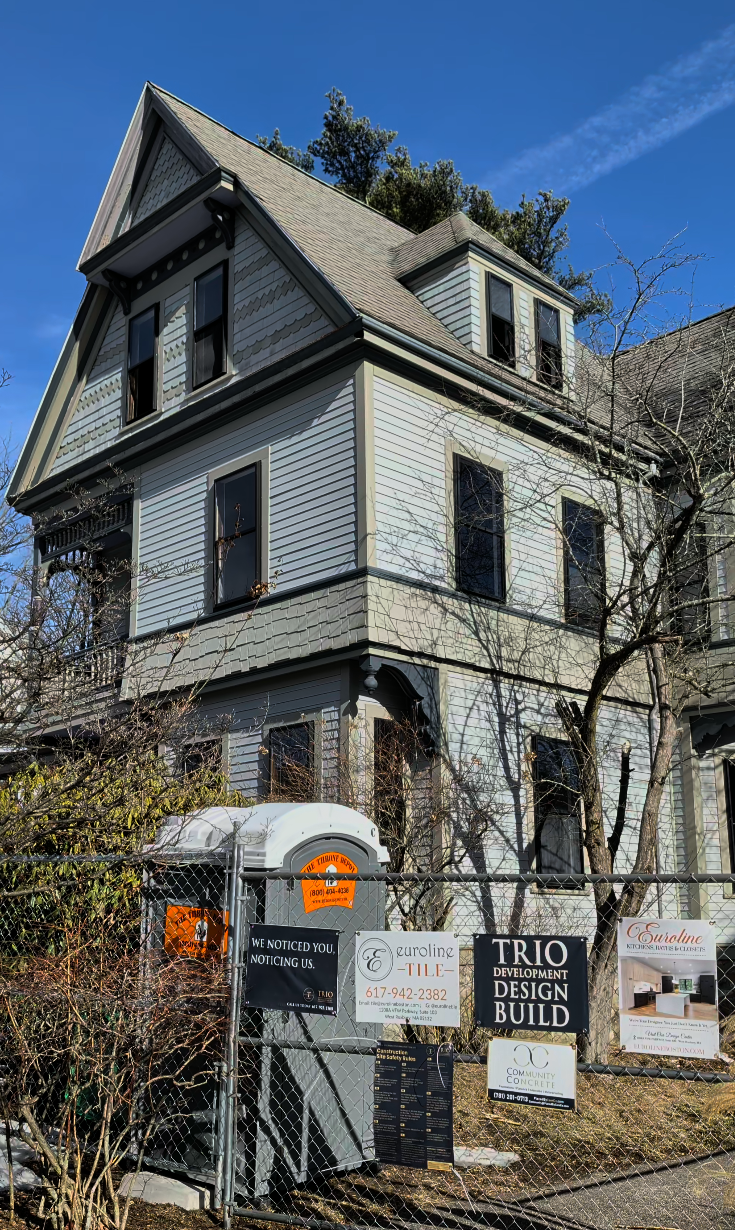
A Victorian on Hartford Street in Newton Highlands that’s being renovated and expanded into multifamily housing under the city’s MBTA Communities zoning. Two city councilors want to bring the same idea – historic preservation enabled by increases in density – to other parts of the city. Photo by James Sanna | Banker & Tradesman Staff
Teardowns: They’re the bugbear of many a wealthy Boston suburb.
A physical manifestation of the laws of housing supply and demand, these typically single-family homes are usually designed to squeeze the maximum amount of saleable house out of a lot rendered supremely expensive by Greater Boston’s housing shortage and demand to live in well-off, amenity-rich communities.
“A lot of developers, they go to the absolute maximum FAR,” said Newton City Councilor Pamela Wright, referring to floor-area ratio rules the city’s zoning code uses to regulate a building’s bulk. “They build from lot line to lot line.”
And that size comes in for serious criticism from neighbors, said Wright and her colleague, Council President John Oliver. Many in Newton say the typical teardown has grown large “to the point of noxious,” Oliver said.
“I’m sure living in that home would be wonderful,” Oliver said. “Living next to it? Where it’s, you know, 3 feet from your lot line and towers over your property, which was or is the norm for your neighborhood? That’s the type of thing I frown on.”
“Those are the people that we’re hearing from, literally all the time,” he added.
Wright and Oliver have set out to do something about it, offering developers a viable alternative to single-family teardowns, in the form of multifamily adaptive reuse.
Historic Preservation Meets New Housing
To try and reduce the number of objectionably large single-family homes going up in Newton, the two councilors, who also sit on the council’s Planning & Zoning Committee, are resurrecting a package of ideas they proposed to their colleagues in 2024.
In addition to more technical changes like adding a sliding scale to the city’s existing FAR rules and subjecting large proposed single-families to additional regulatory review, Oliver and Wright are also suggesting the city modestly rezone its residential neighborhoods to allow up to four units by-right on an as-yet-undetermined number of residential lots “citywide,” but not on every lot like Cambridge’s thoroughgoing rezoning passed in early 2025.
The catch: Developers would have to keep the original home with only a relatively small addition to accommodating things like a second set of stairs to meet fire code or other necessities.
“We want to keep these old Victorians. We want smaller units, things like that, right?” Wright said.
By eliminating a special permit requirement in favor of by-right development, Oliver said, the two hope that their idea will make it a more financially attractive path for builders, too.
“When we say ‘citywide,’ we don’t mean rip all the houses down and build,” he said. “As a matter of fact, that’s exactly what we’re against. We want adaptive reuse, and we don’t want to increase the size of the [building] envelope. We want to maintain the open space and we want to keep the character of the neighborhoods.”
And with four units per property, they ought to sell or rent for less than a new-building single-family or two-family, Wright said, addressing another complaint she says her constituents consistently raise about teardowns: their typically multi-million-dollar sale prices.
“Speculators are paying way over market value and, effectively, they’re paying way over market value for the land,” Oliver said.
In some instances, builders are paying $1.5 million or even $2.5 million for a single-family property, only to tear it down, Wright said. That means any resulting single-family house will easily sell for far, far more.

Developer Trio Design + Build is in the process of renovating a neighboring home on Hartford Street under Newton’s MRT zoning into three units, and building a second three-unit building behind it. Image courtesy of Trio Design + Build
Would Build on Zoning Success Story
The idea bears a similarity to an MBTA Communities zoning district in Newton that’s taken off with developers.
Districts designed to allow for larger multifamily projects were, in several Newton neighborhoods, surrounded by an apron of transitional zoning that let a developer convert an existing house on the lot to multifamily, and build a second, similarly sized multifamily development on the same lot – typically in what was once the backyard. These districts cover around 2 percent of Newton’s land area.
Since Newton city councilors adopted the zoning in late 2023, at least eight projects have been proposed in this transitional zoning, called “Multi-Residence Transit,” as of early March that could add up to 49 new homes if all get financed and built, according to an analysis by the Boston Indicators think-tank. They also represent the “vast majority” of projects unlocked by Newton’s MBTA Communities zoning, said Amy Dain, the Boston Indicators land-use scholar who wrote the analysis.
“I’ve seen it proposed in local housing plans [in other communities] and maybe never adopted, but in this case, we suddenly see a bunch of projects in great, walkable, transit-connected, amenity-rich areas. It’s a real win,” Dain said.
Unlike Wright and Oliver’s proposal, which is floating the idea of three or four units per lot in certain areas, the MRT zone allows up to six units per lot if a project includes adaptive reuse of an existing home.

James Sanna
Idea Still in Early Stages
But 49 new homes – or 34 if you only count the net increase – is a drop in the bucket of a city with 33,000 homes of all types, said Dain, herself a Newton resident.
“One of the big lessons here is that small-scale housing development can have a large-scale impact if it’s allowed across a lot of land area, but small-scale housing development cannot have large scale impact on the housing market if it’s only allowed in a few blocks,” Dain said. “It’s wonderful, but we need to think about, how do we bring this to scale?”
With communities across Massachusetts packed with Victorian-era “streetcar suburb” neighborhoods, Dain said, Newton’s MRT reforms are “entirely replicable” by other communities.
“There’s nothing about it that’s really specific to Newton and wouldn’t work in Belmont and Watertown and other communities,” she said.
In Newton, Wright and Oliver say their proposal is still in a very early stage of development, with many key details still up in the air, like parking, just how widely the idea might be applied and even how to define which large, older houses should be eligible for the zoning. There isn’t yet any proposed zoning language on the table, either.
But the concept seems to have struck a chord with their colleagues.
“I have a sheepish grin because we presented this almost a year and a half ago,” Oliver said. The reaction “was pretty flat. Actually, it was misinterpreted, at best. But this time around, the initial reactions have been very receptive: ‘Yeah, I like that!’”
Editor’s note: Due to a reporting error, an earlier version of this story mischaracterized the extent of Oliver and Wright’s proposal. Their concept for adaptive reuse zoning would be deployed citywide for an as-yet-undetermined set of properties that meet a yet-to-be-proposed set of criteria. The story has been updated to correct this error.