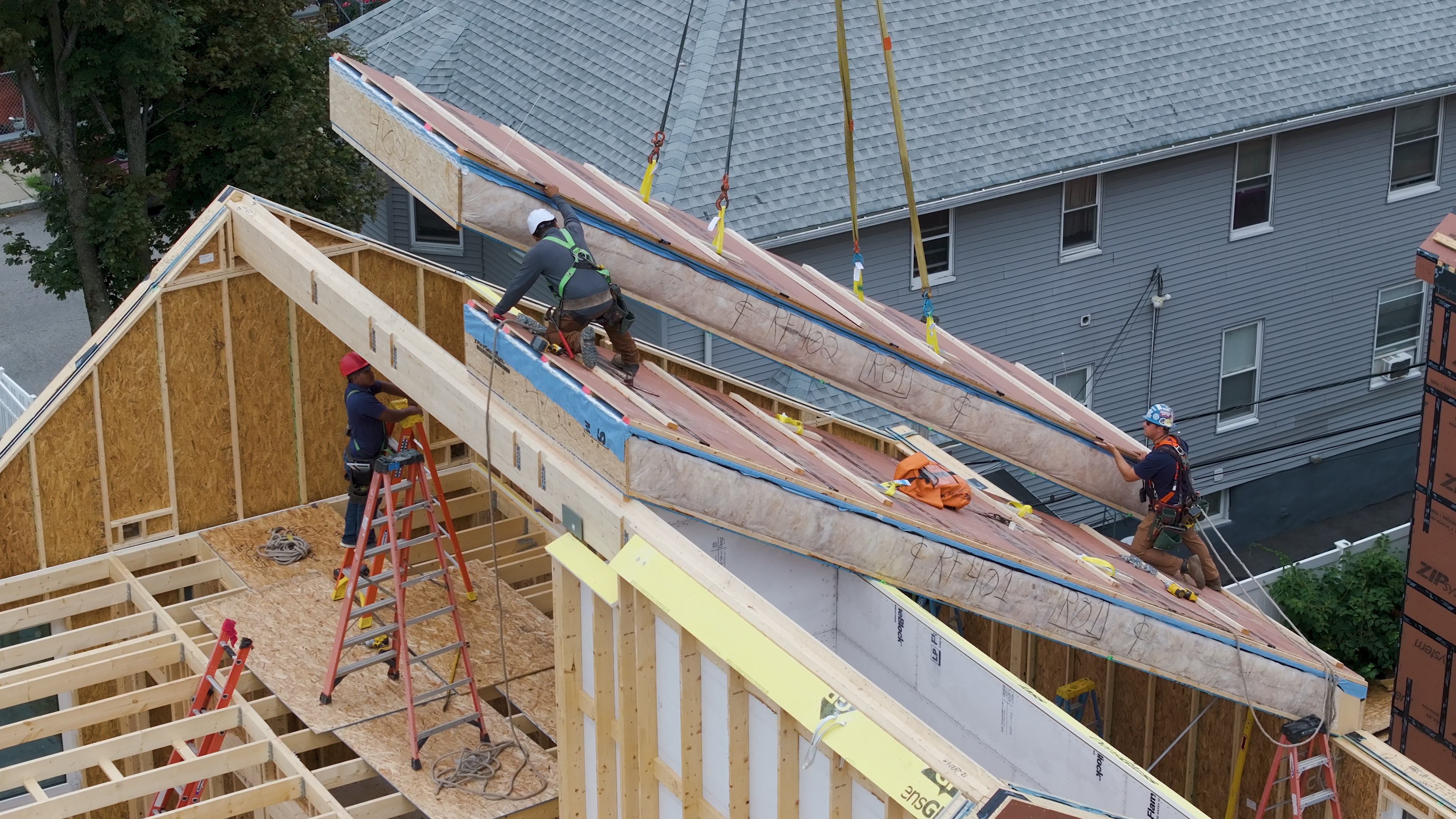
Design Collaborative combined local subsidies with a surplus land disposition program to break ground on a 12-unit project in Dorchester utilizing off-site assembly of building components to reduce the project’s timeline and budget. Photo by Peter Bowring | Courtesy of Dorchester Design Collaborative
Industry executives say a nearly completed affordable housing project in Dorchester could serve as a model for future use of modular and other off-site construction methods in multifamily developments.
The 12-unit, three-building project at 104-108 Norwell St. in Dorchester, just east of Franklin Park, has a number of non-traditional features, including the fact that it’s an energy-efficient Passive House development.
But what’s also catching some attention is the fact that it has used an off-site panelization method of construction designed to achieve savings in both time and money – as well as achieve what supporters say is a higher level of building quality.
“I absolutely think we’ll be seeing more of this,” Milo Stella, a principal and general manager of Dorchester-based Star Contracting, said of using offsite-construction methods on multifamily projects in general.
“It just makes sense,” said Stella, whose firm is part of a collaborative that’s developing the Norwell Street project in Dorchester. “[Off-site construction] doesn’t solve all the direct construction-price problems. But there’s a big-time savings that adds up. You can finish projects much faster than stick-built [construction methods].”
And any type of savings is especially key in affordable housing projects that often include multiple units and strict energy efficiency standards, Stella and other industry executives say.
“People are striving for more environmental efficiencies, more cost efficiencies and more quality efficiencies,” Stella said. “Off-site panelization and modular construction provide a really clear pathway to accomplish a number of goals.”
Panelizaton Isn’t Modular
To be clear: there’s indeed a difference between “modular” and “off-site panelization” construction.
They both fall under the general umbrella of “pre-fab construction” or “off-site construction,” in which entire portions of a building are constructed in a factory.
Modular construction depends more on the off-site construction of shoebox-like structures that can be later transported to sites and then stacked side-by-side, or on top of each other.
The modular cubes, as they’re sometimes called, also usually have pre-installed plumping, electrical and other household fixtures – with all the work conducted at indoor factories before delivery to construction sites.
Offsite panelization is roughly what it sounds like: pre-made exterior walls and roofs that are assembled in factories and later delivered to construction sites.
The framed panels usually include windows, doors and insulation, but not plumbing, electrical and other fixtures.
For the city- and state-backed Norwell Street project, the Dorchester Design Collaborative – which includes Stella’s Star Contracting Co. and Jennifer Ha’s Dorchester-based Hue Architecture – opted for an off-site panelization method in order to better achieve the Passive House energy-efficiency goals.
New Hampshire Firm Sees Interest Uptick
Bensonwood, an off-site construction and panelization company, built the three Dorchester buildings’ exterior walls and roofs at its factory in Keene, New Hampshire.
Each panel is 15 inches thick with insulation, said Seth Clarke, an architect and director of sales at Bensonwood.
The Dorchester project is not Bensonwood’s first multifamily project using off-site panelization construction, Clarke said. And it certainly won’t be its last multifamily project, if the recent pace of industry inquiries is any indication, he said.
“We’re seeing a big uptick in interest,” he said. “More people are looking into this type of construction.”
One of the reasons for the surge in interest: the increasing number of towns and cities that are adopting building codes with strict energy-efficiency requirements, Clarke said.
Though developers who specialize in stick-built construction might disagree, Clarke said the quality of off-site construction is generally superior to traditional building methods, mostly because major work is conducted in controlled indoor environments and not subject to potentially damaging outdoor weather conditions.
In addition, it’s faster to build offsite-constructed buildings because work schedules aren’t as easily disrupted by outdoor weather conditions, Clarke said.
The bottom line, according to industry officials, is that off-site construction can shave weeks, if not months, off the usual time it takes to build more traditional housing projects.
And ultimately time is money – in terms of lower interest-rate payments on construction loans, lower insurance costs, lower labor expenses and other savings.
The direct cost of land and construction materials are roughly the same for both stick-built and off-site construction projects.
But it’s those indirect time-associated costs where project savings, ranging from 5 to 15 percent, can be achieved via off-site construction methods, industry executives say.
Is there a sweet spot for multifamily projects using off-site construction methods?
“Every project is different,” said Stella. “Requirements and costs can vary from project to project.”
Surplus Land Toward Affordable Home Ownership
In the case of the Norwell Street housing project, like many income-restricted projects, it received financial assistance from a number of public sources.
Built on previously vacant, city-owned lots, the project was financed through a $3.2 million construction loan from the Massachusetts Housing Investment Corporation, as well as through grants from the city of Boston and MassHousing’s CommonWealth Builder program.
The project is part of the first phase of Boston’s “Welcome Home Boston” program, which is turning vacant city land into affordable homeownership developments and supporting emerging development teams in the city.
Other off-site construction companies are landing publicly supported affordable housing projects in Massachusetts.
Last year, KBS Builders, a volumetric modular company based in South Paris, Maine, finished a 22-unit workforce housing project for the town of Nantucket. It’s currently in line for a potential workforce housing project on Nantucket.
“We’re absolutely seeing more demand for multifamily housing,” said Thatcher Butcher, president of KBS Builders. “Construction in general is moving more toward off-site construction. We’re seeing more and more movement in that direction. The technology has really improved and it’s helping transform the industry.”
Eddie Petrosso, construction manager for Bristol Pacific Homes in Fall River, said demand for multifamily modular housing is definitely on the rise.
“Senior housing and affordable housing are really taking off,” said Petrosso, whose firm specializes in modular construction.
But it’s not just affordable multifamily housing that’s taking off. Market-rate multifamily housing also is in play, Petrosso said, noting that he lives in a 42-unit market-rate modular apartment building his company built seven years ago in Dartmouth.
“It’s a no-brainer approach to construction,” he said. “Modular is definitely the way to go.”