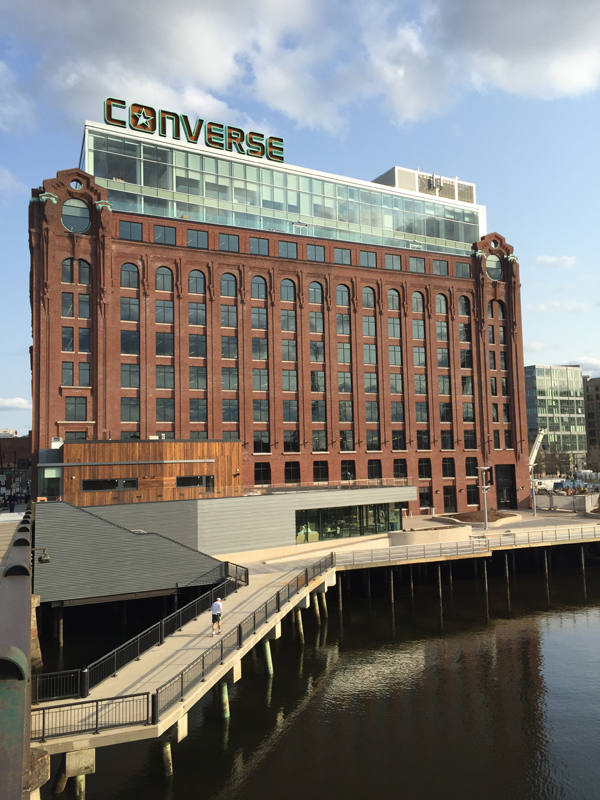
 When a tenant moves into a repurposed building, they may find that the building fits like a glove. More likely, however, the building’s previous life has little in common with its current one, and renovation is necessary to meet the requirements of its repurposed use. In most cases, adjustments, major or minor, are necessary to tailor the building to the new tenant’s size, fit, needs and taste. While not immediately apparent, acoustics is a building component that is paramount to the comfort, functionality and productivity of the occupants. Here are a few examples:
When The Sinclair, a live music venue and restaurant, moved into an office building in Harvard Square, the sound isolation between the venue and the surrounding offices was a significant challenge. Located in a building that caters to an all-hours startup culture, it wasn’t sufficient to assume that the music would only happen outside of 9-to-5; all hours are “normal business hours.” Sophisticated, customized construction upgrades were designed and tested to address this sensitive adjacency to the satisfaction of all the building occupants.
In a different instance, the high-end offices of a prominent financial services company moved to a beautiful, historically registered building in downtown Boston, only to find that the building’s original windows allowed cold air and outdoor noise to freely pass through. Due to the historic nature of the building, window replacements were restricted. The problem was addressed by designing a secondary window system (“interior storm” windows), installed inside the building in tandem with the existing historic windows. The new tight-fitting insulated glass system – along with the existing windows and the pocket of air captured in between – created an assembly that provides almost inaudible outdoor noise conditions to the building occupants, satisfying their desire for a quiet environment.
New Life For Old Mills
Mill building conversion projects are yet another circumstance. When a tenant chooses to take space in an old mill building, they are, in many cases, attracted to the exposed timber beams and wood planks. While they envision their teams collaborating in open areas in this charming setting, they may not realize that those very same architecturally inspiring features can be an acoustical challenge, and that work productivity may suffer as a result.
Exposed wood decking, without a dropped ceiling, is a hard and sound-reflective surface that can lead to excessive reverberation and noise buildup. The currently trendy long benches that provide open plan work surfaces without walls eliminate visual and acoustical barriers between employees. In combination with sound reflective surfaces overhead, these conditions promote sound projection over several workstations and an overall buildup of activity noise. Private conversations at one’s desk will be audible, intelligible and often distracting to neighboring workers.
It is difficult to address this condition without altering the appearance of the exposed ceiling. Solutions such as pendant sound absorptive panels and sound absorptive treatments installed to the underside of the deck that leave the beams exposed, can be cleverly employed to minimize the visual alteration of the space. Micro-perforated sound absorptive wood is an example of an engineered product that can be used to blend in with the overall aesthetics of the space. Some organizations find that by arranging workstations in small groups with acoustically absorptive vertical dividers (walls or screens) between groups, they are able to leave the existing wood deck exposed while avoiding acoustical problems. The corporate culture of the tenant is a key factor in determining the success of a particular design approach: Are they sensitive to distraction? Are they talkative?
Exposed wood-frame constructions can present sound isolation challenges, too. Both airborne sound transmission and footfall noise can be a distraction for employees, making sensitive spaces like a videoconference room plainly unusable. Upgrades required to remediate this condition don’t have to conflict with the desire for exposed ceilings; creative solutions are available in this case, too. For instance, a resiliently suspended gypsum board ceiling can be installed in-between the beams, leaving the beams exposed. The sound absorptive treatment needed for reverberation control is then applied to the underside of this barrier ceiling. Another option is to upgrade the construction at the floor above, by adding a “floating” floor on a resilient substrate on top of the wood structure. Each solution requires careful planning by the design team to coordinate the old and the new in a visually satisfactory fashion, and attention during construction to ensure that all components will perform as expected.
When moving into a repurposed building, its character should be celebrated. There are some inherent challenges, but with creative planning and design that character can be preserved while still providing highly functional work environments that people love to use. n
Ioana Pieleanu is a senior consultant in acoustics at Acentech, a multi-disciplinary acoustics, audiovisual systems design and vibration consulting firm based in Cambridge.