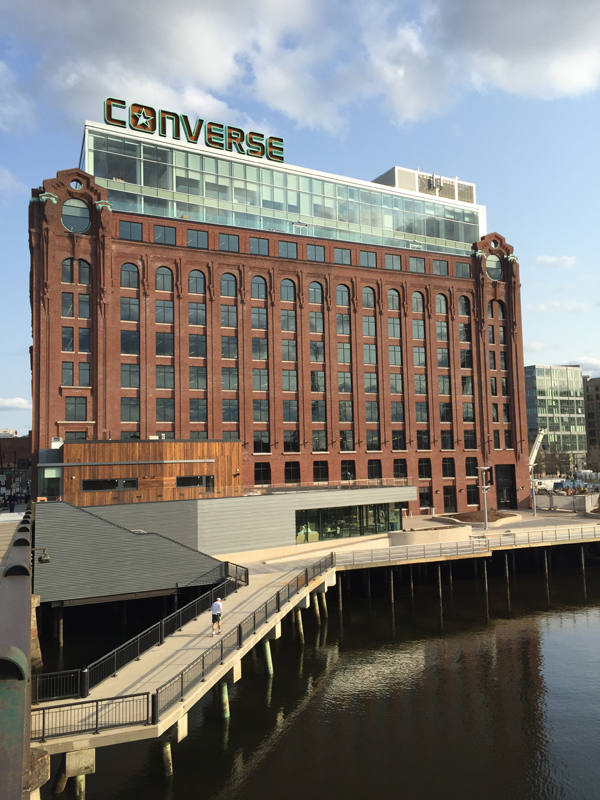
Converse’s new headquarters.
It was built as a Schrafft candy factory when Teddy Roosevelt was president, and later used by the Submarine Signal Co. to manufacture underwater sound equipment.
In what appeared to be the inevitable twilight of its useful existence, 160 North Washington St. became an office building for tenants who valued affordable rent more than up-to-date surroundings.
“When we closed (on the property) in 2012 and you walked into the building, it was as if time had stopped a long time ago,” said Peter Spellios, executive vice president for Boston developer Related Beal Cos.
One thing that never changed, though: its high-profile location at the northern gateway to Boston, a 10-story-tall waypoint for commuters coming across the Zakim Bridge. When athletic shoe manufacturer Converse Inc. sought to relocate its world headquarters from North Andover to Boston, the crumbling brick edifice was on its short list.
“I’d give (Converse CEO Jim Calhoun) a lot of credit for seeing through the existing conditions to what the space could become,” said Jennifer Carpenter, a New York-based architect who designed the interior workspaces. “It had been open to the weather and there were times when you were inside the building, it was raining.”
Converse employees began working in the 187,000-square-foot building, now a sun-splashed assemblage of offices incorporating all the latest practices in creative workspaces, in mid-April. A new condominium tower also to be developed by Related Beal breaks ground on the 2-acre site this summer, part of the combined project known as Lovejoy Wharf. And a new connection to the Boston waterfront is opening up on the property with an extension of the Boston Harbor and a floating public dock, expected to become part of an expanded inner harbor ferry network.
Related Beal bought the property from a previous developer, Lexington-based Ajax Management Partners, in December 2012. Ajax had won approvals for a condo conversion, but the project was halted by the recession and a lawsuit, later settled, by residents of the neighboring Strada 234 condo building.
Converse was looking to relocate to the city at the same time that Related Beal was negotiating to buy the site. The idea of demolishing the building was never seriously considered, Related Beal’s Spellios said. Converse leased the building concurrent with the acquisition.
“The historical significance was always a paramount concern in the permitting process, and Converse had the vision and foresight to see what the building could become for them,” he said.
The project was a potential showcase for Related Beal, given its specialty in adaptive reuse projects in Boston such as The Arlington, the former Boston Consolidated Gas Co. offices in Back Bay that were converted into luxury apartments.
At Lovejoy Wharf, the designs by lead architect Bargmann Hendrie + Archetype Inc. of Boston removed the top story and replaced it with two glass-enclosed 15,000-square-foot levels for executive offices and product showrooms.
Down below, ensuring structural integrity of the building, waterproofing the basement and restoring architectural details were major goals of the two-year project.
On the basement level, a five-foot concrete slab sits above concrete piles sunk into the earth. Water flowed in and out with every tide cycle, requiring the installation of a steel bulkhead along the north side of the building. It took a year to fully weatherproof and dry out the basement, Spellios said.
Sump pits were installed to remove any water that makes it past the new boundaries.
“Essentially we took something that was very wet, with two feet of water at some points in that basement, and now there’s no water,” said Thomas Schultz, an architect with The Architectural Team of Chelsea, which has worked on the building’s core designs since 2005.
Above ground, walls and support columns required extensive reinforcement. Meticulous detailing work undid a century of neglect.
Creative Office Space With A View
Although Converse’s previous headquarters in North Andover had an open-office format, the Lovejoy Wharf complex takes the concept to another level, said Carpenter, founder of the New York-based architectural firm.
To encourage employees from different divisions to connect with one another, the new building has a “communicating stairway” running through the center of the 21,000-square-foot floor plates. Informal meeting spaces known as “pods” are located alongside.
“One of the key things was allowing for these spaces where collaboration can take place, as opposed to the typical conference rooms,” Carpenter said. “Somebody on the floor below and above can see a pod is open and go there to work rather than sticking to where your group is located. When people are encouraged to travel that way, it helps those kinds of interactions and encounters.”
An elevator bank located in the center of the building was relocated to the west side, maximizing natural sunlight and views of the Zakim Bridge and Charles River throughout the offices. With exposed ceilings and concrete floors, noise abatement was addressed through the installation of sound-absorbing spray and carpeting in individual workspaces.
New Connection To Waterfront
Construction of a Robert A.M. Stern Architects-designed 175-unit condo building between Converse and the TD Garden will begin in late spring, Spellios said.
As part of $15 million in public realm improvements required by the Boston Redevelopment Authority, rotting wharves were rebuilt along the rear of the property. A 12-foot-wide extension of the Harborwalk runs along the waterfront and under the Washington Street bridge. A new stairway connects the bridge to the Harborwalk, so pedestrians can now walk from Charlestown to the North End without having to cross any streets. About three-quarters of an acre is set aside for public space including a new plaza.
“It’s just going to reinvent that area of the Bulfinch Triangle,” Spellios said. “You’ve even seeing it in recent weeks with the people coming from Washington Street are cutting along the water’s edge, and it’s amazing.”