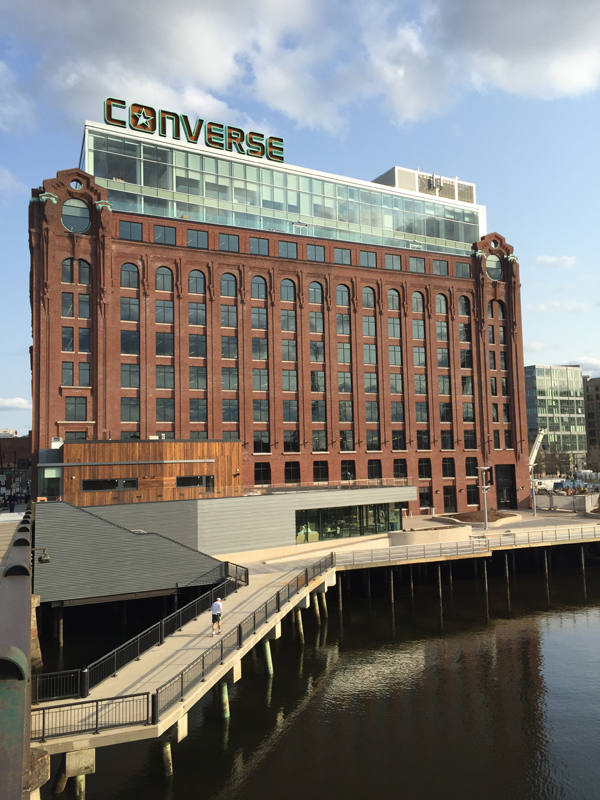
West of Chestnut has become the centerpiece of efforts to revamp Quincy Center.
Some see a bubble forming amid the luxury apartment tower boom as developers tout “free rent” and other goodies to attract renters with deep pockets – but not Kyle Warwick. A rising star in the world of Boston real estate, Warwick cut his teeth on such mega projects as Fan Pier and North Point before leaving Spaulding & Slye to launch Redgate in 2010, and its now high-flying apartment development arm, Gate Residential.
Now Warwick and Redgate are betting close to half a billion dollars that the future of the real estate market belongs to apartment-crazy Millennials ready to plunk decent money for upscale apartments in once downscale locations like Quincy and Chelsea.
And if Warwick and the other high-powered principals of Redgate are right, that’s very good news for the apartment building boom and potentially very bad news for aging Baby Boomers hoping to someday unload their large suburban spreads.
The average age of Gate Residential’s renters: 27.
“Some of our renters are living at home right now,” Warwick said. “These are new renters coming out of school who want to be part of the urban experience.”
In one of its biggest moves yet, Gate Residential recently began seeking investors for a $250 million fund that will see out new apartment projects to build and finance.
However, the fund, simply called Gate Residential One, will be scouting opportunities in other hot metro markets on the East Coast where there is high demand for new apartments among Millennials and others, not just Boston, said Greg Bialecki, the state’s former housing czar and newly minted principal at Redgate.
Bialecki himself represents another big move by Redgate, which hired the former state secretary of housing and economic development to help oversee the apartment push.
He joins other Redgate principals including Damian Szary, a familiar figure on the local residential development scene who has helped build 2,000 new condos and apartments in the Boston area over the past decade and a half.

Scott Van Voorhis
Bialecki said the aim is not to put up a new apartment high-rise here, another there, but rather to build a portfolio of apartment projects in Boston and beyond, all the while tapping into unmet demand on the part of Millennials.
“We think there is a lot of depth in that market, for that kind of product,” Bialecki said. “There is room to grow.”
“We think we can make the case to investors they should invest with us,” he added.
Look To The Fringes
The newly launched $250 million fund comes atop another $200 million in projects either under construction or completed over the past few years by Redgate and Gate Residential. The firm’s latest endeavor is the $100-million West of Chestnut, a 400-unit apartment development that has become the centerpiece of efforts to revamp Quincy Center. To the north of Boston in Chelsea, Gate has finished leasing 230 apartments in the first phase of One North of Boston and has kicked off work on a second phase of 222 units.
Gate Residential got its start in Somerville, with the Maxwell Green apartment development, which has long since leased out and, as Warwick notes, is less than a mile from Davis Square.
All three projects highlight the niche strategy of Warwick and other Gate principals. The firm is targeting cities on the fringes of Boston on major T and bus lines that are ready to shed old reputations as stodgy backwaters – and have lower building costs as well.
Somerville may seem the exception to the rule, given how much new apartment and condo development is taking shape in the city, but that wasn’t necessarily the case back in 2010, Warwick noted.
“It’s obviously a very hip and cool place to live, but in 2010 there weren’t any institutional quality buildings of this kind developed in Somerville,” he said.
The advantage of building in Somerville in 2010 and in Chelsea and Quincy in 2015 is that it enables Gate to offer luxury apartments at a discount from what you would pay in downtown Boston.
Not that they are necessarily cheap: The rents at the firm’s new downtown Quincy development run between $1,700 and $2,500 a month.
But the costs are designed to be within range of a wider segment of young Millennials just starting out in their careers, who can’t afford $3,000, $4,000 or $5,000 a month to live in the South End.
It’s not just price, though, with Quincy and Chelsea having long offered cheaper rent than Boston. Rather, Gate Residential’s apartments are also “highly amenitized,” with offerings designed to appeal to renters in their late 20s and 30s.
Somerville’s Maxwell’s Green, for example, boasts a “community chef’s” kitchen, not to mention pool tables and a great room next to it.
For its part, the firm’s new downtown Quincy apartments will come with two major amenity suites – a “life suite,” featuring a chef’s kitchen, billiards and other games and a “club suite” large enough to cost a dinner party for a couple dozen guests.
There’s a courtyard with a fire pit, a “network café” set up for the aspiring entrepreneur or anyone doing a little work from home, and a dog washing station as well.
“That demographic has been bypassing Quincy,” said Kyle Warwick, principal of Boston-based Gate Residential. “As they get priced out, this is a great location for them.”
Yet the key question is whether this model will work over the longer term, especially when dealing with renters in their 20s and 30s.
After all, renting has traditionally been seen, especially for young college graduates, as more of a necessity than a lifestyle choice, a way station before marriage and a house in the suburbs.
But Gate Residential is betting that today’s Millennials won’t be in a hurry to move out after a year or two, but rather will be staying a while.
If nothing else, huge student debt loads will mean an extended period of renting for many young professionals before they can buy, whether it’s a condo in the city or a suburban home, Bialecki contends.
We’ll see – the death of the suburbs and the idea of Millennials as urban centric has been oversold, at least in my humble option, though it doesn’t mean it’s not real, either.
Stay tuned, for it looks like Gate Residential’s $450 million bet on Millennial apartment living will be getting even bigger in the months and years to come.