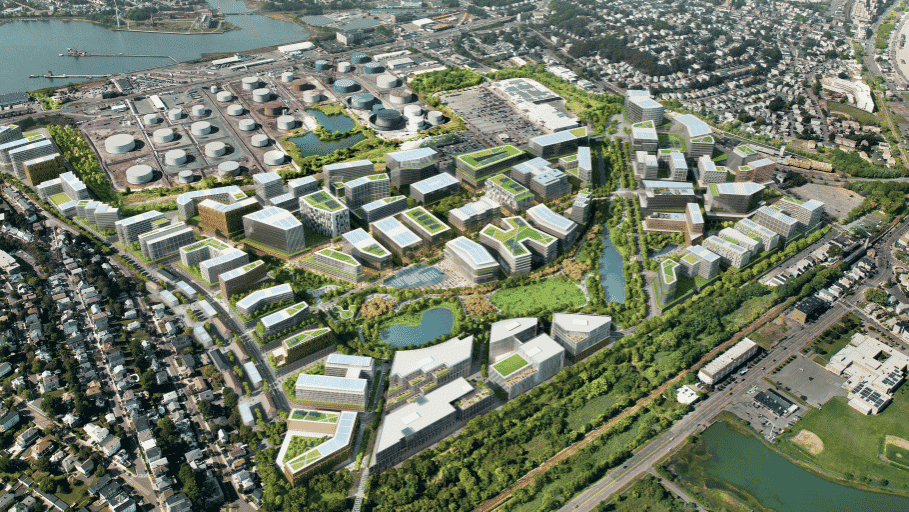
HYM Investment Group’s plans for 10,000 housing units on the Suffolk Downs property would include 930 on-site affordable units, all on the East Boston side of the 161-acre property. Image courtesy of CBT Architects.
Today caps off another momentous year in Massachusetts’ commercial real estate landscape, with massive new projects rising across downtown and in once-unremarkable neighborhoods. As predictions for 2020 fly fast and thick from the pens of industry leaders, it’s worth taking a look back at the stories you, our readers, read the most in 2019. Here are the top five:
- Coliving Developer Acquires Key Davis Square Parcels for $10M – Scape, a British developer planning a billion-dollar pipeline of dorm-style housing projects in Greater Boston, acquired three properties in the heart of Somerville’s Davis Square for nearly $10 million in late June. With the passage of a citywide rezoning, Scape’s investment and another by North Carolina retail developer Asana Partners could indicate more growth is coming to the low-rise commercial district.
- Revere Beach Shopping Center Sells for $24.1M – A shopping center adjacent to Revere Beach was sold to Urban Edge, a Manhattan-based REIT who sees redevelopment potential in the site. The deal was just the latest move in and around the Wonderland Blue Line station and bus terminal this year, with the owners of the area’s eponymous race track property engaging Newmark Knight Frank to market the 34-acre site for redevelopment and several multifamily and hotel buildings completed, under construction or planned. A short distance away in Everett, multifamily developers are also prospecting for new opportunities.
- Ex-BPDA Official Pleads to Taking $50K Bribe from Developer – When U.S. Attorney for Boston Andrew Lelling announced charges against a former Boston Planning & Development Agency official just as the Labor Day weekend was about to begin, he set off a storm of concern and controversy. Was the entire Boston land use process corrupt, as some charged? Was the bribe a one-off aberration in an admittedly cozy set of relationships between the city Zoning Board of Appeals and the real estate industry, as the lack of follow-up charges suggests? City Councilors Michelle Wu and Lydia Edwards declared the moment required dramatic action – the abolition of the BPDA (Wu) and a proper city-wide master plan to build consensus on future development reduce the need for variances, and the replacement of the ZBA (Edwards) with a body much more heavily weighted towards many voters’ concerns and affordable housing creation. It remains to be seen how the chips will fall on this issue in 2020 as Boston’s development continues at a rapid pace
- Texas Billionaire Revealed as Suffolk Downs Owner – Banker & Tradesman Associate Editor Steve Adams scored a coup when he ferreted out the identity of the mystery investor willing to back the construction of an entire new neighborhood on the Boston-Revere line on the site of the old Suffolk Downs racetrack. Fourth-generation Texas oilman William Bruce Harrison partnered with experienced Boston developer HYM Investment Group on the $159 million acquisition of the racetrack property in May 2017. HYM is seeking approval to build 6.1 million square feet of commercial space and 10,000 housing units on the 161-acre site spanning parts of East Boston and Revere. Harrison’s family investment office declares its “ideal hold time is ‘forever.'”
- Amazon Picks Necco Site for Distribution Center – Revere Mayor Brian Arrigo announced, via Amazon’s Alexa virtual assistant, that the e-commerce giant will be opening a distribution center in the former Necco factory near Revere Beach Parkway in the city. The mid-October announcement capped months of speculation about the future of the factory, the single largest industrial vacancy in Massachusetts, which included a possible relocation of Widett Circle’s food vendors to make way for a New England Revolution stadium or some other mega-development on a site that holds the key to protecting much of Boston from climate change-fueled flooding. Amazon’s choice of the 800,000-square-foot building also underscored just how valuable industrial real estate is becoming everywhere in Massachusetts, especially in and around major urban centers.