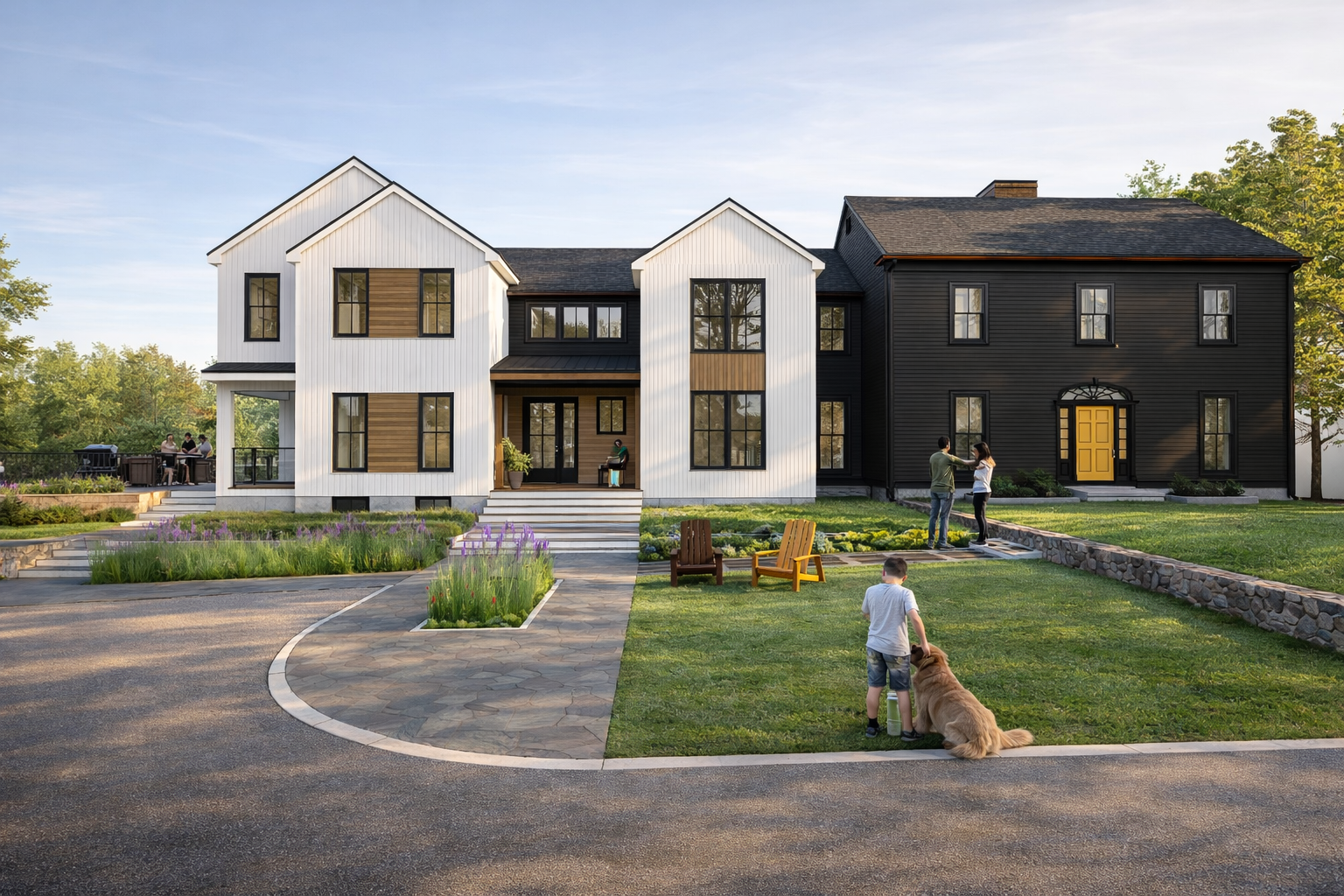
The Charles Cove Residence in Dover was expanded using materiality and color to distinguish between the original construction in the 1860s and the new construction. Image courtesy of ArnoldAnd
One thing I’ve noticed over the last few years is that my clients are increasingly comfortable with contrast.
I spend a lot of time working on additions and renovations to New England homes, and historically the assumption was that any new work should blend seamlessly into the existing house. If you were adding onto a Colonial, the addition should look like it had always been there. If you were renovating a historic home, the goal was often to make the new work disappear.
That approach can absolutely be successful, but it is not the only conversation I’m having with homeowners.
More and more, I’m meeting clients who love traditional New England homes but also want open floor plans, larger windows, stronger connections to the outdoors and contemporary design. They want modern amenities without giving up the homes and neighborhoods they love.
I often describe this approach as making the present legible. Rather than pretending the new work has always been there, the goal is to allow the evolution of the home to be understood. The original house remains visible and respected, while the new work reflects the way people live today.
One project that embodies this idea is the Windmill House in Sudbury, a 1959 center-entrance Colonial. While it isn’t a historic home in the traditional sense, it represents one of the most common housing types found throughout New England. The owners were drawn to the familiarity and proportions of the original house, but they also wanted a cleaner and more contemporary aesthetic.
Rather than dramatically changing the identity of the home, we focused on simplifying it. Applied decorative elements such as shutters and ornamental trim at the entry are being removed, allowing the underlying form of the house to become more prominent. Traditional double-hung windows are being replaced with European-style inswing casement windows that improve performance while creating a more contemporary expression.
The addition itself is intentionally modern. Not because we’re trying to compete with the original house, but because we want the original house to remain visible. Making the addition more contemporary actually allows the Colonial to read more clearly. Rather than competing with the original architecture, the addition helps frame it. The old and the new each have a clear identity and tell the story of the home’s evolution.
Distinguishing Between Different Eras
We’re taking a similar approach at the Charles Cove Residence in Dover, a home dating back to the 1860s. The project more than doubles the size of the house while preserving many of the elements that give it its historic character.
In this case, we used materiality and color to distinguish the different eras of construction. The original historic home is painted a dark monochromatic color, with the trim and siding unified into a single expression. We retained the existing horizontal siding because it felt appropriate to the proportions and rhythm of the original structure.
The addition takes a different approach. It is clad in vertical siding and painted monochromatic white. The shift in color, orientation and architectural language allows visitors to immediately understand what was original and what was added.
These decisions weren’t made to create contrast for contrast’s sake. They were made to celebrate both parts of the house while clearly expressing different moments in its history.
What I find most interesting is that homeowners are increasingly embracing this way of thinking. Many appreciate both traditional and contemporary architecture. They don’t want to choose between owning a Colonial house and living in a modern home. They want both.
Just because someone likes modern architecture doesn’t mean they need to buy a modern house.
Much of our future housing already exists in the form of Colonials, Capes, farmhouses and historic homes that are woven into the fabric of our communities. If we want these homes to remain relevant for the next generation, we need to allow them to evolve.
 That doesn’t mean every addition should be contemporary. There are many successful projects where a historically inspired approach is the right solution. The point is that there is more than one way to thoughtfully add onto an existing home.
For me, preserving the past doesn’t mean freezing a house in time. It means understanding what makes a home special and carrying those qualities forward.
The homeowners I work with are increasingly interested in the latter. They want to respect the past without recreating it. They want their homes to reflect both where they’ve been and where they’re going.
The homeowners I work with aren’t asking me to choose between the past and the present. They’re asking me to help them connect the two. That’s what I mean by “making the present legible.”
Matthew Arnold is founder of Boston-based ArnoldAnd, a design studio specializing in residential, commercial and hospitality projects.