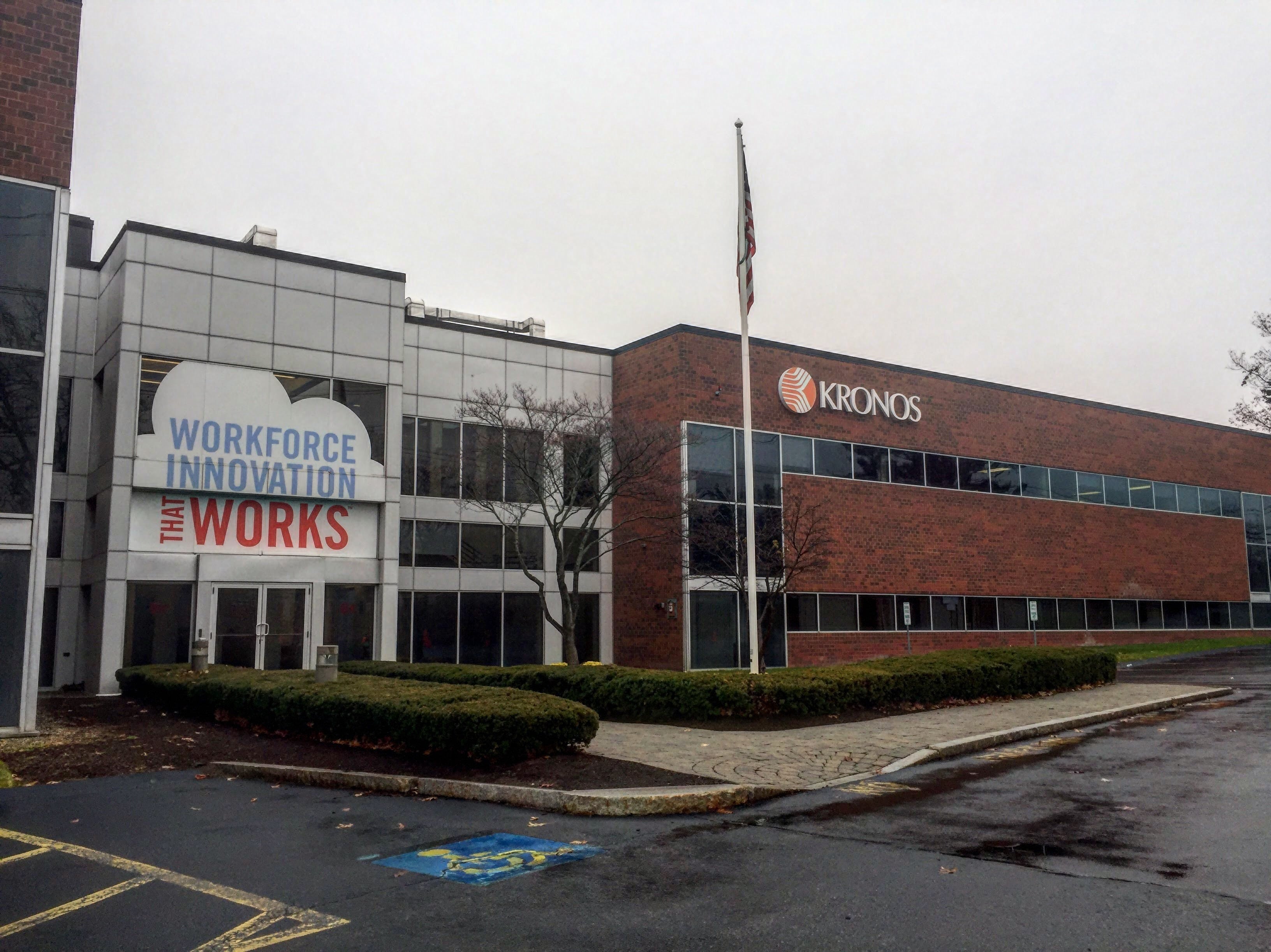
Chelmsford’s Route 129 corridor could have approximately 1 million square feet of vacant commercial space by mid-2017 with the departure of large tenants including Kronos Inc., the town’s largest employer.
A succession of “space available” and “now leasing” signs decorate office and R&D buildings along Route 129, the heart of Chelmsford’s 623-acre commercial district.
Built primarily in the 1980s, the low-rise structures once housed tech trailblazers like Wang Laboratories and Apollo Computer. Today there’s over a half-million square feet of vacancies in the 4.5-million-square-foot market spanning 70 properties. Another 320,000 square feet will become available next summer when the town’s largest employer, Kronos Inc., moves 1,200 employees from three buildings in Chelmsford to a trendy open floor plan headquarters at the CrossPoint tower in Lowell.
Along with the imminent relocation of defense contractor Mercury Systems to Andover, Kronos’ departure is acting as a wake-up call in this Merrimack Valley town of 34,000.
“That really created a call for action,” said Evan Belansky, Chelmsford’s director of community development.
A zoning overlay awaiting final approval from Attorney General Maura Healey is designed to help Chelmsford retain and attract commercial tenants. It opens the door for hotels, retail and multifamily development, and promises fast-track permitting and flexible dimensional and parking standards.
Conversion of existing space into amenities uses would be allowed by right, with permits issued within 90 days. Larger redevelopment projects would be reviewed by special permit within 120 days.
The overlay district also seeks to capitalize on the neighborhood’s visibility from Route 3, with nine properties that have frontage on the highway approved for non-residential structures up to 90 feet by right. That provision was suggested by real estate brokers who pointed out the importance of high-visibility corporate branding, including logos visible from the highway.
The new zoning gives Chelmsford landlords a chance to compete in the amenities race needed to attract companies in Greater Boston’s strong job market, said Greg Klemmer, executive vice president for Colliers International Boston.
“We’ve got a lot of nice buildings, but they’re all dated and they’re all the same,” he said. “All of a sudden, the dynamics of the market have left them in the dust.”
The new zoning is designed to convert approximately 500,000 square feet to amenities or different uses, Belansky said.
Route 495 Submarket Lags Competition
The Route 495 North submarket has been bypassed by the commercial real estate boom driving property values to new heights in Boston, Cambridge and a handful of core suburbs.
It’s a region that’s seen wide swings in occupancy driven by economic cycles and concentrations in volatile industries such as telecom, said Klemmer, head of Colliers’ North suburban team.
Vacancies rose to near 30 percent following the 2008 downturn. But as the office market has rebounded along Route 128, northern suburbs have been left behind. In Chelmsford and Billerica, nearly a dozen buildings with 100,000 square feet of availabilities have sat vacant in recent years.
“As rents rise in Burlington, it pushes tenants up Route 3 and all over,” Klemmer said. “This is the first time that phenomenon has not taken hold.”
The vacancy rate in the Merrimack Valley was 22.8 percent at the end of the third quarter, according to research by Boston-based Encompass Real Estate Strategies. That’s the second-highest of all Greater Boston submarkets, trailing only the Route 24 corridor’s 22.9 percent. Class A rents average $22.08 per square foot, but some landlords are willing to settle for effective rents in the $2 range after tenant improvement packages, Klemmer said.
Tour activity by prospective tenants has been steady at Omni Way, a 3-building complex where 105,000 square feet is currently available including 80,000 square feet that Kronos will vacate next year.
“We’re seeing fairly consistent activity, but one of the things that people struggle with is the amenity package,” said David Gilkie, a senior vice president at NAI Hunneman which represents ownership. “Right now the younger folks want to see coffee shops, fitness centers and places they can commune after work.”