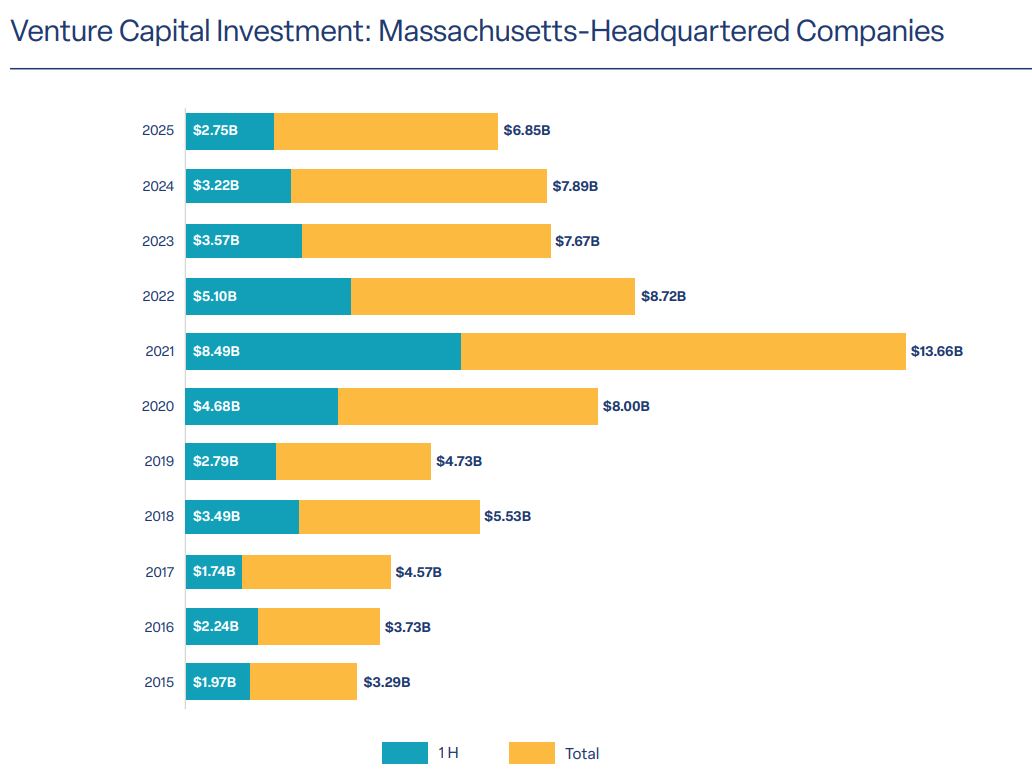
A new MassBio reported found Massachusetts-headquartered biopharma companies secured $6.85 billion in venture capital funding in 2025. Image courtesy of State House News Service | Screenshot
Massachusetts-headquartered biopharma companies secured $6.85 billion in venture capital funding last year – the smallest haul since 2019, according to a new industry trade group report.
The 2025 venture capital funding was “still significantly higher than any pre-2020 year,” though dwarfed by the $13.7 billion haul in 2021, according to a report the Massachusetts Biotechnology Council released Thursday. Between 2024 and 2025, venture capital funding decreased by 13 percent.
The state’s biopharma landscape in 2025 also saw decreased merger and acquisition activity, a drop in initial public offerings, and an increased number of drug candidates in the U.S. pipeline, according to the MassBio report.
“Surveys indicate that policy uncertainty is the top concern of biopharma executives heading into the new year,” the report says. “While FDA approvals rose from 23 to 28, persistent regulatory instability disproportionately affects small biotechs with one or two drug candidates, the backbone of the Massachusetts industry. NIH funding rebounded beginning in September, following successful court challenges and policy changes, though its future remains uncertain, especially in research hubs like Massachusetts.”
A coalition of attorneys general, including Massachusetts AG Andrea Campbell, last February sued the Trump administration, the U.S. Department of Health and Human Services and the National Institutes of Health for cutting federal funding for medical and public health research.
The U.S. District Court for Massachusetts later issued a permanent injunction preventing the Trump administration from moving forward with cuts. The U.S. Court of Appeals for the First Circuit affirmed the ruling this week, in response to an appeal from the Trump administration, Campbell’s office said.
Massachusetts raked in 9.4 percent of all NIH funding in 2025, essentially a flat level compared to 2024. Using July 2025 data, MassBio had previously projected Massachusetts would see a $500 million NIH funding shortfall.
“However, following court rulings, policy changes, and frantic grant awarding in September, NIH funding ended the year with funding cuts of around $125 million, with additional funding data yet to be released,” the report says. “That said, it will be important to monitor the use of multi-year awards, a stated preference by the NIH, and any impact that they have on annual totals going forward.”
MassBio found Massachusetts-headquartered bipharma companies secured 26.2 percent of the industry’s U.S. venture dollars in 2025, compared to 28.3 percent in the year prior. Massachusetts trailed only California in 2025, which accounted for 43.3 percent of U.S. venture dollars.
The commonwealth’s share of venture dollars went to 187 companies in 2025, compared to 215 in the previous year, according to the report. Just over 70 percent of venture capital funding flowed to companies outside Cambridge, and Boston surpassed Cambridge’s funding for a second year in a row.
There were just two IPOs among Massachusetts biopharma companies in 2025, compared to six in the previous year. In 2021, MassBio had counted 25 IPOs.
Thirty-six Massachusetts companies were acquired in 2025 for a total of $20 billion. By contrast, in 2024, 32 companies were acquired at a total value of more than $42 billion, according to MassBio.
A dozen companies made acquisitions totaling $299 million in 2025, while 25 companies made acquisitions worth $10.62 billion in 2024, MassBio said.
The commonwealth’s pipeline of drug candidates increased by nearly 14 percent from 2024 to 2025, compared to the country’s overall increase of 6.8 percent. The most common therapeutic areas involved oncology, the central nervous system and anti-infectives. But China’s pipeline grew by 37 percent, the report pointed out.
“American leadership in biotechnology is both a national security imperative and an economic priority,” MassBio CEO Kendalle Burlin O’Connell said. “Massachusetts companies are building the drug pipeline that will define the next decade of cures and therapies, and MassBio will continue advocating for the federal investments and policy reforms that keep the United States competitive on the global stage.”
In a letter Tuesday, Gov. Maura Healey urged U.S. Health and Human Services Secretary Robert Kennedy Jr. to restore NIH funding cuts that she said have halted 380 clinical trials nationwide.
Healey cited an Oct. 23 meeting she had with Kennedy, in which she said the secretary “assured” her that no clinical trials had been stopped and challenged her to produce “any proof to the contrary.” The governor wrote she now has that proof in the form of a November report from JAMA Internal Medicine.
“There are at least 18 clinical trials and 13,000 patients that have been affected by disruptions to NIH funding in Massachusetts alone,” Healey wrote. “Implicated trials include studies on colorectal cancer, strokes, gestational diabetes, depression, vaccine hesitancy, pregnancy complications, and osteoporosis.”