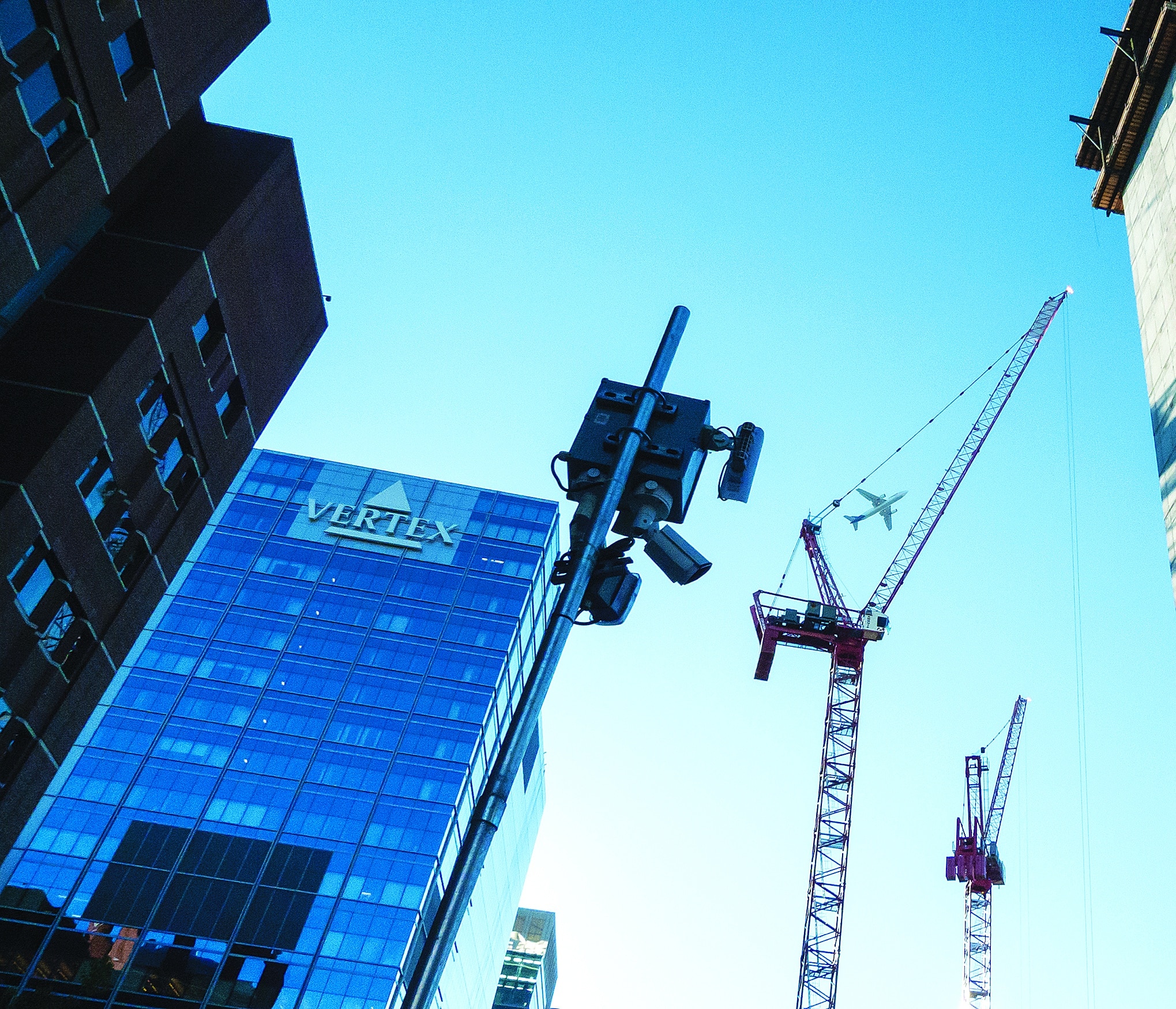
A jet outbound from Logan Airport rises over the Vertex building in the Seaport District. Its 2017 sale was brokered by HFF.
Shame on South Boston’s elected leaders. They should know better.
The neighborhood’s pols, from city councilors to Congressman Stephen Lynch, are scrambling to appease the loudest voices in the room when it comes to an inexplicably controversial plan, one that would, shockingly, take a dirty old Edison power plant on the waterfront and transform the site into desperately needed new housing, as well as hotels, retail space and offices.
As always, and this is true whether it’s South Boston or some sleepy little town in Central Massachusetts, the loudest and most belligerent voices are those of the NIMBY chorus, for which the prospect of new housing – and new neighbors of potentially different backgrounds – is a predictable red flag.
But project opponents and their elected enablers better hope they don’t manage to get their way.
The crazy run-up in real estate values that is steadily driving middle- and lower-income families out South Boston will only intensify if the 1,300 new condominiums and apartments proposed for the old Edison site are sacrificed at the behest of anti-development cranks and housing haters.
8K New Jobs, Home Prices Up by $300K
With a median sale price of $767,000, South Boston is now the most expensive neighborhood in Boston in which to buy a condo, barring luxury high-rise-packed Back Bay, gilded Beacon Hill and the long-since gentrified South End, according to statistics from The Warren Group, publisher of Banker & Tradesman.
At a median sale price of $845,000, South Boston is second only to Jamaica Plain, and by not much, in single-family home prices, discounting the Back Bay, South End and Charlestown, whose limited number of homes are now the province of multimillionaires.
A significant factor in making South Boston so expensive has been the explosion in office space and other commercial development in the adjacent Seaport, which has brought thousands of new workers to the area, from highly paid executives to their myriad minions.
More than 3.7 million new square feet of office and commercial space in the Seaport and its environs was either completed or approved by City Hall from 2014 to 2016, according to the Boston Planning and Development Agency.
That equates to more than 8,000 new jobs in the Seaport in the last four years, and they certainly aren’t all commuting in from the suburbs, especially more urban-minded Millennials and Gen-Xers. Right next door the traditional, residential section of South Boston is a tempting and natural option for anyone working in the Seaport.
It’s no coincidence that over the same period, South Boston’s median home price rose by $300,000 while condo prices jumped by $267,000 – the increases alone equal to what one might still pay today for four walls and a roof out in Central Massachusetts or New Hampshire.

Redgate Capital and Hilco Development Partners are facing resistance from South Boston leaders over a plan to redevelop the neighborhood’s former Edison power plant. Photo courtesy of Redgate Capital.
Southie Saw Less Building Than Other Areas
Sure, there has been a significant amount of new residential construction in South Boston since 2014, with 2,126 new condos and homes approved by City Hall.
But it hasn’t been enough to keep pace and certainly isn’t tops in the city. With the exception of the Seaport – the multimillion-dollar high-rise units being built there aren’t particularly relevant to the issue at hand – those honors go to Brighton, the South End and East Boston. The wealthy buyers and investors who casually lay out millions for condos in luxury towers in the Seaport and Back Bay aren’t hitting open houses for condos in converted churches and restaurant buildings in South Boston, however stylish they may be.
The neighborhood certainly isn’t “condo’ed out,” as City Councilor At-Large Michael Flaherty told the Boston Herald.
The 1,300 condos and apartments Redgate and its co-developer Hilco have proposed for the 15-acre Edison would be the largest single residential development in South Boston. While most of it would be market-rate, it would also include a significant contingent of condos and apartments sold or rented out at below market rates.
For the most part, residential construction in the neighborhood has come mainly in dribs and drabs, one school building or triple-decker at a time.
More Jobs, Housing Demand Coming
Fifteen-acre sites don’t grow on trees in major cities. This is a major opportunity to at least slow the pace of price increases in South Boston.
The fact is, more new development – and more jobs – are coming to the Seaport, with another 2.1 million square feet approved, along with thousands of additional jobs, and, along with them, employees looking for a reasonable commute.

Scott Van Voorhis
The only certainty is that the pressure on South Boston’s housing market will continue to mount.
It’s high time the neighborhood’s elected leaders stop caving to the project’s NIMBY opponents and do the right thing.
And that means pushing for more housing in South Boston – especially affordable units – not just on the Edison site, but elsewhere.
Scott Van Voorhis is Banker & Tradesman’s columnist; opinions expressed are his own. He may be reached at sbvanvoorhis@hotmail.com.