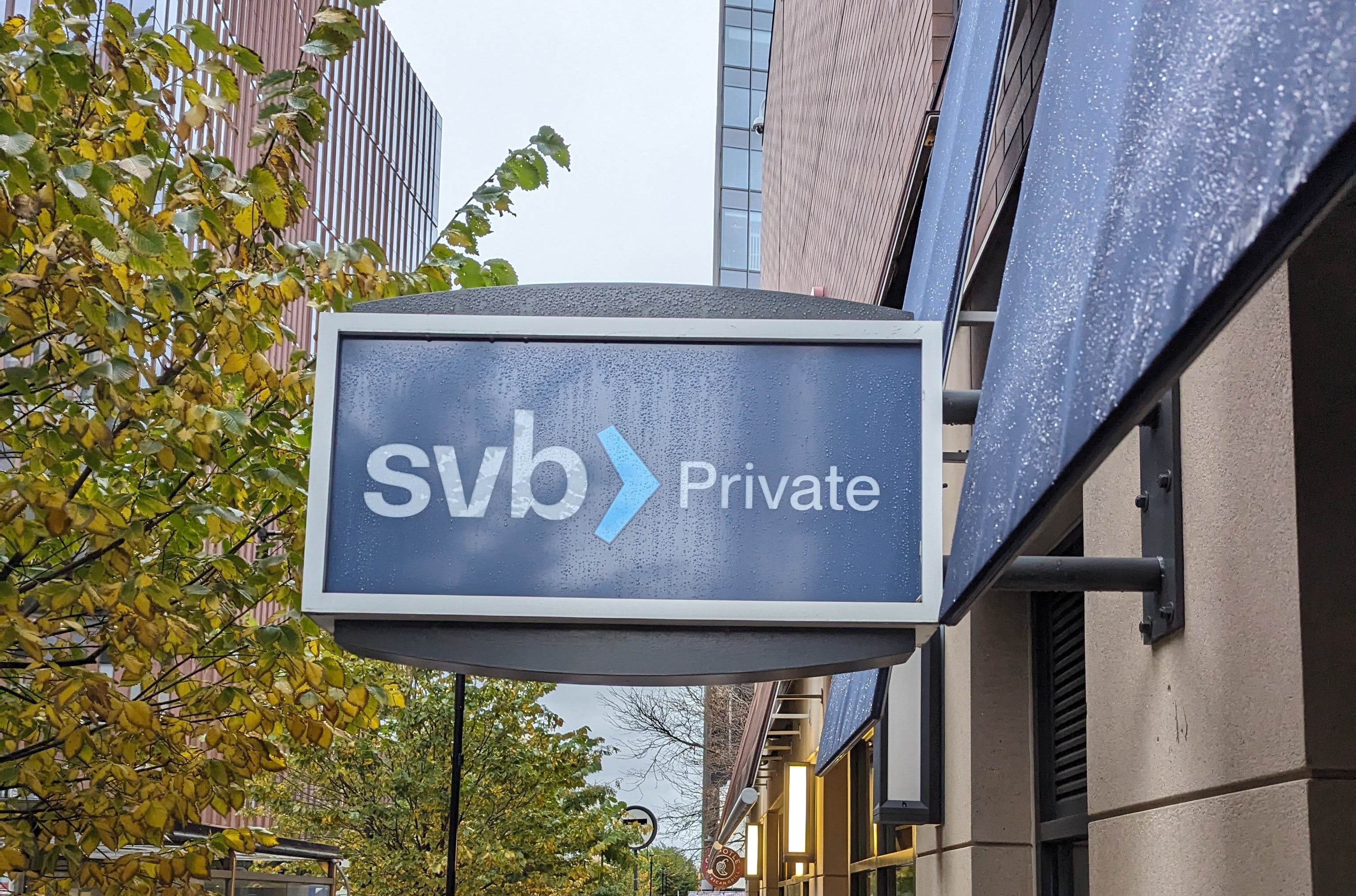
A Silicon Valley Bank branch in Cambridge's Kendall Square. Banker & Tradesman photo / File
Silicon Valley Bank recorded lower deposits and loans in the fourth quarter of last year as the nation’s tech sector continues to suffer under the weight of higher interest rates and investor expectations.
The tech-focused lender continues to operate as a subsidiary of North Carolina-based First Citizens Bank following its post-failure acquisition in early 2023.
SVB’s loans declined by $1.85 billion quarter-on-quarter as of the end of 2023, which offset the increases in loans by First Citizens’ general and commercial banks. This resulted in total loans of $133.3 billion.
The bank’s deposits also dropped by $1.49 billion due to “continued client cash burn and muted fundraising activity in the innovation economy,” First Citizens Chief Financial Officer Craig Nix said during the bank’s earnings call on Friday. This influenced the bank’s deposits, which declined by $379 million to $145.85 billion compared to the previous quarter.
First Citizens Chairman and CEO Frank B. Holding Jr. said SVB faced headwinds in the innovation economy and increased competition in the space. Prior to SVB’s March 2023 failure and forced sale to First Citizens, SVB had dominated the banking services market for Boston and San Francisco Bay Area tech and biotech companies. Since then, JPMorgan Chase nationally, and Cambridge Trust and Leader Bank locally, have sought to take chunks of the lender’s business.
Still, he said he remains encouraged by the value of SVB’s expertise in the innovation economy, as well as the business showing stabilization.
“Our goal is to support the acquired lines of business, maintain their unique capabilities, all while improving efficiency and risk management, positioning us for future growth,” Holding said.
First Citizens said its efforts to integrate SVB into its larger operations are ongoing, the majority of which will be completed this year.
Net charge-offs – loans that will likely not be paid – at SVB remained elevated at $65 million due to continued stress in the bank’s investor-dependent loan portfolios, but decreased by $35 million compared to the third quarter of 2023.
First Citizens executives on the Jan. 26 call noted that SVB’s investor-dependent loan portfolios totaled to $4.3 billion, around 3 percent of total loans, from innovation companies in “early-stage” development and “growth-stage” development – mid- to later-stage innovation companies.
The highest risk category loans were from the early-stage innovation companies, which had loans worth $1.4 billion from SVB, equivalent to over 1 percent of total loans in First Citizens.
Since April when First Citizens acquired SVB after its collapse, Nix said SVB’s deposits have been largely stable despite cash outflows and the bank had added 60 new clients. He added that the first half of the year will remain challenging for the private equity and venture capital markets.
The bank is also looking for opportunities to grow loans in the global fund banking sector through SVB but said total loans are expected to be flat in 2024 due to the continued headwinds in private equity and VC markets, as well as in technology and healthcare banking.