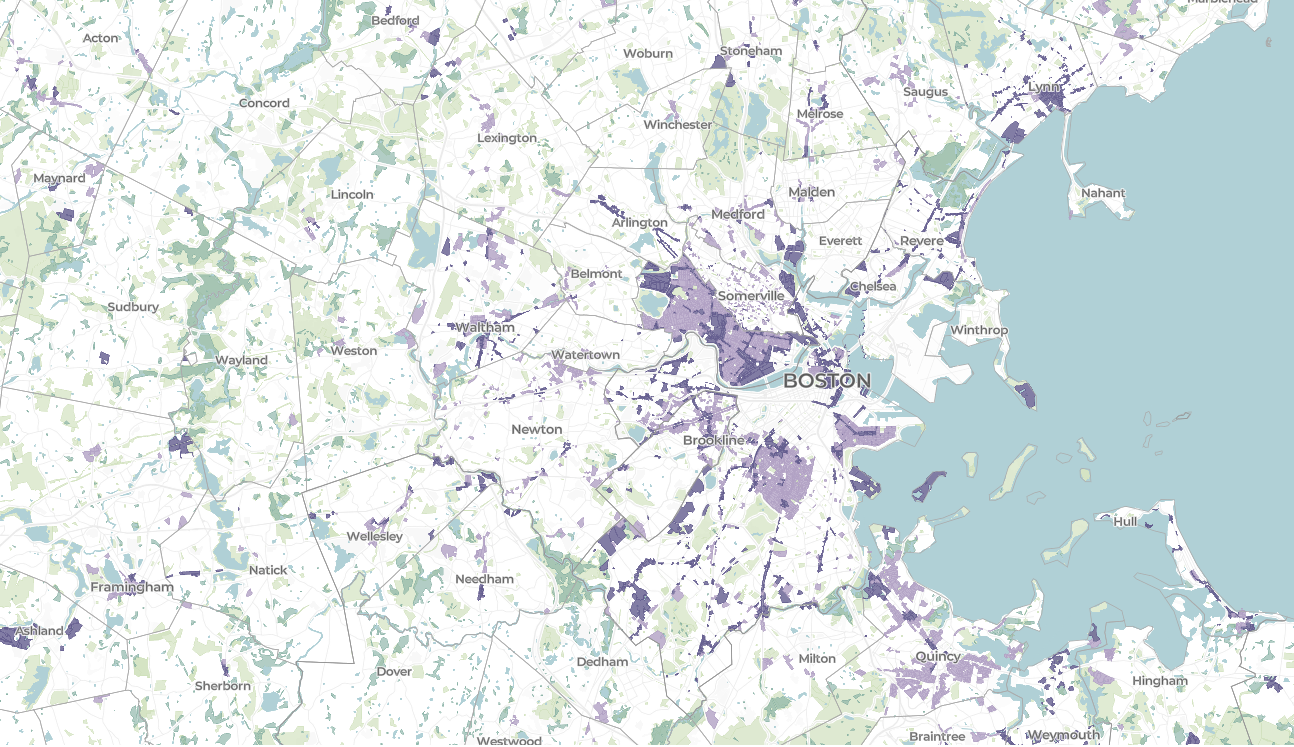
A screenshot from the National Zoning Atlas showing where apartments with at least four units can be built as-of-right and without a public hearing in the Boston area. Darker areas within shaded zones indicate mixed-use zoning. Lighter areas within shaded zones indicate primarily residential zoning. Image courtesy of the National Zoning Atlas
I have to admit that when I first spotted a LinkedIn post about a new report just released by something called the National Zoning Atlas, my eyes started to glaze over.
Yes, I have been writing and reporting about development and real estate for decades now, so there’s not a week that goes by that I am not looking at some issue that involves zoning, especially as it influences housing development.
But my goal is always to explain complex issues – and zoning is nothing, if not complex – in as plain and clear English as possible.
I have never been interested in the mastery of arcane details just for the fun of it, and the name – National Zoning Atlas – suggested something possibly useful, but also irredeemably wonky.
But I am also always on the hunt for stories. And if you are willing to do a little digging, good ideas and stories can often be found in the laws, rules and regulations that govern everyday life in the modern world.
So, I gave the National Zoning Atlas’s LinkedIn post another shot and saw what I had missed the first time. The Washington, D.C-based nonprofit’s latest report digs into zoning in Massachusetts and what impact, if any, recent reforms aimed at boosting the construction of new housing have had.
Half of State Requires 1-Acre Lots
Despite the not-exactly-catchy title – “Zoning Report: Massachusetts” – the report offered a well-written, clear and to-the-point overview of our zoning laws and the role they play in blocking the construction of apartments, condominiums and starter homes in New England’s wealthiest and most populous state.
Kudos to John Infranca, a Suffolk University Law School professor, and a team of students who collected and analyzed zoning codes and maps for every jurisdiction in Massachusetts and who, while they clearly got right into the weeds, were also able to see – and convey – the big picture as well.
The report is packed with surprising details. It’s well understood that zoning in Massachusetts favors single-family homes, but I am not sure I ever knew that it is so completely lopsided.
Practically all of the residential land in the state – 96 percent – is zoned for single-family homes.
More than half of this land zoned for single-family homes requires at least an acre – or roughly 40,000 square feet – or roughly the size of a football field – and a quarter requires 2 acres, or more than 80,000 square feet. Think of the field at Gillette Stadium, times two.
New Zoning Laws’ Small Impact
Even more sobering? That would be the impact of some of the ballyhooed zoning reforms that Beacon Hill rolled out in recent years after a couple decades of dithering.
While a 2024 state law seemingly allowed granny flats, or ADUs, to be built by-right across the state, many cities and town have not updated their local codes.
State law is supposed to trump local zoning, but this still means anyone planning these additions and backyard cottages could theoretically be at risk of a local official’s obstructionism or a frivolous abutter lawsuit unless they’re building on about 5 percent of the total single-family-zoned land in the state.
Then there is the MBTA Communities Act, which required cities and towns across the Boston area to create special districts near train and subway stations for multifamily housing – but which could be entirely made up of already-existing apartments and condos.
Estimates on how much housing the law will produce have already plummeted from 200,000 housing units to, maybe, 30,000 or 40,000.
Which all makes sense given the law itself increased the amount of residential land zoned for apartments in the “median jurisdiction” – OK, I guess they didn’t completely ban jargon from the report – to 2 percent, from 1 percent previously.

Scott Van Voorhis
MBTA Zoning’s Gains ‘Barely Register’
But the conclusion the report draws is anything but jargony or muddled.
“If the purpose of the law was to increase where multi-family housing can be built, the gains it has delivered so far barely register,” the report notes.
And Infranca, the Suffolk University Law School professor, and his students, manage to draw some startling conclusions about the bigger picture of where all these restrictions have pushed Massachusetts in nationwide rankings of unaffordability.
It’s now more expensive to buy a home in Greater Boston than any other “major metropolitan area on the East Coast,” the report finds, citing the median home price locally.
Translation: Boston is now more expensive than New York City, which is just completely insane.
Scott Van Voorhis is Banker & Tradesman’s columnist and publisher of the Contrarian Boston newsletter; opinions expressed are his own. He may be reached at sbvanvoorhis@hotmail.com.