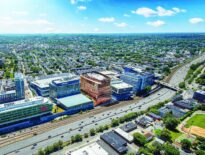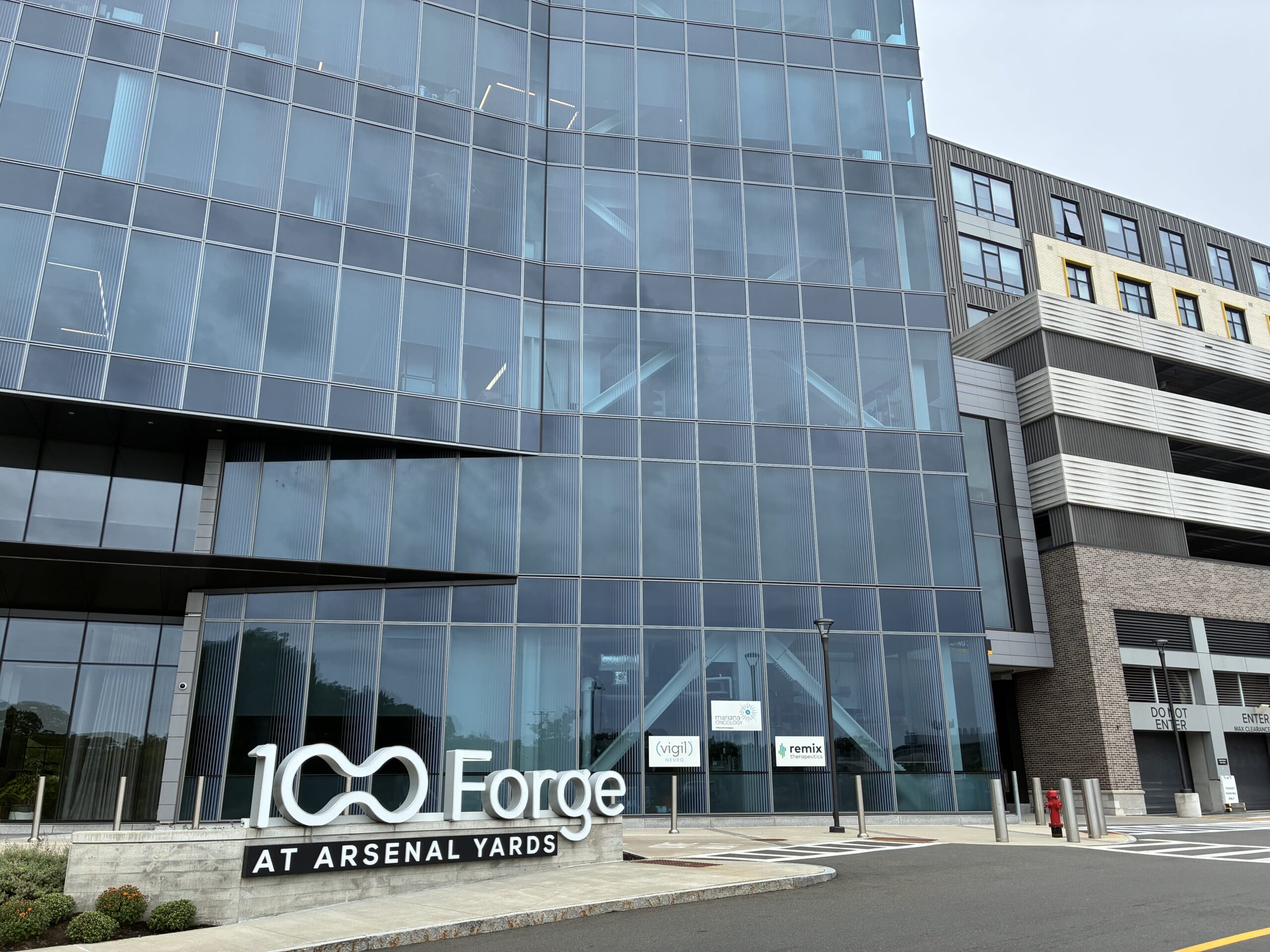
Boylston Properties’ 165,600 square-foot 100 Forge lab building at Arsenal Yards was completed in 2022 as part of the early stages of Watertown’s life science construction boom. Photo by Steve Adams | Banker & Tradesman Staff
Watertown’s battered and bruised life science market appears to be on the mend.
No one is prepared to say that Greater Boston’s third-largest lab market is in full recovery mode after years of rising vacancy rates, falling rents and cautious investment.
But recent leasing activity suggests the Watertown submarket, with about 3 million square feet of life science space, is at least stabilizing and perhaps entering some sort of recovery stage.
Thanks to leases at Boylston Properties’ Arsenal Yard, Davis Company’s 66 Galen St. and other key locations, Watertown’s vacancy rate has recently dropped from about 43 percent to 31 percent, according to JLL’s latest data.
That’s still higher than the second-quarter regional life science vacancy rate of about 28.7 percent. But Watertown’s vacancy rate is lower than many other suburban submarkets and better even than the Seaport District in Boston, the second largest submarket in Greater Boston, according to industry data.
“There’s momentum in Watertown,” said Mark Fallon, director of research and strategy at Hunneman Real Estate. “I like the trend. But the Watertown market is still impaired. It’s a big ship that still needs to [fully] turn around.”
Cluster Draws Medium-Sized Tenants
Others agree: Watertown, with its close proximity to Cambridge and Boston, is slowly starting to attract a somewhat impressive array of medium-sized tenants, often in the 20,000 to 40,000-square-foot range.
“The market feels like it’s improving,” said Mark Deschenes, president of Boylston Properties. “I don’t see a lot more companies coming around. But I do see better companies.”
By better companies, Deschenses means better funded and more mature life science firms, among other attributes.
Those better firms include ALS Therapeutics and Triveni Bio, both of which recently signed leases – 33,000 square feet and 19,500 square feet, respectively – at Boylston Properties’ massive, 430,000-square-foot Arsenal Yards property along the Charles River.
With those and other recent leases, Arsenal Yard’s vacancy rate is now about 20 percent: high by historic industry standards but solid compared to facilities elsewhere in Watertown and across the region.
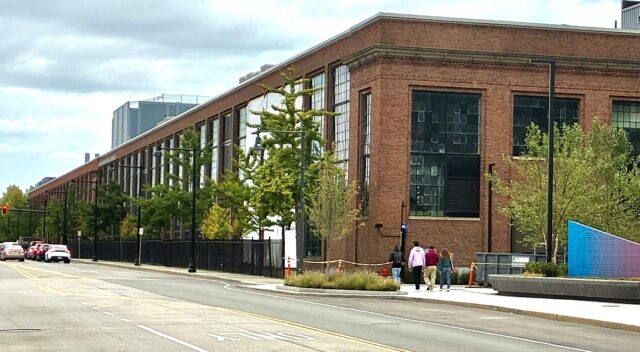
Alexandria Real Estate Equities’ 1.1 million square-foot Arsenal on the Charles campus in Watertown had a 54.7 percent occupancy percentage at midyear, according to the lab developer’s quarterly financial report. Photo by Steve Adams | Banker & Tradesman Staff
Green Shoots Metro-Wide
Watertown’s gradual improvements come as Greater Boston’s overall struggling life science sector also shows signs of encouraging activity.
The welcome news includes a recent 25 percent spike in regional venture capital funding and eight local firms holding IPOs in first half of 2026, matching the combined total from 2024 and 2025.
Although many life science firms continue to shed workers and even close up shop around the region, there was nevertheless about 850,000 square feet of leasing activity in Greater Boston in the second quarter, according to data from commercial brokerage CBRE.
Watertown and other life science submarkets continue to have their share of problems, no doubt.
Hunneman’s Fallon noted many life science buildings in Watertown continue to have large amounts of empty space, including facilities at 250 Arsenal Place, 585 Pleasant St. and 23 Elm St.
“There’s definitely a lot of vacant space still around,” he said. “It’s going to take a while to fill them.”
Yet progress, albeit slowly, is being made.
Midsized Market Generates Momentum
Bob Richards, vice chair at JLL in Boston, said a lot of investment money these days seems to be flowing to medium-sized, later-stage life-science companies – and that’s good from a leasing perspective.
In particular, he said, a leasing “sweet spot” for Watertown seems to be firms looking for spaces in the 20,000 to 35,000 square-foot range.
He pointed out Watertown lease deals such as those by Merida Bioscience (34,000 square feet) at 200 Arsenal and BioLabs (22,000 square feet) at 134 Coolidge Ave.
“The economic vitality of Watertown has pushed it ahead of even Seaport,” said Richards, noting Watertown’s life science vacancy rate is now lower than Seaport’s 36 percent vacancy rate.
Richards said Watertown’s average life science rent prices, now at roughly $66 per square foot, are a competitive plus compared to average rents in Seaport, now hovering around $81 per square foot.
East Cambridge remains the undisputed king of the life science sector in Massachusetts, both in terms of size (14.1 million square feet), demand (19.1 percent vacancy rate) and the higher rents it can fetch ($100 per square foot average asking price, according to CBRE’s second-quarter market report.
Watertown Beats Somerville
Watertown is also performing considerably better than nearby Somerville’s life science market, where the vacancy rate is running around 51 percent, even after TransMedic Group’s lease of 500,000 square feet of space at Assembly Square.
The overall CRE vitality of Watertown is also being helped by non-life science activity, such as Google’s recent move to take 25,000 square feet of space formerly occupied by Werewolf Therapeutics at 200 Talcott Ave., within Alexandria Real Estate Equities’ giant Arsenal on the Charles, next door to Boylston Properties’ Arsenal Yards.
“I like the fact that there’s lab and office leasing complementing each other in Watertown,” said Hunneman’s Fallon.
“Watertown definitely has some momentum,” said Bryan Montgomery, head of research at JLL in Boston. “It’s truly a naturally positive market compared to others. It’s a value proposition to many companies.”
In particular, he noted the 100,000 square feet of leasing activity at The Davis Company’s new 66 Galen St. facility, which opened only in 2024, just as the overall Greater Boston life science market was tanking.
“Watertown is on the mend,” he said. “But we’re still in early recovery mode there.”
Boylston Properties’ Deschenes agreed that Watertown’s life science sector has a way to go before it fully heals – as does the entire Greater Boston life science sector.
“We’re still in the early stages of a recovery,” he said. “Companies are staying smaller longer before they [opt to] expand. But Watertown is very well-positioned as a whole, compared to other areas of Greater Boston.”