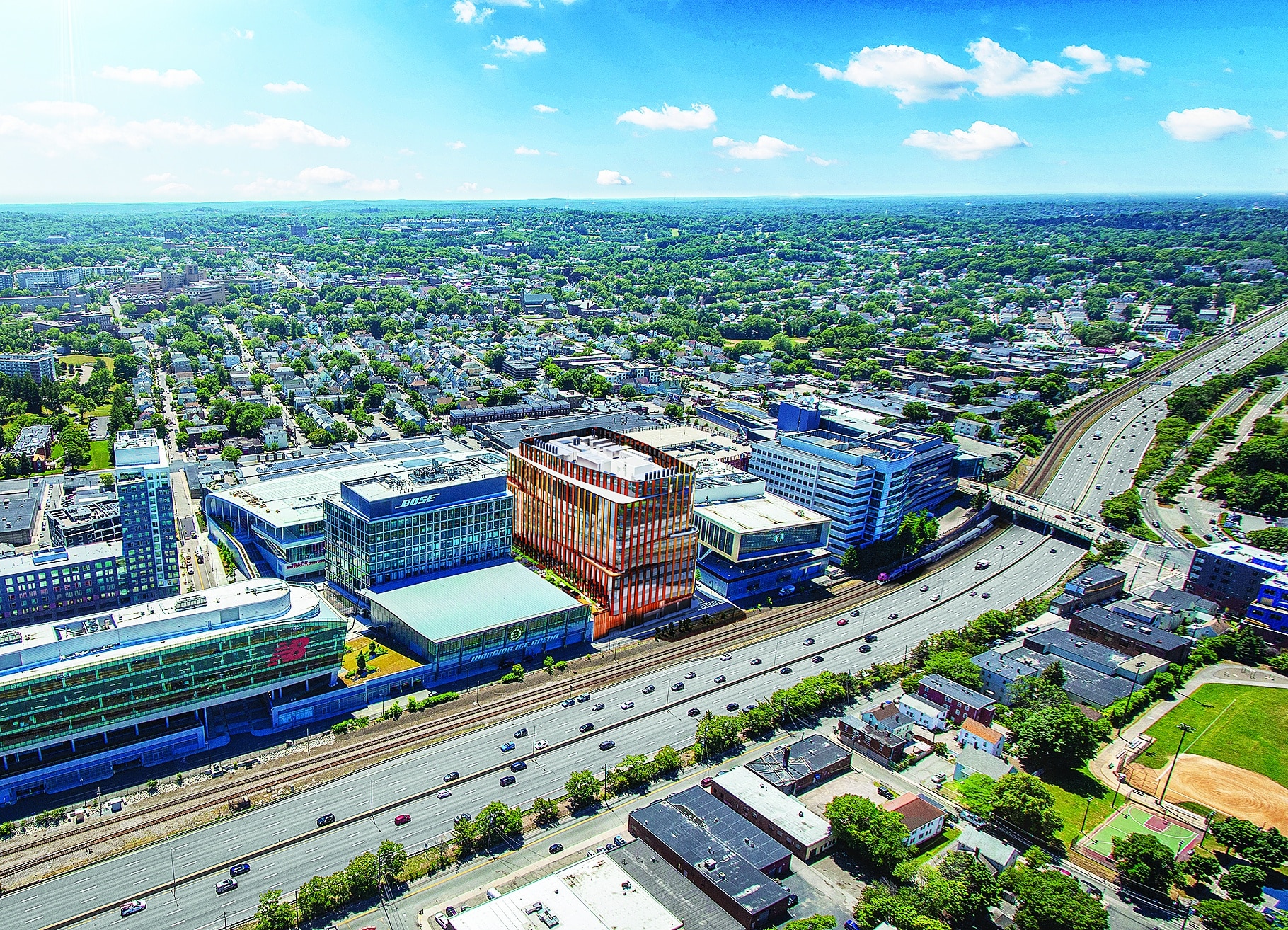
An aerial view of the 350,000 square-foot Forum lab development at Boston Landing in Brighton. Image courtesy of SGA
Three years ago in these pages, I made an argument I knew would not be popular with this readership. Rising lab vacancy, I wrote, was a welcome sight from biotech’s side of the table, because companies overcommitting in a zero-vacancy market could finally right-size and put those dollars toward science. I still believe that. What I did not anticipate was how much harder it would become to start the companies to fill that space.
By most measures, our industry is coming back. MassBio’s 2026 “Industry Snapshot” report found Massachusetts-headquartered companies raised $3.45 billion in venture capital in the first half, marking a 25 percent increase and the strongest opening half since 2023. Eight Massachusetts companies went public, representing nearly two-thirds of all U.S. biotech IPOs.
But the money was concentrated. The top 10 deals took 46.5 percent of every venture dollar raised here, leaving 89 other funded companies to split the rest.
More companies are getting started here, but each one on less: Seed deals rose from 15 to 21 while the average round fell to $4.65 million from $7.65 million, a fourth straight year of decline. Federal research grants to our hospitals and universities fell 6.2 percent in number. Biopharma employment contracted for the first time in more than two decades.
The leases signed this year were set in motion by seed rounds raised three and four years ago. The seed rounds happening now are the tenant demand of 2030, and those are shrinking. How much of the 63.2 million square feet of lab and manufacturing real estate inventory in this state remains empty at the end of the decade is being decided right now.
A Failure to Offer Flexibility
We are not asking you to cut rents. We are asking you to structure deals a young company can sign. I say that knowing your lenders underwrite on term length and tenant credit, and that a 12-person company is a hard signature.
Our members continue to raise the same things with us. Shorter initial terms with expansion rights. Smaller suites built out and ready to occupy. Tenant improvement packages sized to a company’s real runway. Security deposit and letter of credit requirements scaled to stage. And smaller line items that move more easily than rent, starting with what you charge for parking.
Declining to think creatively about terms is part of the problem. The health of this industry is your business model, and that makes real estate part of the solution. Where you find room in the short term, you are buying the long-term stability of the ecosystem that fills these buildings.
If a direct lease truly cannot flex, then partner with operators who run shared, managed lab space and can carry the infrastructure a startup cannot buy on its own. That work is already at scale in Greater Boston. A Watertown operator signed for 57,000 square feet last year, among the largest leases in the state.

Kendalle Burlin O’Connell
The version we need most is managed-graduation space: larger suites for the company that has outgrown an incubator but cannot yet sign a 10-year direct lease. That is the moment we lose companies to other markets.
MassBio Ready to Help
No one is asking real estate to carry this alone.
Our board has approved putting MassBio’s own reserves toward early-stage non-dilutive funding support. State government has stayed at the table with a renewed 10-year Life Sciences Initiative. Last month I made the same case in the Boston Globe, with two Third Rock Ventures partners, to our own side of the ecosystem. Large pharma, venture funds and angel investors need to start betting again on risky science.
Real estate has reaped the benefits of this industry’s growth for decades. We are asking you to take some creative risk with us now, so we come out of this stronger and still in the lead amid global competition.
Come alongside us, and we will meet you there. MassBio and the 1,700 companies we represent are ready to work with any developer willing to try something different. China’s drug pipeline grew 36.2 percent last year, and closer to home, we have watched promising founders launch in other states. A company that starts somewhere else takes the next 20 years of its growth with it.
The lab space is already here. Let’s make sure the companies are too.
Kendalle Burlin O’Connell is the chief executive officer and president of MassBio.