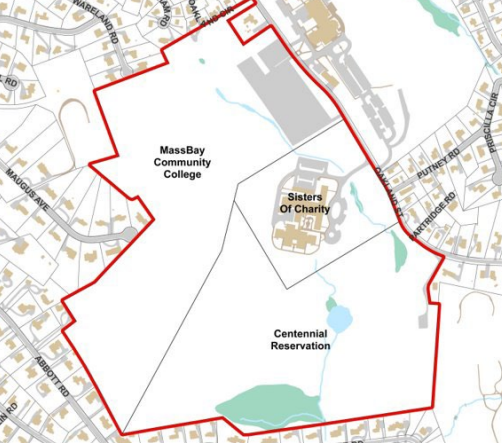
A map of the wooded parcels the state has promised to put conservation restrictions on if housing gets built on a 5-acre parking lot (grey rectangle, upper center). Image courtesy Wellesley Advisory Committee
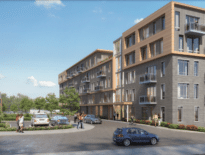
Wellesley officials are equipped with an additional $900,000 for potential legal action on a proposed 180-unit housing development on land that abuts the town’s Centennial Reservation.
A special town meeting voted to instruct the Select Board to hold off on an immediate lawsuit Monday night, however, and first negotiate with state officials on the future of the MassBay Community College property at 40 Oakland St.
The proposed development, part of the Healey administration’s State Land for Homes initiative, has prompted an opposition campaign by two resident groups.
The town meeting authorized $900,000 for legal services beyond nearly $500,000 previously approved, for a potential court challenge if talks break down.
The 240-meeting town meeting and residents debated for more than two hours Monday night before the vote, in which 118 town meeting members voted in favor of the so-called “Option B,”
The non-binding question instructs the Select Board to consider 11 issues related to the project in discussions with state officials, including that the “number of units be reduced to the greatest degree possible.”
A majority of the town’s Advisory Committee supported additional discussions with the Healey administration before filing legal action, Chair Madison Riley said.
Some opponents have argued that the MassBay parcel qualifies for protection under Article 97 of the Massachusetts Constitution, which protects conservation land from development. They have cited a 1986 letter from the community college leadership vowing to preserve the property as open space.
“The Advisory Committee sees litigation as expensive, disruptive and unpredictable,” Riley said. “One member noted that the state routinely defends and wins cases like this.”
Other residents argued that litigation would give the town more leverage to extract concessions, such as a reduction in the number of housing units.
“There is no mitigation and there will be none without the threat of a lawsuit,” said Larry Shind, a board member of the Friends of Centennial.
Healey has prioritized housing production in the state’s surplus land disposition strategy, spotlighting underutilized state properties as an opportunity to help meet the administration’s 2025 goal of encouraging construction of 222,000 new homes by 2035.
In an April 10 letter to Wellesley officials, Secretary of Housing and Livable Communities Juana Matias and Division of Capital Asset Management and Maintenance Commissioner Adam Baacke said the development would be concentrated “on and around” the parking lot and enable the rest of the MassBay property to be placed in permanent conservation restrictions.
Opponents have raised questions about potential impacts on the neighboring town-owned Centennial Park and wooded sections of the 45-acre MassBay property behind the student parking lot, and the project’s demands on town infrastructure.