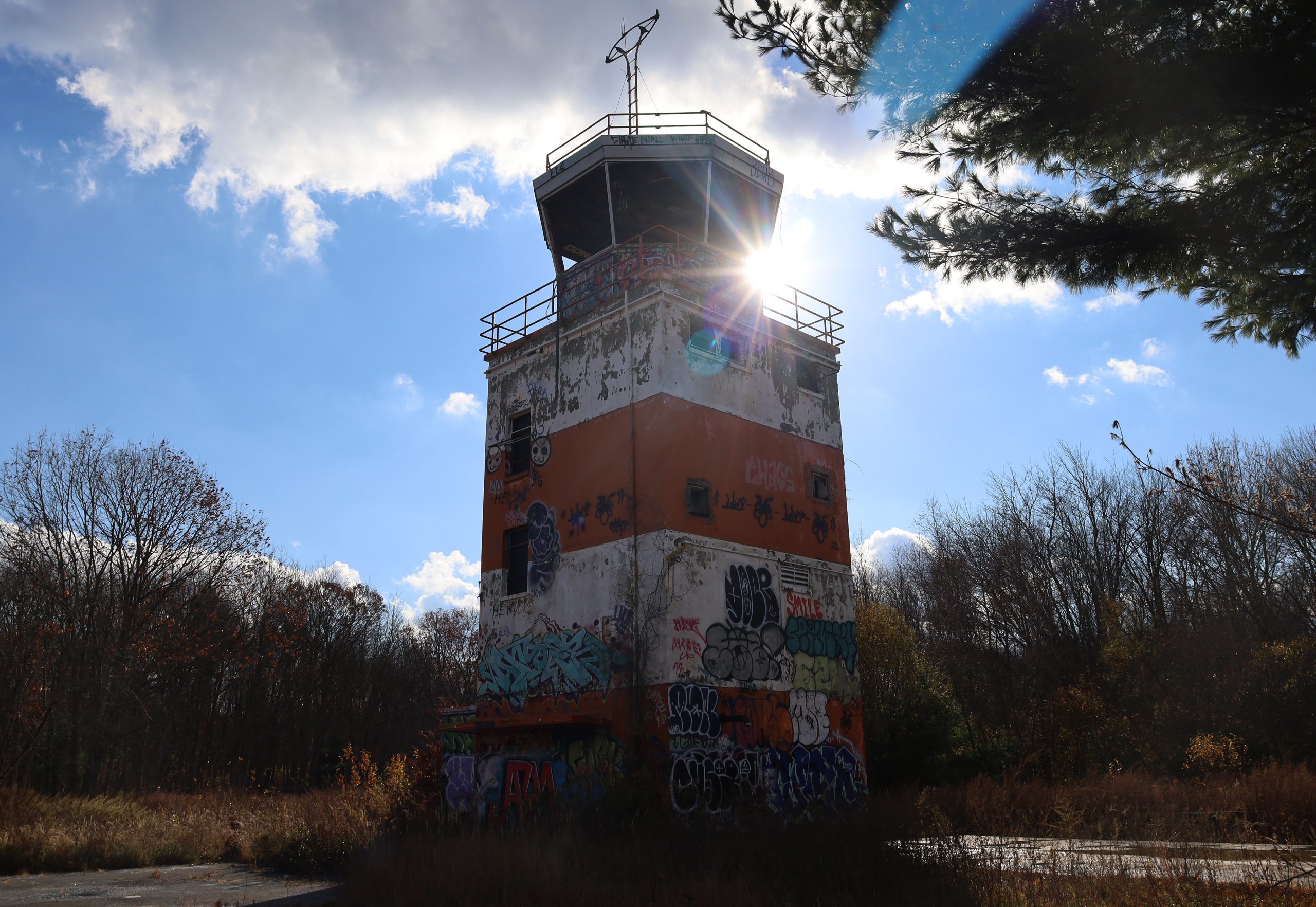
A graffiti-covered building at the closed South Weymouth Naval Air Station. Photo by Maria Pemberton | CommonWealth Beacon / CC BY-ND 4.0
A decades-in-the-making project to transform a mostly vacant former military base south of Boston into a buzzy mixed-use development is poised for a major step forward with an assist from Beacon Hill.
The spending bill now on Gov. Maura Healey’s desk includes language critical to the overhaul of the former Naval Air Station South Weymouth, which supporters say could unlock thousands of units of new housing plus plenty of space for commercial activity on a site that has been mostly idle for nearly 30 years.
Sen. Patrick O’Connor, a Weymouth Republican whose district includes the property, called the proposal that cleared the Legislature “the last step” necessary to allow development to resume after a series of delays.
“We feel confident that this is going to be the last time that we’ll have to go to the Legislature and the last time we’re going to have to act on this,” O’Connor told CommonWealth Beacon in an interview before the final vote. “We really have a very reputable development team that the community has bought into, and we just want them to have the runway to start getting to work.”
The 1,400-acre site, which also reaches into neighboring Rockland and Abington, was first commissioned in 1942. During World War II, it served as the home base for a blimp patrol squadron and assisted with recovering test torpedoes for the US Navy.
After the war, the base went through several transformations. It stored naval aircraft, offered flight training, and hosted what a town history called a “secretive research and development outfit.” The facility closed in 1997.

The empty, graffiti-covered runway at the former South Weymouth Naval Air Station. Photo by Maria Pemberton | CommonWealth Beacon / CC BY-ND 4.0
Efforts to redevelop the property, which offers ample space for housing just 15 miles south of Boston with access to the MBTA’s commuter rail network, have gone through a series of stops and starts over the past 15 years with several different developers and changes in ownership.
A proposal to build a megamall was shot down. An earlier attempt at extensive mixed-use development under developer LNR collapsed during the 2008 Great Recession. In 2013, Connecticut-based Starwood Property Trust purchased LNR, and in the following years, another company called LStar bought the site, then ran into financial trouble and sold off parcels of the land to different owners.
At that point, O’Connor said, the project “looked like a really complicated puzzle” with “five different landowners” who each had separate interests.
“I’ve been working on this project for almost 20 years, and every time that we get momentum, something crazy happens, like the financial crisis of 2008,” said O’Connor, who also served on the Weymouth Town Council before joining the Legislature.
The outlook has improved over the past half-decade. Global investment firm Brookfield Properties became the master developer in 2020, responsible for managing the overall vision of the project, and a series of agreements have once again tied the parcels together.
But project leaders say Beacon Hill needs to get involved because the state law that created the Southfield Redevelopment Authority to oversee the project is still based on prior zoning and planning that predates the most recent changes.
O’Connor said the language tacked onto the Legislature’s fiscal year 2025 closeout budget would formally “combine all those properties” and bring the project into alignment with the most recent zoning plan approved by the three towns.
Some construction has taken place, erecting about 1,000 housing units on one corner of the parcel, but locals expect that a full project could provide up to 6,000 units and millions of square feet of commercial space.
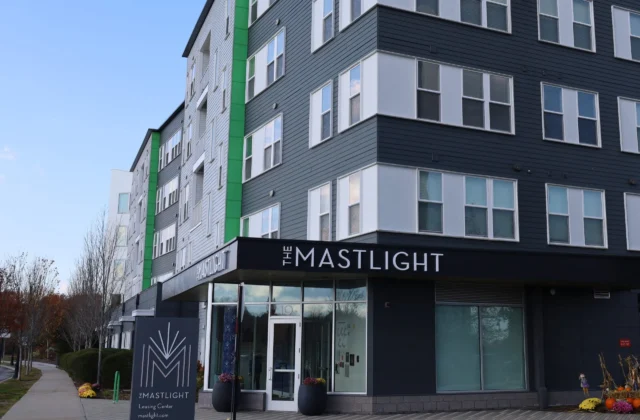
The Mastlight apartment complex, located next to the former South Weymouth Naval Air Station. Photo by Maria Pemberton | CommonWealth Beacon / CC BY-ND 4.0
O’Connor said New England Development, a Boston-based real estate development firm plans to lead the on-the-ground work with financing from Brookfield.
It’s been a personal project for House Speaker Ron Mariano of Quincy, whose district includes the base.
“The language included in the supplemental budget is a meaningful step towards realizing the decades-long goal of revitalizing a community through the development of thousands of new units of housing, and through the creation of commercial and recreational space, that will benefit the residents of Weymouth, Abington and Rockland,” Mariano said in a statement to CommonWealth Beacon. “As a lack of housing continues to drive folks out of Massachusetts, this project is a blueprint for how the Commonwealth can address the housing crisis head on and bolster economic development at the same time.”
Although O’Connor is optimistic the bill will achieve development liftoff, there’s still one more major to-do looming on the horizon: access to water.
One of the chief issues impacting plans over the year has been the lack of a permanent water source to the site. There’s enough water availability right now to start the project, according to O’Connor, but in the long term, he expects the only viable solution is to add Weymouth and potentially its neighbors to the Massachusetts Water Resources Authority network.
Last year, the House sought to provide $1 billion toward expansion of the MWRA – which provides sewers but not water to Weymouth – as part of a housing bond bill, but the measure did not survive negotiations with the Senate.
In August, the Healey administration awarded a $32 million infrastructure grant to Weymouth to cover costs of water, sewer, and roads at the base. The funding got rave reviews from locals, with Weymouth Council President Michael Molisse calling it a “major milestone.”
Healey dubbed the proposed redevelopment “game-changing” in a press release
O’Connor said the state grant will allow both the town and the base to get “ready for the potential expansion of the MWRA.” But he stressed that more action will be needed down the line.
“At some point in this development, it will stall if the MWRA is not brought in there, because there is no other permanent water source,” O’Connor said. “We’ve explored almost every single option, and really, there’s nothing outside of MWRA that would be feasible at that site.”
This article first appeared on CommonWealth Beacon and is republished here under a Creative Commons Attribution-NoDerivatives 4.0 International License.