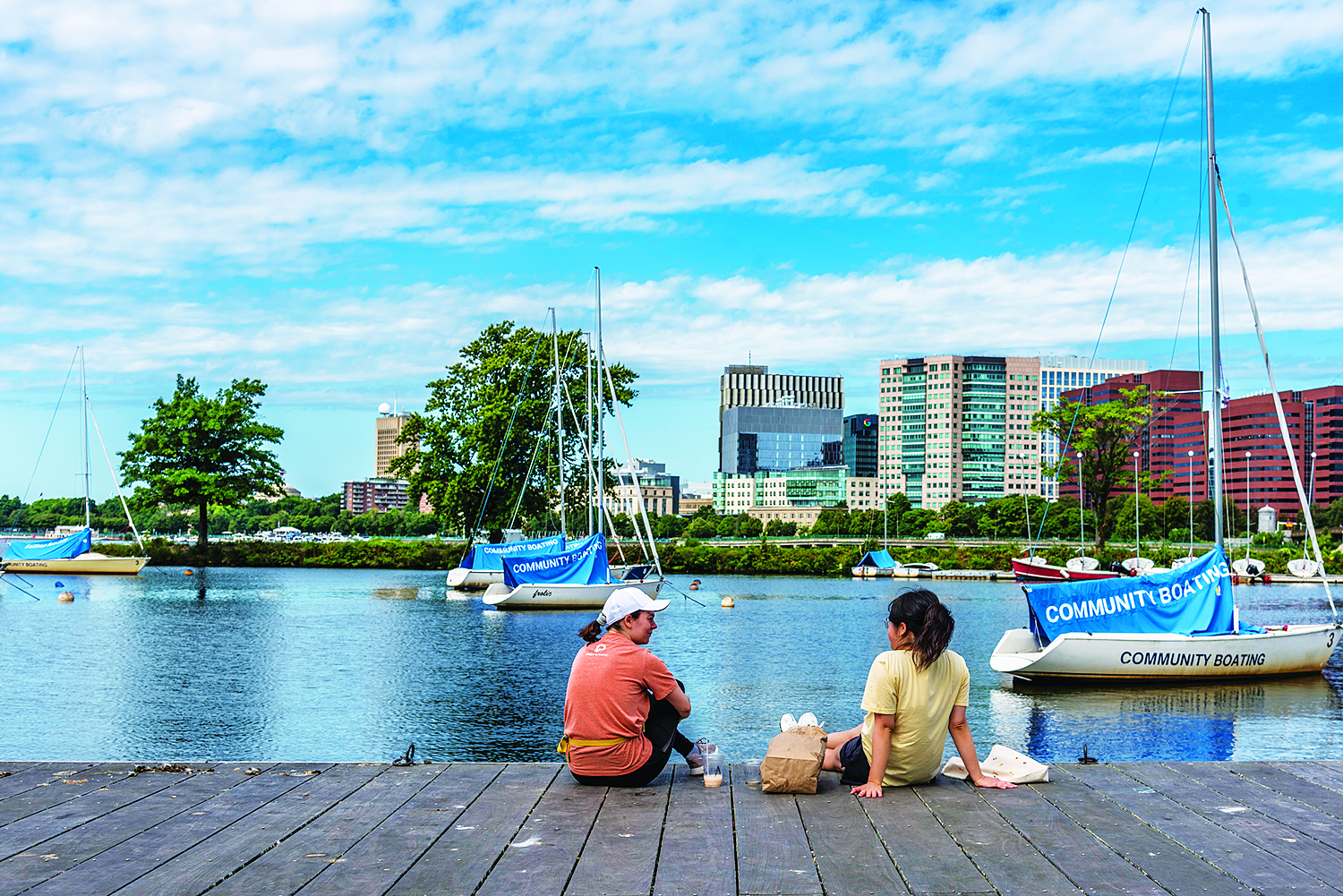
Two people sit on a dock along a Charles River lagoon in Boston in September 2024. The state agency responsible for Boston-area sewers is battling with advocates who say it’s past time to fully keep sewage out of the Charles and Mystic rivers. Stock photo
Amazingly, after more than three decades, we are just now approaching the final act of the multibillion-dollar Boston Harbor cleanup.
The Massachusetts Water Resources Authority was set to file a proposal last week with federal regulators that would ideally put an end to the semiregular overflows of sewage and storm water into local rivers like the Charles and the Mystic every time there’s heavy rain.
But the MWRA does not appear to have learned all that much from its success in cleaning up Boston Harbor, which paved the way for the redevelopment of the Seaport, long an industrial backwater adjacent to what was then one of the nation’s dirtiest bodies of water.
Instead, the authority has been pushing a plan that would potentially decrease the so-called combined sewer overflows, or CSOs, that still plague the Charles and Mystic, but which would stop short of eliminating them altogether.
Calls to ‘Finish the Job’
Launched in the late 1980s following a federal court order, the Boston Harbor cleanup always envisioned eventually tackling these CSOs, that have long plagued the Charles and Mystic, both of which flow into the harbor, notes Paul Levy, who oversaw the cleanup as head of the MWRA from 1987 to 1992.
Now president of the board of the Charles River Watershed Association, Levy would like nothing better than to see his old agency finish the job.
“I’m hoping the MWRA will make the commitment to completing the job so many hope for – swimmable and fishable rivers – which would be a tremendous asset to the region,” Levy said.
However, Levy and other environmental advocates face a tough battle to eliminate, once and for all, the combined sewer overflows that regularly befoul the Charles and the Mystic.
Following a public backlash over project costs last year, the MWRA backtracked, having initially picked the least expensive of four plans to deal with the issue. The authority’s first proposal would have simply further limited sewage and stormwater overflows into the Charles and Mystic, instead of eliminating them.
“We have come this far, why would we stop now and not finish the job?” said Emily Norton, executive director of the Charles River Watershed Association, or CRWA. “People across greater Boston love the Charles River and are disgusted when they learn we are still treating it like a toilet.”
The MWRA is now moving ahead with a somewhat more expensive and extensive plan, which the authority says will be enough to stop the overflow of sewage and wastewater during a “typical year” decades from now.
But that would still be a far cry from the plan the Charles River Watershed Associations is pushing, which would eliminate CSOs even in storms so severe that they are forecast to hit only every 25 years.
Healey, Wu Offer No Backup
The river advocacy and cleanup groups aren’t getting much support from the MWRA board, which is somewhat surprising given who appoints the board’s members.
After all, two of the state’s most prominent Democrats – Boston Mayor Michelle Wu and Gov. Maura Healey – appointed six of the board’s 11 members.
Yes, this is the same mayor who can’t stop talking about her plans for “urban forests” and her very own Green New Deal, and the same governor whose campaign website touts her “bold action to … protect Massachusetts’ natural resources.”
In a statement, a spokesperson for the state’s Executive Office of Energy and Environmental Affairs claimed “significant progress” by the MWRA and said efforts should focus on “reducing” sewage and stormwater overflows into the Charles, while protecting water quality, public health and affordability.
The upshot? No elimination of these nasty CSOs, just an effort to reduce the amount of sewage and stormwater pouring into the Charles and Mystic during heavy storms.
Wu’s press office did not respond to inquiries about the mayor’s position on the CSO issue.
Why the Problem Even Exists
While the MWRA has steadily modernized the region’s wastewater infrastructure over the years, key points along the Charles and Mystic continue to be serviced by an antique, 19th century system in which sewage and stormwater run through the same beleaguered pipes.
Heavy rain or a downpour is often enough to overload this primitive system and send a torrent of sewage and stormwater pouring into the local rivers through what amounts to old-fashioned relief valves, making it unsafe to boat, let alone swim or fish.
The MWRA says its plan will stop the flow of sewage and rainwater into the Charles and the Mystic in a typical year by 2050, which is somewhat deceptive given that years of heavier rainfall are likely to be far more common in the decades to come amid rising temperatures.
The state authority has already spent more than $900 million to slash combined sewer overflow volumes into local rivers by 90 percent over the last three decades. Of the remaining overflows, 94 percent of the sewage is treated before being released, an MWRA spokesperson said.
“Our commitment to addressing them is unwavering and we continue to share the goal of improving water quality in the waterbodies, understanding that CSOs are one of many contributors to water quality,” the spokesperson said in a statement.
Penny-Wise, Pound-Foolish?
But it’s also an ultimate case of a penny-wise, pound-foolish approach, Levy and the Charles River Watershed Association contend.
The MWRA initially pushed environmental regulators to downgrade the water quality standard for the Charles to class B (CSO), which would have freed the state authority of the legal obligation to work towards eliminating overflows of sewage and stormwater.
After pushback, the authority shifted gears and picked a somewhat more expensive, $1 billion plan – in 2050 dollars – that still falls short of effectively eliminating the flow of sewage and storm runoff, critics contend.

Scott Van Voorhis
The MWRA’s new plan would, by 2050, raise the average home’s sewer bill by $43 to $2,380 per year.
But Levy and the Charles and Mystic watershed groups want the MWRA to go the distance with a more expensive, $3 billion plan that would finally end the dumping of sewage into the Charles and Mystic, protecting the rivers even in a 25-year storm.
That plan, which would all but eliminate CSOs on the Charles and Mystic, would cost the average household an additional $82 a year – again, in 2050 dollars – compared to the option now preferred by the MWRA. Overall, the average annual MWRA sewer bill would rise to $2,462 by 2050, according to authority financial documents.
In today’s dollars, making overflows of sewage into the Charles and Mystic a thing of the past would cost just $46 more per year than the MWRA’s less-than-seal-tight CSO plan.
To accomplish this would require a major public works project, building an underground tunnel to handle surges of stormwater and sewage when heavy rains hit.
Yes, it’s more expensive. But more than three decades after the Boston Harbor cleanup, it’s finally time to stop dumping our literal crap into the Charles and other local rivers.
Scott Van Voorhis is Banker & Tradesman’s columnist and publisher of the Contrarian Boston newsletter; opinions expressed are his own. He may be reached at sbvanvoorhis@hotmail.com.