iStock photo
World Cup matches and 250th Anniversary events expected to bring millions of visitors to Massachusetts next summer are prompting officials to revisit regulations and potentially close loopholes turning residences into mini-hotels.
In Boston, some city councilors have suggested the city amend its 2018 short-term rental ordinance. The regulations emerged following a legal challenge from online bookings leader Airbnb, but short-term rentals continue to attract complaints from neighbors and the local hotel industry.
Critics, including neighborhood associations and some councilors, say the current ordinance is riddled with loopholes and has few meaningful deterrents. The maximum penalty is $300.
“One of the big challenges is we are dealing with people who are acting in bad faith, Airbnb being the most notorious,” said Martyn Roetter, a board member of the Neighborhood Association of Back Bay. “The phenomenon has gotten out of control in some areas.”
A union that represents 12,000 hospitality workers called for changes to the ordinance to curb abuse.
“Certain corporate actors are abusing exemptions in the Boston short-term rental ordinance, such as the `hospital stay’ exemption,” UNITE HERE Local 26 President Carlos Aramayo said in an email. “This exemption was meant for families who are in need of medical treatment, not tourists. This exemption takes a significant amount of housing off the market.”
Targeting Abuse of Hospital Stay Exemption
Some city councilors are asking for a new look at existing exemptions for corporate rentals and hospital stays, saying they are abused by Airbnb hosts.
In East Boston’s Eagle Hill, a Newton-based landlord has operated an Airbnb despite the city’s requirement that short-term rentals are the property owner’s primary residence, District 1 Councilor Gabriela Coletta Zapata said. In the North End, a Duxbury landlord rented out an apartment to tourists after claiming the property would only be used for hospital stays, she said.
“Platforms routinely ignore city orders to remove illegal listings. Fines are capped at $300 per incident, which is barely a slap on the wrist,” Coletta Zapata said during an October hearing on the issue. “Loopholes like extended stay and hospital stay are being weaponized to evade the law.”
In a statement provided to Banker & Tradesman, Airbnb New England Public Policy Manager Britte McBridge defended the hospital stay exemption.
“We hope the city will not make hosting medical stays harder. Thousands of patients and their families use Airbnb during medical treatment at Boston’s world-class hospitals and healthcare facilities. Access to flexible, more affordable accommodations makes that experience less stressful for guests, and our hosts take pride in being able to support their guests during those times,,” McBride said.
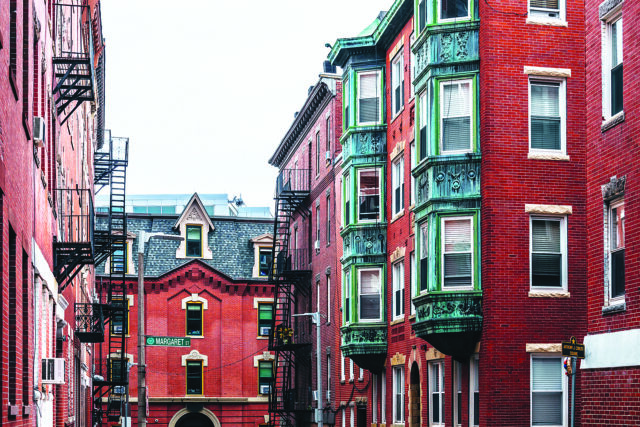
Sheafe Street in Boston’s North End in July 2024. Neighborhood associations and some Boston elected officials say the current short-term rental ordinance is flawed and lacks effective enforcement mechanisms. iStock photo
Airbnb Lawsuit Shaped Final Ordinance
Boston enacted the short-term rental ordinance in 2018, but Airbnb filed suit in federal court to block its implementation.
The final version still in effect restricts short-term rentals – defined as fewer than 28 days – to properties that are the host’s primary residence. Homeowners can rent bedrooms within their residence – known as home share units – or owner-adjacent units, such as an entire apartment within a two- or three-family building.
It exempts properties offered for hospital stays, requiring documentation from a health care facility or non-profit organization. Corporate rentals, defined as units offered for a minimum 10 days, also are exempt.
But violations can be difficult to confirm and enforce, according to city officials. Under the current ordinance, property owners have 23 days to register with the city or face removal from Airbnb following the receipt of a complaint, ISD Assistant Director Regina Hanson said at the hearing.
Hanson said she is the only ISD employee specifically dedicated to enforcing the ordinance full-time, in addition to an inspector two days a week and “small staff support.”
ISD Commissioner Tanya Del Rio confirmed that the department hasn’t had a hearing officer to hear appeals of violations for four years, but is in the process of hiring two people to fill the role.

Steve Adams
A ‘Monstrously Baroque’ Enforcement Process
The 2018 settlement with Airbnb limited many of the city’s options to meaningfully punish violators, said Ford Cavillari, chairman of the Association of Downtown Civic Organizations.
“A lot of it is rooted in the ordinance,” he said. “There’s no clear enforcement. If you leave your trash out on the wrong day, you get a ticket and it’s really simple. This ends up being a monstrously baroque process.”
The percentage of Airbnb listings in Boston that are registered with the city remains in the low 20 percent range, according to research compiled by ADCO and Inspectional Services Department data.
As of mid-year, an all-time high of 1,090 short-term rentals are registered with the city, according to a report by the Mayor’s Office of Housing. When the law took effect in 2019, there were 807 listings.
The largest category is hospital stays, which comprise 27 percent of 2025 registrations. Nearly two-thirds of registrations are in one- to three-family homes.
Registrations are clustered most heavily in the downtown, Dorchester and Jamaica Plain neighborhoods.
Median monthly revenue from short-term rentals of entire homes in 2024 was $2,796, the report determined, compared with $3,351 for a typical long-term rental.
At the hearing, District 8 Councilor Sharon Durkan acknowledged the legal risks of changing the ordinance, but suggested removal of the corporate and hospital exemptions.
“We have not been challenged in court over the current ordinance, but we will be forced to open up the ordinance if Airbnb doesn’t get in line,” Durkan said.