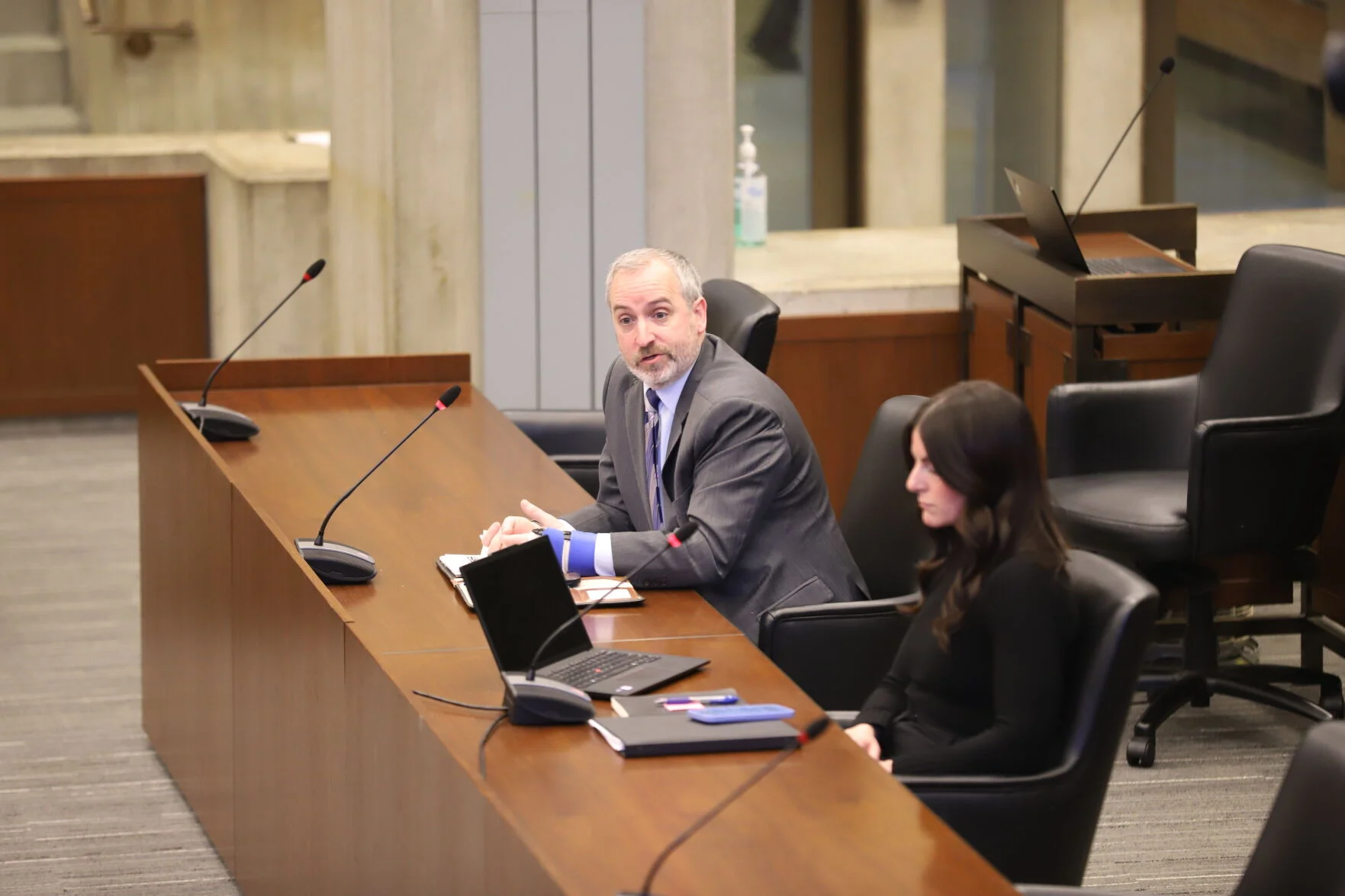
Commissioner of Assessing for the city of Boston Nicholas Ariniello (left) and the city's Chief Financial Officer Ashley Groffenberger (right) testify at a City Council Ways and Means hearing on Dec. 8, 2025 at City Hall. Photo by Ella Adams | State House News Service
The solutions are viewed as either a Band-Aid or desperately needed residential relief, but it’s clear that property taxes in the city of Boston are again a focus of City Hall and State House debate.
According to Boston seniors, labor unions and city councilors, the blame for projected residential property tax increases lies within the state Senate, which has taken no action on a Boston Mayor Michelle Wu proposal to temporarily shift some of Boston’s residential property tax burden onto commercial property owners.
“Why are they not being brought to the floor for us to know where they stand?” Massachusetts Senior Action Council’s Adonika Chaplin, a retired Boston police officer, said Monday at City Hall about tax relief proposals before the Legislature. “We elected them to act on our behalf, not on their behalf. One day, they will be where we are. We are struggling to make ends meet at the grocery store, at the prescription lines.”
Wu last week urged business leaders and the Boston City Council to support her proposal in the face of projected 13 percent average property tax increases for Boston homeowners. The council and House of Representatives passed two different versions of Wu’s proposal last year, but it died both times in the Senate and continues to face scrutiny from business and real estate groups.
The House referred Wu’s proposal (HD 4422) to the Committee on Revenue in March. The Senate has not sent the bill to any committee and until there is a referral, the bill can’t get a number or have a public hearing.
Wu Critic: Tax Issues ‘Likely Structural’
According to Boston Policy Institute figures, the total value of commercial property in Boston dropped $2.3 billion in fiscal 2026, compared to a $1.9 billion drop in fiscal 2025.
“This was always a short-term solution to what the administration said was a short-term problem last year. But what these numbers show us is that this is not a short-term problem. This is not smoothing out. This is very likely a structural thing,” Boston Policy Institute (BPI) Executive Director Gregory Maynard told the News Service.
Wu’s estimates project that overall residential property values will increase by 2 percent and overall commercial values will decrease by 6 percent when adjusted for new growth. Her proposal would not increase commercial property taxes, but reduce the extent that they decrease.
“I don’t think it can be understated – the fact that commercial values fell more this year than last year is very bad, and indicates that what is happening is different than what happened in the Great Recession or under Menino, and that Boston needs to take a different approach to it,” said Maynard, a prominent critic of the mayor’s. “This is the kind of thing that happened to the city before the office building boom this century. The tax shift is a Band-Aid, and it seems like the patient might need surgery.”
After rescinding their support last December for a “compromise” version of Wu’s proposal, business and real estate groups are still skeptical of the measure. They argue the shift would place additional burden on an already-struggling commercial sector, and have suggested that the state address targeted tax relief through standalone bills, or that the city determine how to diversify its revenue sources.
Beacon Hill and Back Bay City Councilor Sharon Durkan on Monday called Wu’s proposal “the only available lever to prevent extreme residential tax hikes.”
“I’ve heard from commercial real estate owners that they do not care what happens here, that this is like – this is a media fight. I heard from commercial owners that this is the cost of doing business, this change and this temporary shift. They would be able to absorb this. The seniors and the young families I’m talking to in my district cannot absorb this,” Durkan said.
Downtown Plan Criticized
City Council President Ruthzee Louijeune said on Monday that lawmakers haven’t touched other standalone tax relief proposals at the State House.
“Even if there have been alternatives offered, there have been no hearings on those alternatives. There’s been no work to actually provide relief to our residents, other than push back on what has generally been seen as a compromise bill,” Louijeune said at the City Hall press conference.
But Boston’s commercial property is the most valuable across the entire state, Maynard said.
“The push and pull over the increase in taxes on these downtown office owners is that the health of the Seaport and Financial District and Back Bay is not just a Boston issue, the way that, like, Watertown’s downtown is a Watertown issue. It is a statewide issue with statewide implications. And the fact that the administration has offered really no plan for downtown revitalization, I think, is a big issue here,” Maynard said.
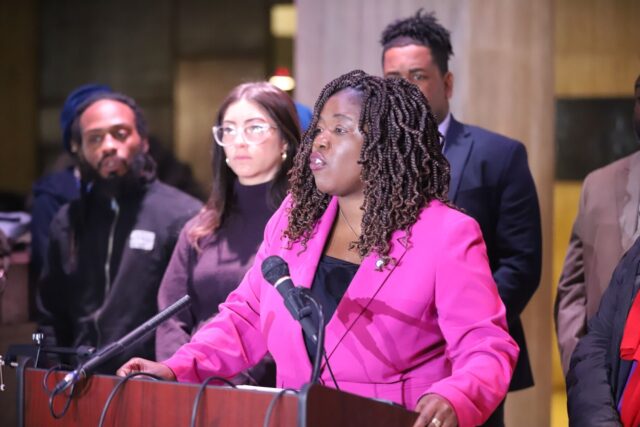
Boston City Council President Ruthzee Louijeune speaks at a press conference at Boston City Hall on Dec. 8, 2025. Photo by Ella Adams | State House News Service
Concern for Statewide Implications
Boston has never sought a Proposition 2 ½ override, Groffenberger noted, and the city is not suggesting it move in that direction. She added that the Massachusetts Municipal Association is having “preliminary discussions” about potential Proposition 2 ½ reforms, but the city isn’t working on anything related.
Sen. William Brownsberger, a major opponent of Boston’s home rule petition, has expressed his concerns that the measure could “upend a tax limitation that has been in place for the better part of 50 years and result in tax changes all across the state.”
Small Property Owners Association of Massachusetts Vice President Amir Shahsavari called moves to potentially overturn Proposition 2 1/2 “troubling and dangerous.”
“If there are no checks and balances or limits placed on how much taxes can increase, a lot of the hardworking middle class business owners will get squeezed, And that squeeze will spread to ordinary citizens, as well, in the form of the same problem that existed in the past, where Massachusetts was known as ‘Taxachusetts,’” Shahsavari told the News Service.
Static Tax Rate Would Mean $232M Budget Cut
He said Boston should look at its spending, among other actions. The city issued guidance to its departments last week for the upcoming fiscal year to reduce their budgets by 2 percent below the existing year’s appropriation.
Asked whether the city could cut its budget to offset residential tax increases, Groffenberger said that would force the city to cut millions of dollars from its budget.
“If you were to attempt to keep the residential tax rate the same for next year, the same as what it currently is, that would require a reduction in the overall tax levy and a budget cut of about $232 million,” Groffenberger said. “To mirror for FY26 the same impact on the residential tax rate as a 180 percent shift, that would be a reduction of the levy of $116 million. So, I know it seems relatively small in the context of a $4.8 billion budget, but so much of our budget is non-discretionary costs.”
The city is living within its levy limit, but trying to reallocate the balance of that limit through the home rule petition, Groffenberger explained.