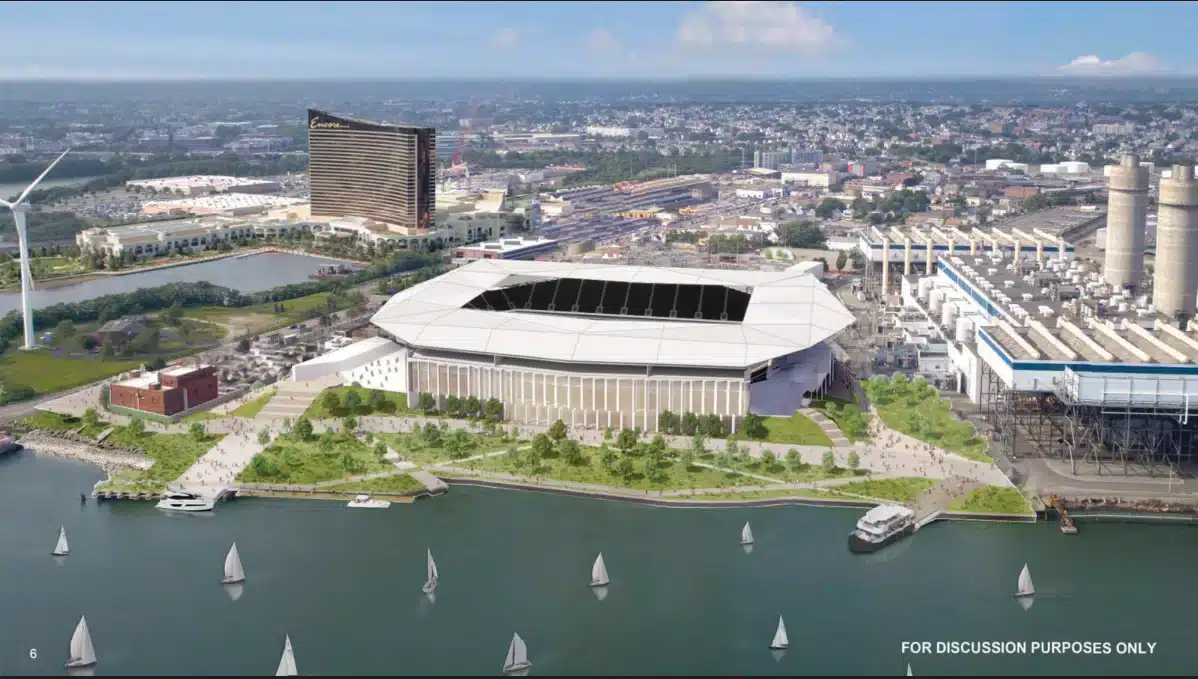
A rendering provided by The Kraft Group shows a potential new stadium in Everett for the New England Revolution proposed for the site of a decommissioned power plant on the Everett waterfront. Image courtesy of The Kraft Group
A soccer stadium proposed for the Everett waterfront vaulted one of the biggest obstacles to becoming reality with just hours to spare Wednesday afternoon.
Boston Mayor Michelle Wu’s office announced a $48 million community benefits agreement with the Kraft Group, which is trying to build the stadium to provide a home for its New England Revolution men’s professional soccer team.
Negotiations between the two sides had been stalled for months, and faced a legally-mandated midnight Dec. 31 deadline to work out a community benefits agreement – the stadium would sit a stone’s throw from congested Sullivan Square, in Boston’s Charlestown neighborhood – before the agreement would be sent to arbitration.
The deal announced Wednesday afternoon puts the Kraft Group on the hook for $13 million in direct payments to the city covering infrastructure and community benefits in Charlestown, plus a cut of each ticket sold in perpetuity. The latter provision is expected to hit $34 million over the 25,000-seat stadium’s first 15 years in operation, Wu’s office said.
While the stadium still needs to go through local permitting and state environmental review, the agreement opens the door to a second huge real estate project for Everett’s Lower Broadway corridor, following the Encore Boston Harbor casino. The stadium is expected to spur even more development in the area, alongside the Davis Companies’ multi-million-square-foot Everett Docklands development planned for a former petrochemical tank farm nearby.
Boston Deal Pays for Sullivan Square Upgrades
The money will help pay for $5 million worth of unspecified “substantial” infrastructure investments in the notorious Sullivan Square intersection including “roadways, sidewalks, bike paths, intersections and transit facilities” in the area and along Lower Broadway in Everett. The stadium will also have to submit an annual traffic and parking management plan to the city, to prevent stadium traffic from cutting through Sullivan Square and pay for event-day Boston Police Department deployments.
“The City fought for a fair deal for Boston and our residents, and that is what we have achieved through this agreement,” Wu said in a statement. “After months of negotiations, we have secured commitments addressing the needs of Charlestown residents and feedback from community partners. This stadium will enhance Boston’s position as the sports and entertainment capital of New England while transforming a blighted site on our doorstep.
To curb the stadium’s traffic impacts, Wu’s office had sought Kraft Group help to pay for mass transit upgrades in the area. However, the only transit infrastructure the Kraft group committed to in the deal was a ferry dock at the stadium and a Bluebikes bike rental valet service for event days.
While Everett and MBTA officials are working on bus rapid transit infrastructure connecting the city with the MBTA Orange Line station in Sullivan Square, an MBTA analysis found that a Silver Line extension in the area would only carry around 390 passengers per hour.
No concrete proposals have emerged for a commuter rail station in the area on the MBTA’s Newburyport-Rockport Line to serve the stadium, although state and local officials have worked with owners of the Encore casino to design and finance a bike and pedestrian bridge connecting the area to the Assembly Row stop on the MBTA’s Orange Line.
Everett Deal Pays for Part of New Bridge
A separate $91.7 million deal inked with outgoing Everett Mayor Carlo DeMaria, also announced Wednesday, includes $17.5 million to add a new entrance to the Assembly Row station and help pay for the pedestrian bridge.
Everett’s deal will also give that city $2.25 from every ticket sold for stadium events and commits the Kraft Group to paying for a public waterfront park at the stadium site. It’s separate from a $100 million commitment the Kraft Group already made to clean up environmental contamination at the site, DeMaria’s office said.
“I have always known that the residents of Everett deserve more than the inequitable burden of smokestacks and contaminated former industrial land that we have been asked to bear for too long. My vision for Everett has been for our city to have a vibrant waterfront with access for our residents, new clean industries that bring our residents construction and long-term job opportunities, improved public transit options, and new revenue sources to support city services,” DeMaria said in a statement, adding that the changes were things “many people never thought would be possible in our city. I am grateful and proud to have had the opportunity to bring these benefits to my hometown that I have been privileged to lead for the past 18 years.”
The Boston deal also ensures the stadium’s land will be elevated above predicted 2070 flood levels, to seal off a potential coastal flooding path, and will force the Kraft Group to submit stadium plans to the Boston Planning Department “to ensure compliance with this agreement,” Wu’s office said.
“At its core, this is an investment in Everett and its future. In addition, it provides improved access and an enhanced neighborhood experience by removing a physical and visual barrier for the residents of Charlestown and we appreciate Mayor Michelle Wu and her team’s partnership,” the Kraft Group said in a statement released by the New England Revolution. “Under the agreements, we will undertake significant environmental remediation and demolition of the long‑vacant powerplant, invest in extensive traffic and transportation improvements, and deliver substantial community benefits, including millions of dollars towards infrastructure improvements. The project will open the waterfront with the creation of a new public park, strengthen pedestrian and bicycle connectivity, and enhance access to public transit.”