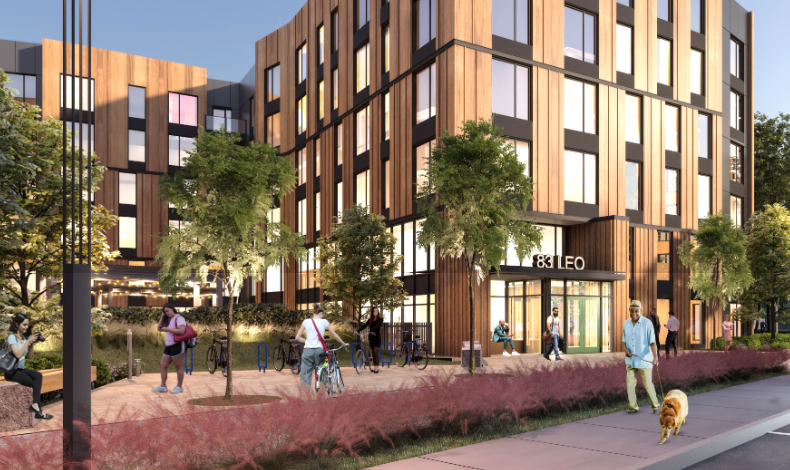
A 333-unit Nordblom Company apartment complex at 83 Leo Birmingham Parkway in Brighton is one of four large projects that could receive tax abatements to help begin construction. Image courtesy of Stantec
A new targeted tax abatement program designed to revive stalled private housing developments could put shovels in the ground for 1,400 apartments in Allston-Brighton and Charlestown.
At the same time, the Wu administration’s announcement of its latest initiative underscored frustration in real estate and housing circles that Boston is falling behind in housing production strategy.
Both for-profit developers and progressive YIMBY groups fret that Boston is missing opportunities to spur housing production. High affordability requirements, expensive green building regulations and slow progress on rezoning continue to make Boston an unattractive place to build, they say.
In some cases, the region’s notoriously hard-to-build-in suburbs are providing better opportunities for multifamily development than New England’s largest city.
“Our suburban communities, at least on paper, have higher density to allow multifamily housing near transit than the city of Boston does near subway or light rail lines,” said Jesse Kanson-Benanav, executive director of Abundant Housing MA.
State Actions Loosen Suburban Rules
Recent state laws such as the MBTA Communities Act and legalization of backyard accessory dwelling units have loosened restrictions on housing construction in the suburbs, Kanson-Benanav noted. Boston is exempt from Chapter 40A, the state Zoning Act, and long has operated under its own unique zoning rules for a variety of historical reasons.
That leaves it up to mayoral administrations and staff at the Boston Planning & Development Agency – now largely the Boston Planning Department – to drive zoning reform.
Kanson-Benanav pointed to more ambitious plans in New York City, where Mayor Zohran Mamdani is seeking to rezone large sections of the North Bronx and Brooklyn along transit corridors for higher-density development. Closer to home, the city of Cambridge eliminated its remaining single-family districts in 2025. The theory behind both moves: cut project costs and risks by reducing long, often contentious approval processes, thereby unlocking more housing.
By contrast, Boston Mayor Michelle Wu has rejected suggestions that Boston encourage housing development through citywide rezoning. The administration’s own upzoning program, Squares + Streets, has rezoned only a portion of one neighborhood since it launched in 2023: Roslindale Square, which encompassed properties surrounding the MBTA commuter rail station.
The Boston Planning Department released a draft plan for Hyde Park’s Clearey Square area in June, but the plan’s zoning changes have yet to appear on the BPDA board or Zoning Commission’s meeting agendas.
“What gives me pause is this very neighborhood-by-neighborhood approach. That results in really elevating the voices of those who are opposed to new housing,” Kanson-Benanav said.
Call for Income-Restriction Rollbacks
Other communities have been debating reductions in the minimum percentage of income-restricted units in multifamily developments, reflecting the steep downturn in new construction since 2022.
With interest rates and inflation beyond local officials’ control, changes to the inclusionary zoning policies are becoming viewed as a way to help developers complete their financing packages.
In June, the Chelsea City Council voted to exempt projects with less than 10 units from inclusionary zoning. Waltham’s City Council scaled back the city’s 2020 inclusionary zoning ordinance in August, with officials citing its minimum 20 percent affordable component as making projects infeasible. No affordable units were built under the 2020 ordinance; the updated version requires 10 to 15 percent income-restricted units, depending upon the size of the project.
Another city with notoriously high housing prices embraced the supply-side argument that building more housing is necessary, even at the expense of income-restricted units. In July, San Francisco’s Board of Supervisors reduced the affordable minimum percentage from 15 to 5 percent, and exempted projects with fewer than 24 units entirely.
Boston still requires a 20 percent income-restricted component in all developments with seven or more housing units – 17 percent subsidized housing and 3 percent of units set aside for tenants with housing vouchers, which come with their own costs.
“We went to the city and said, ‘Would you at least go back to [former Boston Mayor] Marty Walsh’s 13 percent?’ and the mayor was unwilling to consider it,” said one local developer active in Boston and suburban markets, who asked to speak anonymously because they have active projects in Boston. “Everything is really hard in Boston. We love Boston, but all you can build is luxury condos. With the discussions about rent control, everybody just ran away.”

Boston Mayor Michelle Wu speaks to the Greater Boston Chamber of Commerce Sept. 16. Some developers and housing advocacy groups say Boston is falling behind similar big cities and Massachusetts suburbs alike in failing to promote policies that encourage multifamily development. Photo by Sam Drysdale | State House News Service
Wu, Shen Defend Priorities
Wu and Chief of Planning Kairos Shen this week defended their approach, as the city announced proposed tax abatements with developers of four stalled projects.
Subject to assessors’ approval of Chapter 121A tax agreements, the $33 million proposal applies to Fulcrum Global Investors’ 1 Mystic Ave. project in Charlestown, which is approved for 408 units in a 16-story tower, Hines’ 318-unit 22-24 Pratt St. in Allston, Nordblom Company’s 333-unit 83 Leo Birmingham Parkway in Brighton and the 341-unit building D at Allston Yards.
Approximately a dozen other stalled projects approved for at least 100 units apiece are in play for future tax abatements, Shen said in a press briefing Sept. 14. Such projects could yield a total of approximately 4,000 newly constructed units.
City officials were particularly concerned with a collapse in groundbreakings for projects of this size, Sheila Dillon, chief of the Mayor’s Office of Housing, told reporters in the same briefing. Up to $100 million worth of tax abatements could eventually be made available to unstick these larger projects, Dillon and Shen said.
The administration rejected targeted tax abatements in 2024, hoping that interest rates would ease and making projects able to pencil, Wu said at a Greater Boston Chamber of Commerce forum Sept. 16.
“We are now seeing that interest rates are not normally where they are,” Wu said. “We’re going to go up even higher potentially: geopolitical conflicts causing oil prices to spike, construction costs, the general uncertainty, tariffs, all of that. So, we are in a very different position now.”

Steve Adams
But Wu and Shen separately said the administration is taking the long view in holding the line on a 20 percent income-restricted component in most new projects. Such requirements ensure that units are income-restricted in perpetuity.
The administration also has been in talks with union pension funds about contributing gap financing to get stalled developments started, Wu said.
“The situation is usually so dire that no single thing, even IDP alone, would be able to get a project over the line anyway,” Wu told business leaders.
Tamara Small, CEO of the commercial developers’ group CREDA Massachusetts, came away from the chamber event unpersuaded by Wu’s comments. Small suggested Boston lower the IDP minimum to 5 percent on a trial basis.
“Inclusionary [zoning] is the thing we hear over and over from developers as being a significant barrier to market rate housing development in Boston,” Small said in an email. “This is why housing development is happening in Revere, Everett, Chelsea, etc., but not in Boston. If every investor and developer who would like to build in Boston, but can’t, is saying that this is a problem, why is that being ignored?”