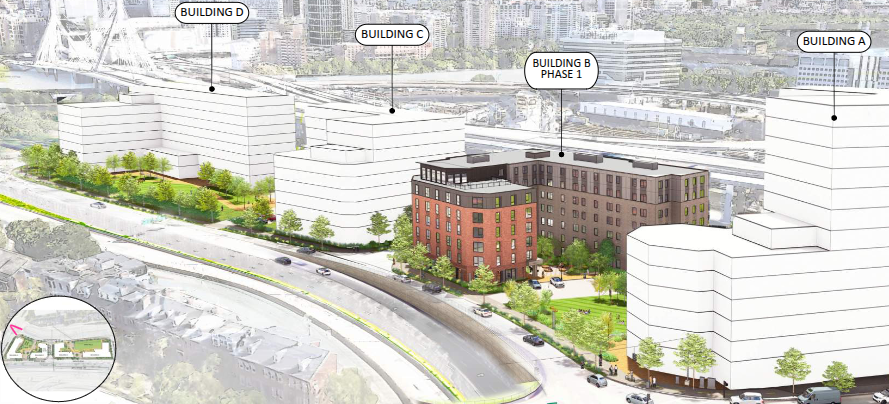
Image courtesy of Icon Architecture
Boston Sand & Gravel is headed to court to challenge the centerpiece of Mayor Michelle Wu’s program turning surplus city-owned real estate into housing developments.
The company is suing Trinity Financial, a Boston-based developer selected by the Boston Planning & Development Agency to build up to 705 apartments near Bunker Hill Community College in Charlestown.
In a lawsuit filed in Suffolk Superior Court, Boston Sand & Gravel seeks an injunction blocking construction of the housing until it’s modified to “prevent the inevitable injuries and deaths” caused by pedestrians and bicyclists crossing an access road into its 9-acre property.
The Charlestown property, consisting of parking lots used by Bunker Hill Community College and known as the “Austin Street Lots,” was the highest-impact site identified during a Wu administration inventory of underused municipal properties, with the goal of selling or leasing them to private developers for housing creation.
The Boston Planning and Development Agency awarded the development rights for the Austin Street property to Trinity Financial following a request for proposals. The agency planned to lease the property to the developer.
In October 2025, the BPDA approved the 790,000 square-foot project. The first phase of the project would be a 7-story, 126,000 square-foot building containing 123 income-restricted units.
“After two years of public meetings, and numerous face-to-face meetings with Boston Sand and Gravel, it is unfortunate that Boston Sand and Gravel has decided to initiate litigation in an apparent attempt to delay this important project for the city of Boston and for those who are in need of the affordable housing it will provide,” Trinity Financial Senior Vice President Abby Goldenfarb said in a statement.
In the lawsuit, Boston Sand & Gravel states that it received permanent access rights from Massachusetts Highway through a 1996 settlement after it sued the state for effects that the Big Dig would have on its operations. The settlement gave Boston Sand & Gravel permanent access for its trucks to travel on an access road connecting its property, attorneys Stephen Brake and Mariel T. Smith of Nutter wrote in the complaint.
The project’s Building B, which would be located next to the maintenance road, will create a situation “where hundreds of pedestrians and bikers will have unlimited access to cross the maintenance road, creating an inevitable situation of repeated accidents involving the conflicting uses of BSG trucks,” the complaint states.
In a recent interview with Banker & Tradesman, Trinity Financial Project Manager James Keefe said the company “decided to move forward with this [first phase] because it’s the most urgently needed. It delivered the highest public benefit, as these key infrastructural improvements that are helpful for unlocking the later phases of the project.” Trinity had hoped to begin construction in early 2027.
In a statement, Boston Sand & Gravel said it “consistently raised concerns” about the design of the project during the permitting process.
“Our trucks and operations are not inherently dangerous, but a development that intermingles pedestrians, bicyclists and passenger vehicles with the passage of these trucks via our access rights, creates an unnecessary and elevated risk,” the company stated, adding that it remains open to working with Trinity Financial on design changes.
Editor’s note: This report has been updated with statements from Trinity Financial and Boston Sand & Gravel..