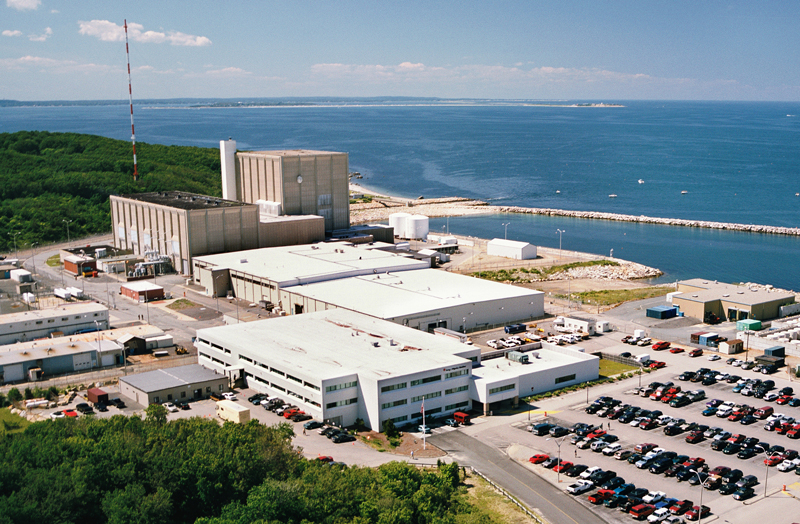
South Shore business leaders argue the decommissioned Pilgrim Nuclear Power Station in Plymouth has the potential to be reborn as a hub for enough zero-carbon energy to power 700,000 homes. Photo courtesy of Holtec
As electric bills soar, Tim Cahill, the former state treasurer turned regional business leader, believes nuclear energy could be poised for an unlikely comeback in power-starved Massachusetts.
In fact, the president and CEO of the South Shore Chamber of Commerce sees the potential for the old Pilgrim nuclear plant site in Plymouth to become home to a new generation of smaller, highly advanced nuclear reactors.
That is, if anti-nuclear activists, the mainstream media, and the state Senate don’t snuff it out first.
On Sept. 16, Sukesh Aghara, a UMass Lowell professor who heads the university’s nuclear engineering program, will speak to members of the South Shore and Plymouth Area chambers of commerce about the latest advances in the field and what the future might hold for Massachusetts.
Cahill, who also ran for governor in 2010, told me he believes that technological advances and the development of SMRs – small modular reactors – could be a “game-changer.”
Two of these smaller reactors, some of which are capable of recycling uranium from other power plants and which produce much less waste due to their small size, could replicate the massive output of the old Pilgrim plant, powering roughly 700,000 homes with carbon-free electricity.
There could mean not only hundreds of new jobs and tens of millions of dollars in tax revenues for Plymouth, but benefits for the entire South Shore as well.
Nuclear Momentum Stalls on Beacon Hill
Adding a big new source of reliable, carbon-free power to the electric grid can only help moderate the upward pressure on rates, ease reliability concerns, and make the South Shore a more attractive place for businesses to expand and relocate to, Cahill contends.
“Our goal is to educate people as to what is real about nuclear power – the pros and the cons, as opposed to just the cons,” Cahill said.
But after a promising start, momentum for a nuclear revival has stalled out at the State House.
The state House of Representatives passed a Healey administration proposal to nix a 1980s-era law that requires any new nuclear plant to pass a statewide referendum, but the state Senate has voted against it.
House and Senate negotiators are hammering out their differences over a major energy bill, so the proposal to nix the referendum could still make it into the final version amid all the horse trading between the two chambers.
However, Holtec International is in the middle of the years-long decommissioning process at Pilgrim, having shut the plant down in 2019.
Holtec is also busy resurrecting the Palisades nuclear power plant in Michigan and building two SMRs at the site, showing what could be done here, too. Combined, the small modular reactors are expected to generate enough power to roughly equal the output of the old Pilgrim plant.
Lingering Public Fear
The Senate is not the only obstacle, with the mainstream media having spent decades amplifying the fear-based propaganda and distorted claims of the anti-nuclear activists.
Stories rarely measure claims of potential harm and doomsday scenarios by activists against scientific facts and statistical probabilities.
“A lot of people don’t realize that it’s clean energy,” Cahill said. “We have all been brought up to believe that nuclear is bad and dangerous and too risky – we were all watching ‘Chernobyl’ and remembering Three Mile Island.”
The former, a reactor meltdown in then-Soviet Ukraine in 1986 caused by a flawed reactor design never used in the U.S., was made into a popular HBO miniseries in 2019.
The latter, a partial meltdown in rural Pennsylvania in 1979, came just 12 days after a popular but overwrought thriller about a nuclear accident, “The China Syndrome,” hit theaters. The backlash halted the nuclear industry’s growth.

The federal Nuclear Regulatory Commission certified small modular reactor builder NuScale Power’s designs under the Biden administration in 2023. Image courtesy of NuScale Power
Local Press No Friend to Nuclear Power
Today, local press coverage of Pilgrim and the lengthy decommissioning process rarely, if ever, mentions that it led to a significant rise in carbon emissions, or the hit Plymouth took when the plant closed, taking with it $70 million in tax revenue and hundreds of well-paid jobs.
Typical of the coverage is Mark Pothier’s two-part series in the Plymouth Independent, a nonprofit local news site the former Boston Globe business editor helped launch in 2023.
“Talk of Plymouth hosting a small modular reactor, or SMR, persists like radiation itself,” Pothier wrote, clearly signaling he thinks the whole idea is a crock of you know what.
The comments under a Facebook post on the story in a Plymouth community Facebook group were illuminating.
“Another opinion from anti nuke [sic] Globe staff,” one account wrote in one comment, adding: “Your data is obsolete.”
Not that everything was ever all peaches and cream. Pilgrim had its share of problems, with shutdowns over the years related to deficiencies of a regulatory nature, though federal officials always stressed there was never an imminent threat to public safety.
“The specific issues that drove Pilgrim to Column 4 were of low to moderate safety significance,” a Nuclear Regulatory Commission report said after an intensive series of inspections at Pilgrim, following an unplanned shutdown during a winter storm in 2015.
The current owners, Holtec, had addressed most of these issues by the time the plant closed in 2019.

Scott Van Voorhis
Nuclear Plants Provide High-Paying Jobs
There’s also the thorny issue of what to do with the old nuclear plant’s waste, currently stored on-site in dozens of concrete-and-steel casks. That, though, is not an issue unique to Pilgrim, with the federal government having tried and failed for years to find a repository to ship nuclear waste to.
But while you’ll find no dearth of news stories on dangers real or imagined about what was the Bay State’s only nuclear plant, good luck trying to find any mention of the more than 600 people Pilgrim employed regularly, a number that rose to 900 at its peak.
I’m pretty sure that people in Plymouth and surrounding towns cared about those jobs, and keenly felt their loss when Pilgrim closed in 2019.
The plant also provided work for numerous electricians and other building trades workers, Craig Pinkham, national vice president of the Utility Workers Union of America, AFL-CIO, told me.
But with the closing of Pilgrim and some older power plants as well, the pool of jobs for utility workers has been shrinking.
“They were really, really great jobs – high-paying jobs,” said Pinkham, who was previously president of Local 369 located in Massachusetts. “It’s stressful – the future is unknown for our workers.”
Scott Van Voorhis is Banker & Tradesman’s columnist and publisher of the Contrarian Boston newsletter; opinions expressed are his own. He may be reached at sbvanvoorhis@hotmail.com.