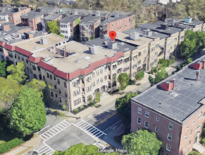
Nestled within the South End neighborhood, Northeastern University’s new athletic facility will serve as a vital part of Boston’s civic community. Image courtesy of Perkins&Will
Construction at the site of Northeastern University’s new $500 million athletic complex has been halted following disturbance of asbestos during demolition work at the Matthews Arena.
Completion of the new 262 St. Botolph St. facility is now scheduled for the first half of 2029.
The nine-month delay means that the school’s men’s and women’s hockey teams will have no home rink for a third season, the independent, student-run Huntington News reported. Previously, completion was scheduled for fall 2028.
The Massachusetts Department of Environmental Protection has been notified about the discovery of asbestos-containing material from the 1910 Matthews Arena and work has been suspended, according to the report. The agency’s public database does not contain any recent documents related to the property, however.
Before work resumes, construction crews will receive safety training and air monitoring equipment will be deployed at the site, Senior Vice President for Finance and Administration Brett Sweet wrote in an email. Suffolk Construction is the general contractor.
Environmental engineers Haley & Aldrich first discovered asbestos and other contaminants in the soil in 2024, according to the email.
The 262 St. Botolph St. arena project was prompted by structural deterioration of the Matthews Arena, along with Northeastern’s goal of upgrading student and athletic program facilities.
Demolition of Matthews Arena began in February. Originally known as the Boston Arena, it hosted Boston Celtics and Bruins games in its early days before the opening of the Boston Garden.
The new arena, designed by Perkins&Will, retains the Matthews Arena’s terracotta arch as a decorative artifact while incorporating modern elements including all-electric building systems.
The new arena will use a ground- and air-source heat pump system connected to 46 geothermal wells. And a 100,000 gallon cistern will collect rainwaiter for ice making.