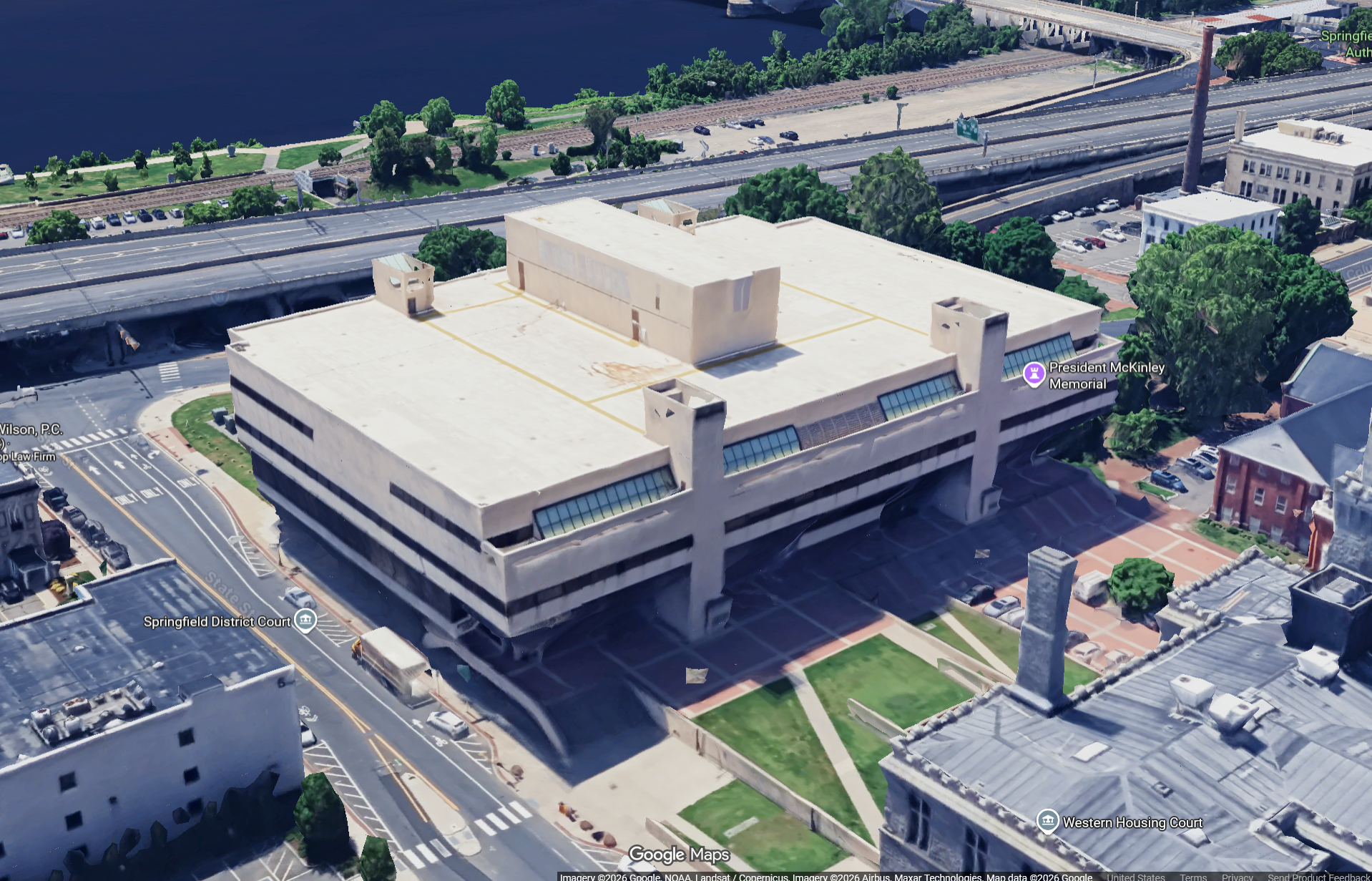
The Roderick L Ireland Courthouse, in downtown Springfield, Massachusetts. Image courtesy of Google Maps
A judge found “no legal or logical support” for allegations of conflict of interest tied to the redevelopment of a Springfield courthouse, and denied an injunction that losing bidders sought to pause the project.
Hampden Superior Court Judge David Hodge ruled that the Massachusetts Division of Capital Asset Management and Maintenance (DCAMM) and Liberty Junction, the developer selected to build the courthouse, can continue their negotiations to move the $2 billion project forward.
The ruling is a direct rejection of the central argument made by the attorneys for losing bidders Jeb Balise and Dinesh Patel at an Aug. 11 hearing: that John Barros’s involvement with the winning development team and his subsequent role as interim executive director of the Massachusetts Convention Center Authority tainted the procurement process. There has also been an outcry from Balise, Patel and members of the public about the involvement of Conan Harris, husband to Congresswoman Ayanna Pressley and co-owner alongside Barros of one of the companies involved in the winning bid.
The court denied the plaintiffs’ request for a temporary restraining order and preliminary injunction, finding that the plaintiffs had no likelihood of success on the merits – what Hodge called the “touchstone of the preliminary injunction inquiry.”
Patel and Balise said in a statement Monday that they plan to appeal the Hampden County Superior Court ruling “declining to pause the state’s leasing process, while continuing their underlying lawsuit challenging the procurement.”
On the conflict-of-interest claim, Hodge said the plaintiffs’ legal theory was “convoluted,” noting that the state conflict-of-interest statute cited by the plaintiffs applies to state employees, while DCAMM “is not a state employee.”
Hodge also went further, finding that the evidence did not establish a violation by Barros.
“The plaintiffs have offered no evidence that Barros ever acted in a manner that would cause a reasonable person to conclude that any person could improperly influence him or unduly enjoy Barros’s favor in his performance of duties as the Interim Executive Director of MCCA,” Hodge wrote.
The judge also rejected the plaintiffs’ argument that Barros’s timing of his required disclosure was significant. Barros, who was part of the Liberty Junction team before becoming the MCCA’s interim director in January, had consulted MCCA and State Ethics Commission counsel before taking the job, according to an affidavit he filed. The court found he filed the required disclosure July 1, the day after the conditional selection of Liberty Junction.
Hodge said there was no evidence Barros contacted DCAMM or the selection committee about the courthouse proposal. He also rejected an argument that Barros could have exercised influence through an overlap between the MCCA and DCAMM boards.
“Without pointing to any evidence, specific communications or transactions, the plaintiffs surmise that there must have been some improper influence involving Barros because one member of MCCA’s board is DCAMM’s secretary, Matthew Gorzkowicz,” Hodge wrote, referring to the secretary for administration and finance.
The judge said if a conflict had existed, the plaintiffs would have to show it substantially influenced the selection.
“The conditional selection of Liberty Junction was based on the assessment of objective factors, primarily the price tag,” Hodge wrote.
Liberty Junction’s proposal was roughly $420 million cheaper than the Patel-Balise proposal.
Although the lack of likelihood of success was enough to resolve the injunction request, Hodge also weighed the potential harm and public interest “out of an abundance of caution and in light of the high stakes at issue.”
He found that the losing bidders had not shown irreparable harm because they could seek monetary damages for lost profits if they ultimately prevailed.
“The plaintiffs have not presented any evidence or persuasive argument that the denial of the preliminary injunction would irreparably harm them. If they were to prevail at trial in this case, they could recover a monetary judgment for the amount of their lost profits,” Hodge wrote.
The judge also found that delaying the courthouse project would harm the public interest, citing an affidavit from Trial Court Administrator Thomas Ambrosino.
The plaintiffs said they intend to appeal the ruling while continuing their underlying lawsuit.
“The people of Springfield deserve a full airing of the facts and circumstances surrounding this procurement, and they deserve a process that is fair, complete, and complies with the law. We remain fully committed to that goal. Our confidence is complete, and our commitment to this community is unwavering, which is why we will continue to pursue every available legal avenue, completely and without hesitation,” Balise and Patel said in a joint statement.
They said that the ruling did not dismiss their lawsuit or resolve its ultimate merits, and said they had begun issuing subpoenas last week seeking documents and testimony concerning the selection process.
The developers also pointed to continuing criticism of the courthouse selection from Springfield and Hampden County officials. They cited an Aug. 13 Springfield City Council subcommittee hearing where developers and councilors questioned the state’s projected savings, tax implications and lease terms, as well as criticism from the Hampden district attorney, register of probate, sheriff, clerk of courts and Springfield mayor.