Image courtesy of The Architectural Team and Ground Inc.
A team of two local developers is seeking approval for a 300,000-square-foot mixed-income housing project that’s been designed with attention to minimizing the urban heat island effect in Roxbury.
Known as Drexel Village, the project would create 217 apartments and condominiums at Nubian Square’s Crescent parcel.
In November, the Archdiocese of Boston’s Planning Office for Urban Affairs and Boston-based J. Garland Enterprises won the designation from the Boston Planning & Development Agency to redevelop the city-owned parcel at the corner of Tremont Street and Melnea Cass Boulevard.
One of the key criteria in the city’s request for proposals was designs that address the heat island effect generated in neighborhoods such as Roxbury with scant tree canopies. Roxbury residents have Boston’s lowest life expectancy at 59 years, and average summer temperatures are 10 degrees higher than less densely-developed neighborhoods such as West Roxbury.
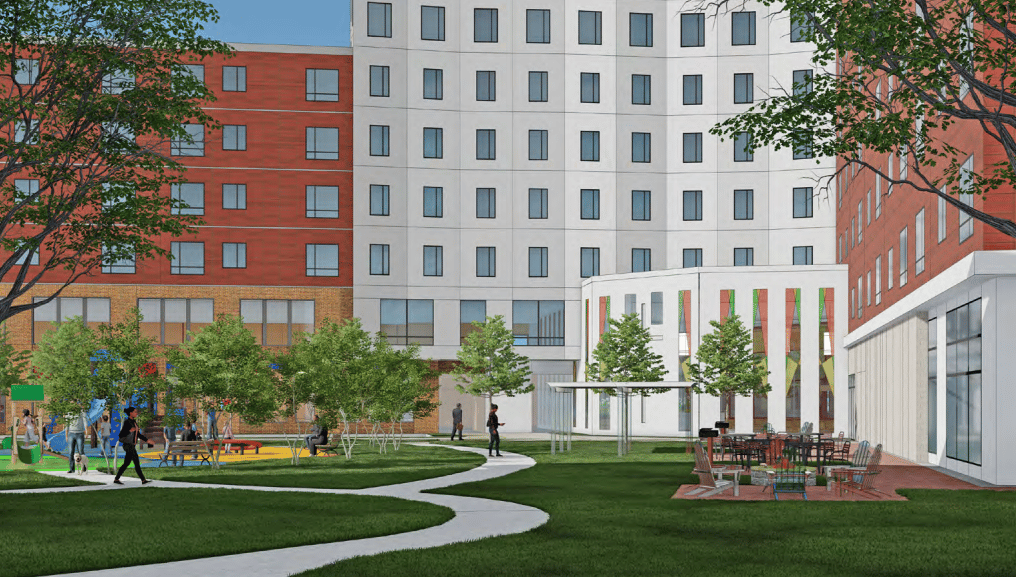
Developers notified the BPDA this month that the final proposal will include three buildings including mixed-income housing, a daycare center and nearly 1.4 acres of open space with public art. A newly-created public art committee will advise the developers before they submit their project notification form to the BPDA and begin the formal review.
The city offered eight publicly-owned parcels totaling 1.6 acres. J. Garland Enterprises and POUA struck an agreement with St. Catherine Drexel Parish to ground-lease its neighboring property on Ruggles Street, giving them more land and flexibility to retain 1.5 acres of open space as part of the project spanning 2.5 acres.
Designs by The Architectural Team of Chelsea would include 10- and 6-story residential buildings with white membrane roofs, reducing heat absorption. A portion of the parish parking lot would be replaced with an underground garage, and a terrace roof garden would generate produce for the parish’s food pantry.
Mayor Michelle Wu has spotlighted a goal of minimizing the heat island effect including expanded reviews of private developments.
In September, Wu announced the creation of an Urban Forest Plan to increase tree canopies in neighborhoods such as Roxbury, Chinatown, East Boston and Allston-Brighton.
The plan recommends that the city review projects that interfere with street tree plantings and require landscaping plans to be reviewed by the Zoning Board of Appeal.