
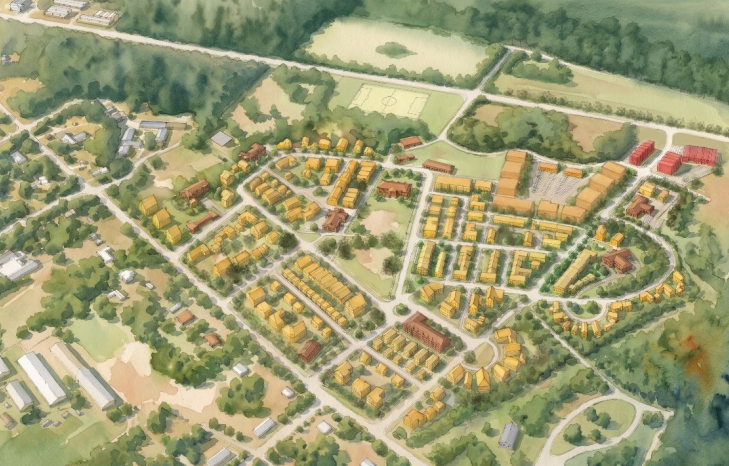
Image courtesy of DCAMM
The Healey administration’s “State Land for Homes” program is seeking developers for a 72-acre Central Massachusetts site with potential to add up to 386 homes.
The state Division of Capital Asset Management and Maintenance characterizes the Lancaster Industrial School for Girls project as a potential fast-track approval, following completion of a conceptual plan for a walkable village-style project.
DCAMM issued a request for proposals on Friday, following a local process led by urban design consultants Speck Dempsey.
The result was a regulating plan that includes single-family homes, townhouses and apartment-style buildings, along with potential neighborhood retail. Up to 64 units could be built in existing buildings, according to the plan.
“The neighborhood has the potential to be one of the most exceptional in all of central Massachusetts, blending Lancaster’s rural charm with the hallmarks of a traditional New England town,” the RFP states.
The school was founded in 1856 as a progressive alternative to incarceration in 1856 and included residential buildings and farming plots. It closed in 1972, and buildings were later used as pre-release facilities by MCI Framingham. Since 2005, the buildings have been occupied by nonprofits and public agencies, including DCAMM’s surplus property unit. The only remaining tenant is the Robert F. Kennedy Community Alliance.
The town of Lancaster selected Speck Dempsey as lead planner for the project. The firm is led by “Walkable City” author Jeff Speck and former Massachusetts Assistant Secretary of Transportation Chris Dempsey.
Site visits are scheduled on Oct. 7 and 22. RFP responses are due Nov. 19.
The selection criteria include a track record of speed to production of new, high-quality housing units and total financial offer.
Gov. Maura Healey announced the new surplus property disposition program prioritizing high-density residential development in 2022. Approximately 700 acres of land are in various stages of disposition. The program requires projects with at least four housing units per acre.
A proposed apartment complex on a parking lot owned by Massachusetts Bay Community College in Wellesley has attracted opposition from local officials and some residents. In July, the Wellesley Select Board filed a lawsuit in Norfolk Superior Court challenging DCAMM’s plans to sell the property to a developer.
DCAMM also plans to restart its efforts to redevelop the Hurley and Lindemann buildings in Boston’s West End, after a planned life science project fell through.
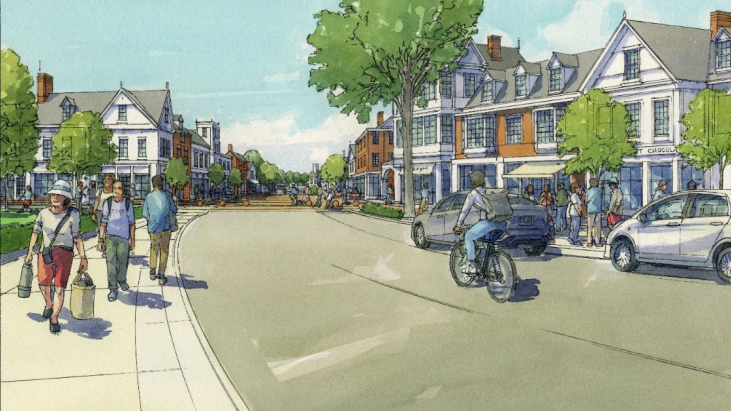
Image courtesy of DCAMM