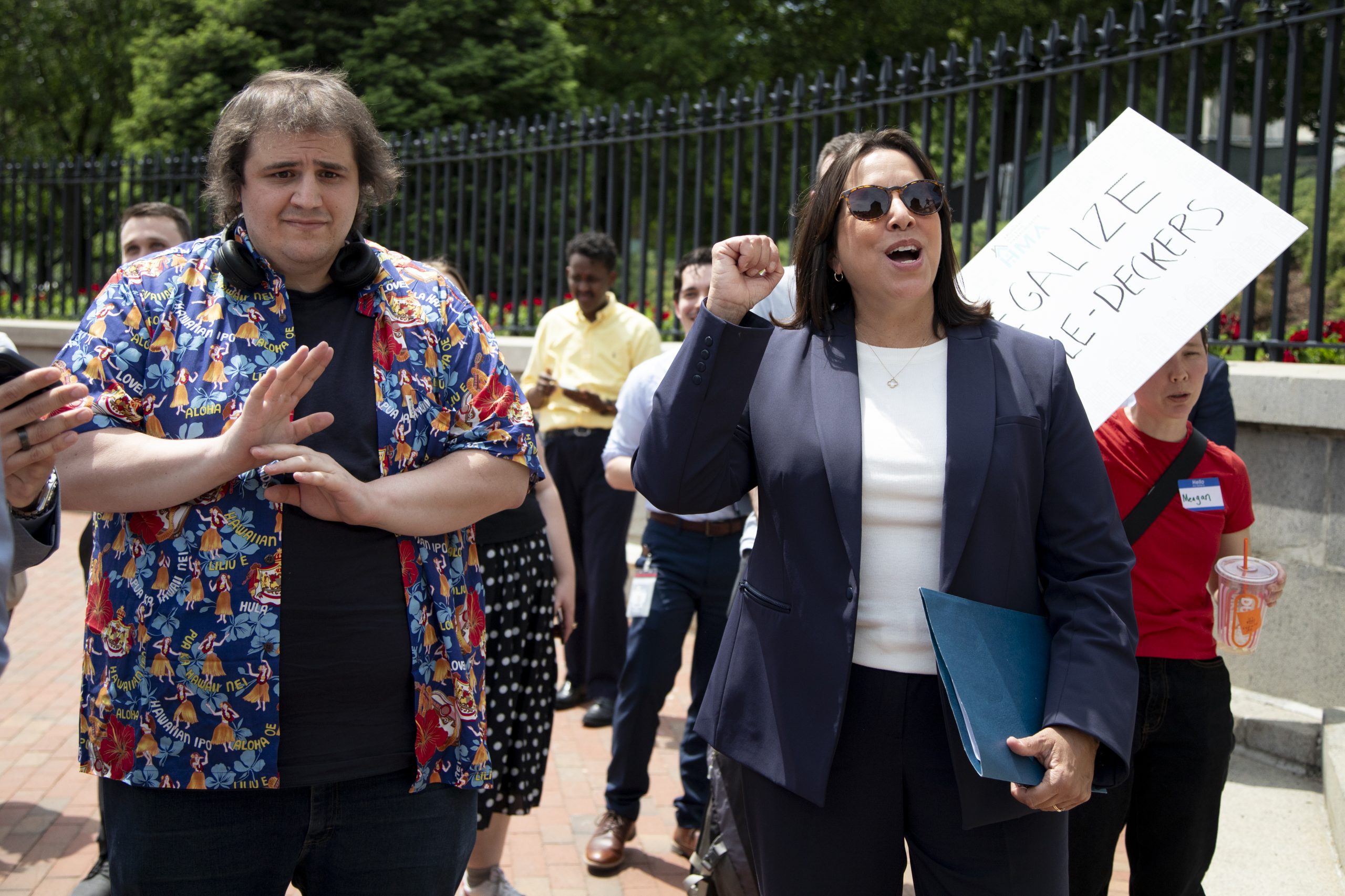
Lt. Gov. Kim Driscoll (right) cheers at an Abundant Housing Massachusetts event outside the State House on May 27, 2026, joined by Marblehead resident David Modica (left), who skyrocketed to sudden fame after questioning the intentions of a rezoning plan during Marblehead's spring 2026 Town Meeting. Photo by Chris Lisinski | CommonWealth Beacon
Advocates for stronger state laws allowing more housing to be built got a boost Wednesday from the Healey administration, as Lt. Gov. Kim Driscoll told a crowd gathered in front of the State House that local communities have to step up and be part of the solution.
“Right now, too many of our communities are unaffordable for people who go to work every day,” Driscoll told rally-goers who came to support legislation being pushed by the advocacy group Abundant Housing Massachusetts. “There is a way to address our housing shortage. It’s called building more housing and building it faster.”
So-called YIMBY, or “Yes In My Back Yard,” legislation, sponsored by Sen. Brendan Crighton of Lynn and Rep. Andy Vargas of Haverhill, would generally allow up to five units on all lots served by water and sewer and up to three on all non-sewered lots. It would also eliminate parking minimums near transit and make it easier to split larger lots and build on smaller lots, which proponents said would help lead to more affordable starter homes.
“Young people are fleeing our state in droves for more affordable states,” said Jesse Kanson-Benanav, executive director of Abundant Housing Massachusetts. “The people that our communities rely on – child care workers, nurses, service, and retail workers – can’t find homes in the cities and towns that they serve. When there are not enough homes, the wealthy will always outbid working people, and everyone has to move further away, including away from Massachusetts.”
Driscoll Backs Local Autonomy, with Limits
The YIMBY rules would be fine-tuned by the Executive Office of Housing and Livable Communities and subject to some “reasonable restrictions” from cities and towns.
Driscoll, who served 16 years as mayor of Salem, said she believes in local control by municipal government, but within limits.
“As a former local official, I love local autonomy,” she said, “but not if it means the autonomy to build nothing anywhere or not meet our key housing goals.”
A goal of the bill backers said, is to roll back some of the ways that municipalities can stymie new housing in the name of community preservation.
Bay Staters “need to remember that zoning and zoning laws are provided to municipalities from the state,” said Vargas. So, he said, “if we’re not building housing, it’s time for the state to relook at how we can take up that responsibility more aggressively.”
Memories of MBTA Zoning Fight Loom
Efforts to push communities to allow more housing through the MBTA Communities law have already stirred opposition. Dozens of communities dug in their heels against the law, which requires cities and towns near MBTA service to rezone for more multifamily housing, with some ultimately choosing “paper compliance” with the law that rezoned in a way that would lead to little or no new housing.
Against that backdrop, and even with the support of the Healey-Driscoll administration, the YIMBY bill’s fate is anything but certain. Under new rules for the current term, just eight weeks remain until all bills need to be approved in both chambers and sent to conference committees or perish. Lawmakers will still be able to negotiate on the language until the term concludes.
Senators on the Joint Committee on Housing voted to send an amended version of the bill to Senate Ways and Means in December, where it has sat since. Representatives on the committee have not moved the bill out of the housing committee.
“I think there’s opportunities to do individual bills” even given the tight timeline, Crighton said. He noted that there is an economic development bill pending that may include housing provisions when it is finalized. That could echo the way MBTA Communities became law – a few brief lines in a 2021 economic development bill.
Marblehead’s Modica Speaks
Advocates at Wednesday’s rally trotted out an unlikely recent celebrity in the pro-housing world to hammer the point home in colorful fashion. Marblehead resident David Modica took the internet by storm when a video clip went viral of him earnestly asking a recent town meeting whether voters were “kind of being pricks” by approving an MBTA Communities rezoning plan that was unlikely to actually result in new housing.
Marblehead loves its history, Modica said, sometimes at the expense of its present.
The town’s structures are covered with memorial plaques about when buildings were founded and why.
“It’s a very high-plaque-density place,” Modica joked, but most of the beautiful structures there were built during a period of no setback rules and no parking minimums, on account of the horses, and couldn’t be built now under modern zoning rules.
Though he confessed that he “is not a history guy,” Modica suggested Marblehead could benefit from some of the same flexibility shown in the past. A sign he came across on Fort Sewall, completed in 1644, reads “’the structure has been modified to accommodate the town’s changing needs,’” Modica said, “and I was like, maybe history does have lessons for us, after all.”
This article first appeared on CommonWealth Beacon and is republished here under a Creative Commons Attribution-NoDerivatives 4.0 International License.