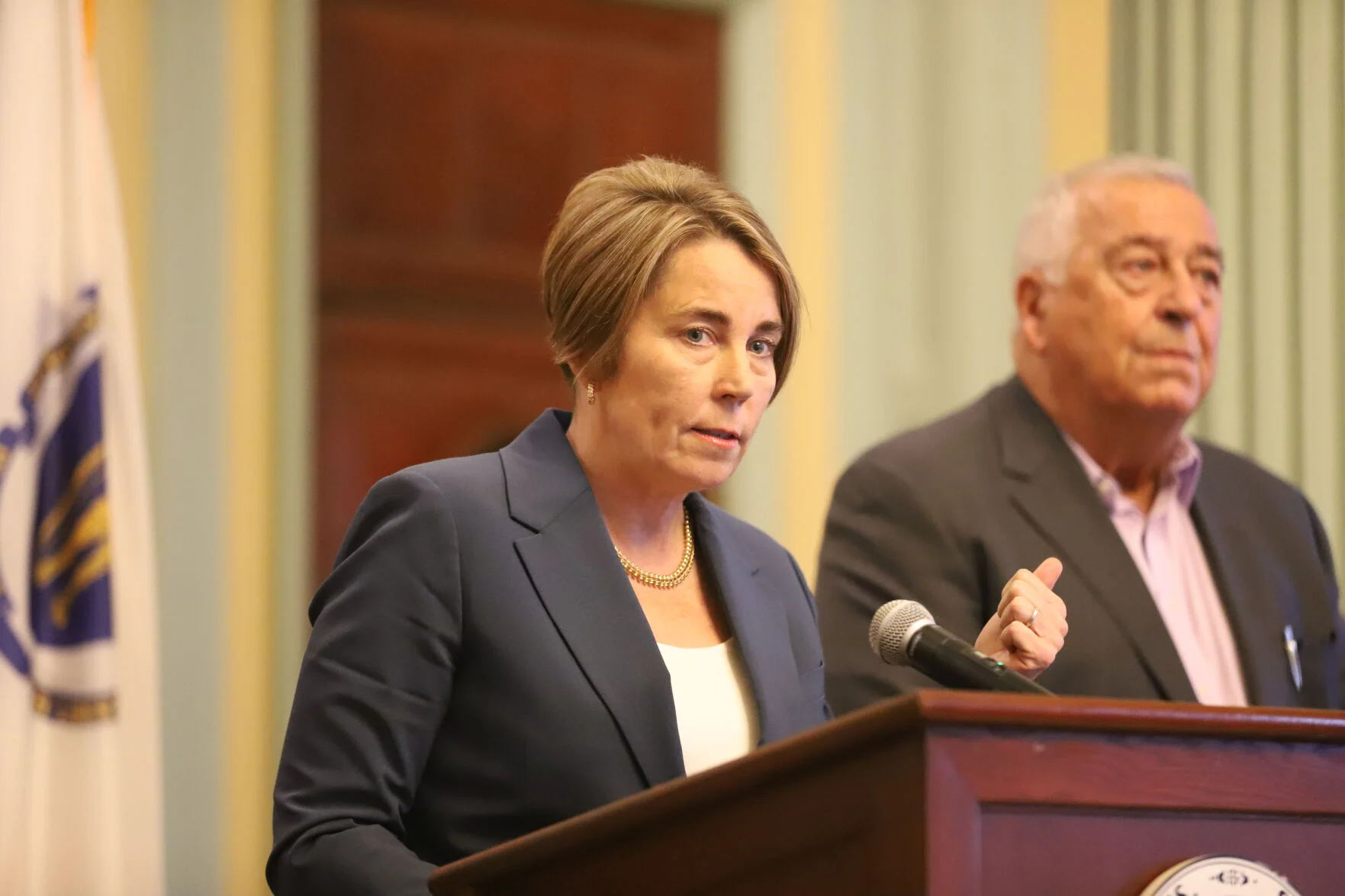
Gov. Maura Healey speaks at a leadership media availability on Nov. 3, 2025 in the Senate Reading Room. On the right stands House Speaker Ron Mariano. Photo by Ella Adams | State House News Service
It’s one of the biggest have/have-not divides right now in Massachusetts, and it cuts across all racial lines and all economic ones as well, but for the super wealthy.
That would be the gap in political and economic power between homeowners and prospective homebuyers and renters.
Homeowners call the shots in Massachusetts politics. A vocal minority of those seem determined to protect the value of their rapidly appreciating assets without regard to larger issues or concerns.
Like any easily mobilized, relatively well-off pressure group, they can be a decisive force in local politics when it comes to blocking plans for new apartment buildings, seen by some as a threat to property values.
And a number of state lawmakers are certainly not keen on dealing with angry homeowners, either, as can be seen by the years it took Beacon Hill to pass the MBTA Communities and Housing Choice housing reform laws.
Homebuyers and renters on the hunt for new digs, by contrast, often have no voice or vote in the towns or cities where they are looking to buy or rent.
In theory, at least, they do have one potentially powerful political ally in the governor, who is elected to look after the best interests of the state.
Enter Gov. Maura Healey, who, like a long line of governors before her, recognizes it’s in the state’s broader interests to encourage the construction of more homes, condominiums and apartments to address a now decades-long housing shortage.
Baker Tried Hard, Too
It’s certainly the right thing to do, given the struggles homebuyers and renters face now in trying to find anything habitable that they can actually afford.
But it’s also in the state’s best interests economically as well.
The business community has warned for years of the sticker shock that has made it challenging to recruit workers from other regions with more reasonable housing costs.
However, the jury is definitely out on whether Healey will have any more luck in tackling the state’s housing crisis than her predecessors, who, at best, made very modest strides.
Sure, she’s been outspoken on the issue, but so was former Gov. Charlie Baker, under whose watch the MBTA Communities Act and Housing Choice laws both passed.
On the plus side? The Healey administration has taken a strong stance on MBTA Communities, successfully enforcing at least paper compliance on part of most of the cities and towns covered by the law.
The Healey administration’s $5 billion-plus Affordable Homes Act may be best known in the general public, beyond the big price tag, for legalizing granny flats across the state.
The governor, who faces reelection next year, claims that 100,000 units are in “the pipeline,” thanks to the Affordable Homes Act’s investments in affordable housing financing and reforms like the MBTA Communities act, though a large part of these units were permitted under Baker. It’s also not clear how many are close to breaking ground, though the vast majority are likely not.
State Land for Homes Working?
One area Healey is definitely making strides at the expense of entrenched homeowner opposition, is now ramping up efforts to sell off surplus state land to housing developers with her “State Land for Homes” initiative.
In the face of pushback from some Wellesley residents and town officials, the administration has stood strong in efforts to put a parking lot at MassBay Community College out to bid.
That 5-acre lot could yield 180 new apartments, while preserving dozens of acres of state-owned woodland next door.
There was also a recent announcement of plans to develop another 48 new homes on two state-owned lots, on the Middlesex Community College campus in Bedford and the other on the Bridgewater State University campus in Bridgewater.
Still, the biggest potential sale Healey’s housing team has announced to date are plans to unload nearly 70 acres at Devens, the old Army base turned industrial park spanning parts of Ayer, Harvard and Shirley.
State officials are now seeking proposals for a 6-acre-plus site and another totalling more than 62 acres.
The Healey administration has done a good job preparing the way for more housing at Devens, which has thousands of acres of undeveloped land.
Administration officials worked with state lawmakers to lift a housing cap that has kept the number of homes, apartments and condos at Devens under 300 – a ludicrously low number, though one firmly preferred by residents two of the base’s towns in years past.

Scott Van Voorhis
Don’t Let Devens Go to Waste
But while that smaller site could yield 30 to 50 homes, there is no such estimate in the RFP for the larger site.
I reached out to MassDevelopment, which oversees development at Devens, for an explanation, but did not hear back by B&T’s deadline.
Still, if the larger site were built out at the same density as the planned redevelopment of the MassBay parking lot, it would yield over 2,100 homes.
Sixty-two acres is nothing to sneeze at.
And if the end result of that development effort is, say, 150 to 200 units, it would be a travesty.
Nor would it bode well for any hopes that Healey will be able to succeed where her predecessors have failed when it comes to standing up to opponents of new housing.
Scott Van Voorhis is Banker & Tradesman’s columnist and publisher of the Contrarian Boston newsletter; opinions expressed are his own. He may be reached at sbvanvoorhis@hotmail.com.