
iStock illustration
Following an ill-timed development boom, nearly half of the recent lab projects in Greater Boston are now controlled by lenders, according to industry research.
Since early 2023, developers have built 70 projects totaling 17.9 million square feet, and 11 million square feet is still available, according to CBRE research.
Of the $11 billion lent for the projects, properties tied to $5.3 billion in loans now are controlled by the lenders.
“There haven’t been too many foreclosures, but sponsors are under water, lenders are making the decisions,” CBRE Senior Vice President Tim Mulhall said during a mid-year market presentation. “When they are chasing current tenants, lenders are in on all the calls going through lease negotiations.”
The presentation was sponsored by NAIOP Massachusetts, the commercial developers’ trade group which is rebranding as Commercial Real Estate Development Association (CREDA) this month.
The post-pandemic development boom increased the region’s lab inventory by approximately 30 percent.
Within the group of projects now controlled by lenders, the availability rate is nearly 74 percent.
Some lab developers have recruited advanced manufacturing and clean energy tenants to fill the void left by biopharma tenants’ diminished demand for real estate.
Alexandria Real Estate Equities, the nation’s largest lab landlord, announced in April that it is in negotiations with tech companies to lease 242,408 square feet at 311 Arsenal St. in Watertown and 3000 Minuteman Road in Andover for “lower-cost alternative uses.”
Such industries generally pay lower rents and also have the option of occupying more affordable industrial flex-type properties, according to brokers.
Lab developers that hold out for life science tenants could be rewarded, however, according to recent brokerage research showing an uptick in leasing requirements.
JLL is tracking 2.3 million square feet of lab requirements after the entry of 20 new companies into the market in recent months, pointing to a potential future rebound in occupancy.
For some developers, the recovery comes too late to maintain control of properties they acquired at the previous era’s prices.
In Burlington, GEM Realty sold its 10 Corporate Drive for $20 million in February, a office-to-lab conversion that failed to attract tenants. GEM Realty acquired the property in 2021 for $42.3 million and received $61.7 million in financing from Cambridge Savings Bank.
“A massive basis reset is going to happen,” Mulhall said. “There’s plenty more coming. The issue is the scale of the dollars that are going to be lost. There are difficult decision-making decisions being made and it slows everything down.”
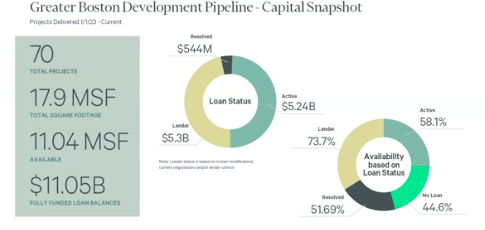
Image courtesy of CBRE/NAIOP MA