iStock photo illustration
New polling commissioned by an advocacy group says Massachusetts’ banks have a market opportunity if they can win low-income residents’ trust.
The research, conducted by the MassINC Polling Group and commissioned by the Boston-based Partnership for Financial Equity, found 8 percent of low-income residents are unbanked according to the report, yet nearly half of those without bank accounts say they are interested in opening one in the future.
“Low-income residents want to be part of the financial mainstream, but cost, past negative experiences, and lack of clear information continue to push many people away,” said the Partnership for Financial Equity in a statement. “This research shows that trust can be built—and rebuilt—
when banks meet people where they are with transparent products, fair treatment, and strong community partnerships.”
The polling of 624 Bay Staters making less than $80,0000 found 85 percent of low-income respondents said that they trust banks in general. But only 25 percent expressed strong trust. Still, trust was significantly lower among unbanked residents, which the Partnership for Financial Equity characterized as a sign of “fraglie” trust.
This demographic of respondents also utilized alternative financial services more frequently than their higher-income peers. More than 50 percent of low-income resident respondents, and over 75 percent of low-income Latino resident respondents, used at least one alternative financial service in the past year, even when they had a bank account.
These services tend to cost more than bank accounts and advocates for financial inclusion have long described these elevated costs as a “tax” on lower-income Americans.
Banks looking to win over this untapped pool of low-income customers should expand Bank On– and Basic Banking-certified accounts with no overdraft or maintenance fees, improve transparency and communication around fees to build trust with customers and offer pathways for consumers with negative banking histories to rejoin the financial system. Negative experiences with banks, fees, and lack of trust are the most commonly cited reasons people remain unbanked, according to the report.
Banks should also maintain physical branches in low-income communities as several have done in recent years, the report argued, and partner with community organizations to design products and outreach strategies.
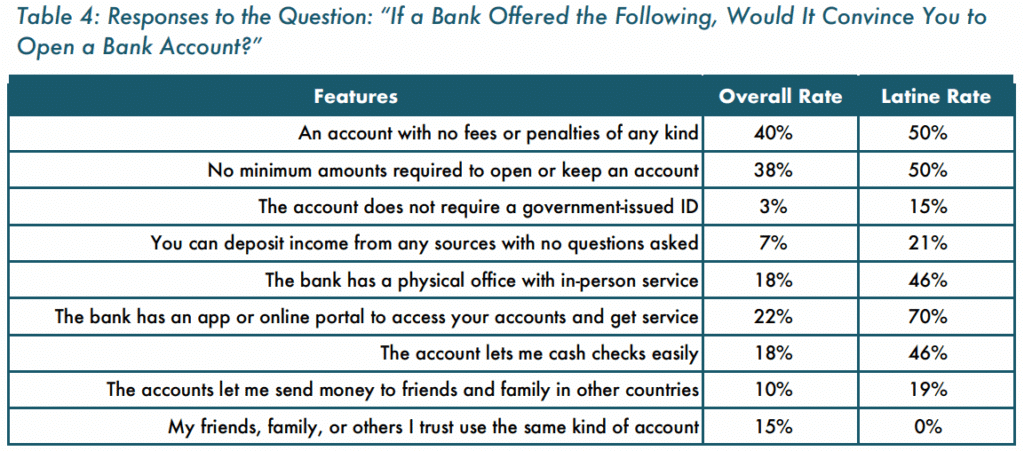
Image courtesy of the Partnership for Financial Equity