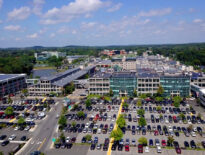
Boston-based developer The Davis Companies is redeveloping an 82-acre former gasoline and oil tank farm in Everett into millions of square feet of mixed-use real estate. Image courtesy of The Davis Companies
Just over 15 years ago, Massachusetts began targeted programs to generate investment and opportunity in 11 – now 26 – cities designated as “Gateway Cities.” These cities, once thriving economic and cultural centers of their regions, had been in various states of decline after years of disinvestment.
An array of approaches focused on revitalizing Gateway downtowns, expanding housing and increasing economic activity to employ residents and draw growth to each city.
In Gateways, the state’s Economic Development Incentive Program (EDIP) delivers supercharged tax incentives for employer expansions.
MassDevelopment’s Transformative Development Initiative (TDI) lends staff capacity and technical assistance to support neighborhood renewal.
The Housing Development Incentive Program funds leverage housing development. These among other public- and private-sector initiatives have produced significant results in these cities.
The growing headway made by Gateways underscores the principles that are the foundation for the Gateway Cities movement.
These cities have been anchors of regional economies because of the critical assets they built over time. Collectively, they are transportation hubs, seaports, highway crossroads, cultural centers and seats of government, each with historic downtowns. Most have the full complement of public works infrastructure. Some have their own power generation, as well as municipal power and light companies.
They also have sites ready for development or redevelopment. Such sites are critical in catalyzing employment-generating opportunities for Gateways.
From Pittsfield to Everett
In Pittsfield, the William Stanley Business Park recently expanded to over 16 developable acres. The Park, a former GE industrial campus, constitutes the premier shovel-ready site in the Berkshires. It includes access to a commercial rail spur. The recent expansion of Jain Americas to Pittsfield, at a nearby 153,000-square-foot building for its new PVC production line, signals the value of Stanley Park’s acreage for future investment.
In Worcester, the 51-acre GreenTech Park, a redevelopment of a former St. Gobain plant north of the city’s downtown, is another premier property. Located adjacent to Interstate 190, GreenTech is especially attractive to employers ready to benefit from the infrastructure, higher education and workforce assets of New England’s second-most populous city.
In Everett, the Everett Docklands Innovation District is rising from a former ExxonMobil oil tank farm. At 86 acres, it may be the most significant inner-core urban development space on the East Coast, with up to 7.2 million square feet of mixed-use space in play currently and up to 16 million square feet possible at full build-out. It has access to a deep-water port and a pretty great view of the Boston skyline.
In Taunton, the 149-acre Silver City Business Park, a former mall site, offers approximately 10 million square feet for commercial development. Targeting advanced manufacturing, e-commerce and R&D opportunities, its developer has already constructed a 248,000-square-foot spec flex building. It’s served by 9 million megawatts of power load and also offers dedicated road access to Routes 24 and 140.

Peter Abair
Asset-Driven Revitalization
As part of its statewide economic development mission and Team Massachusetts partner, MassEcon provides statewide site location services. In developing inventories of available buildings and sites that meet the criteria developed for business prospects, Gateway City properties feature prominently.
Since 2020, just under 30 percent of MassEcon-assisted projects expanding in or relocating to Massachusetts have chosen Gateway Cities. In total, the 14 MassEcon-assisted site location projects in this period account for 403,000 square feet of facility space and 1,104 new jobs in Massachusetts’ Gateway Cities.
Gateway Cities are leveraging long‑standing assets – strategic locations, industrial legacies and robust infrastructure – to attract new investment and sustain economic momentum. Supported by state programs, committed state and local leadership and responsive private‑sector partners, these communities are transforming once‑underutilized properties into engines of growth.
The continued success of Gateway development efforts demonstrates not only the relevance of these cities in Massachusetts’ economic future but also the power of coordinated, asset‑driven revitalization to create jobs, strengthen regions and expand opportunity across the commonwealth.
Peter Abair is the CEO and executive director of MassEcon, a statewide, independent economic development nonprofit.