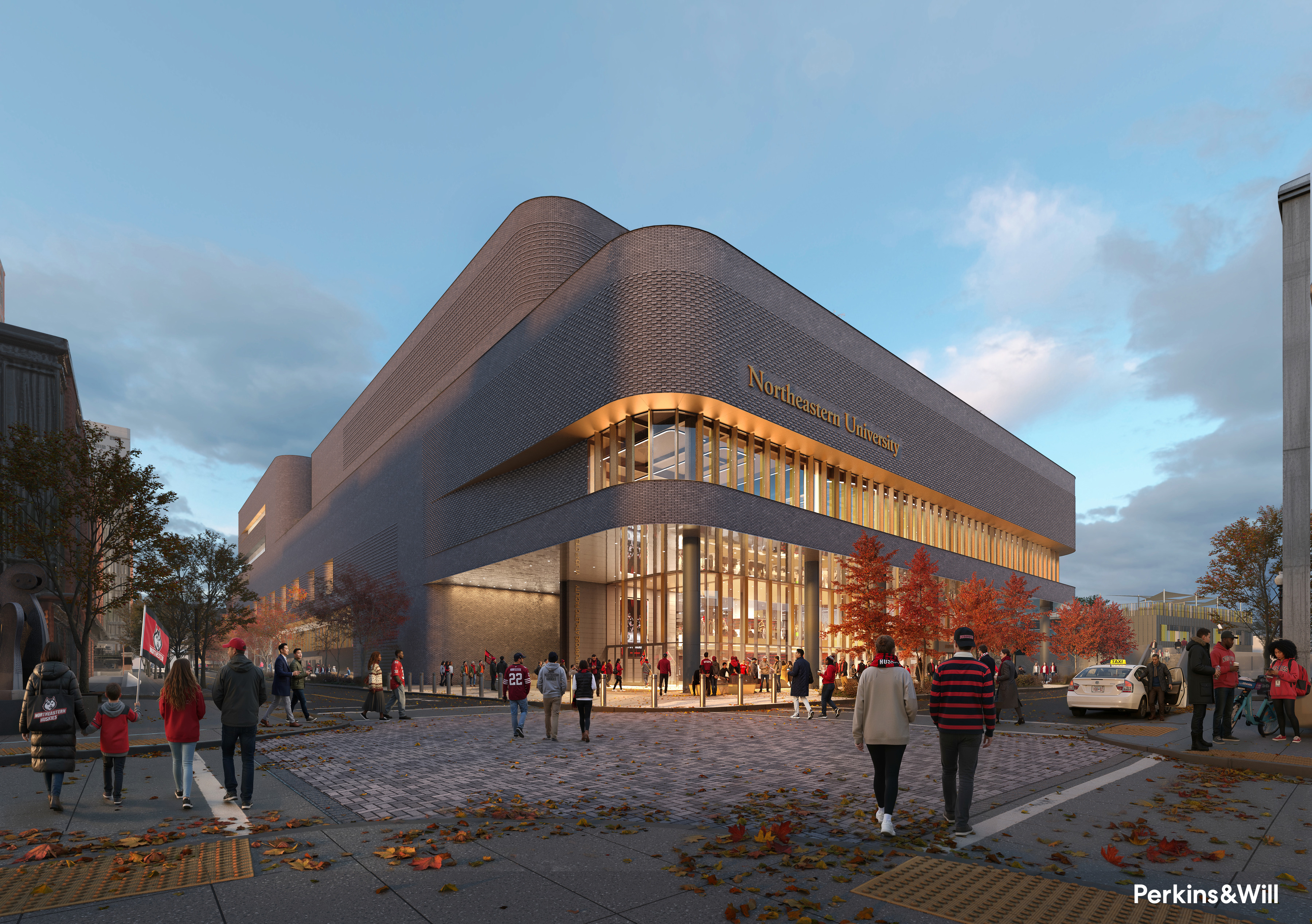
Nestled within the South End neighborhood, Northeastern University’s new athletic facility will serve as a vital part of Boston’s civic community. Image courtesy of Perkins&Will
For more than a century, Matthews Arena has been woven into the cultural fabric of Boston, a landmark where generations gathered around sport, community and shared memory.
Now, Northeastern University is carrying that legacy forward with a new multipurpose athletic facility unlike anything else in the country: a vertically stacked athletics and wellness campus designed to fit on a tight site in the heart of the city.
As the first project emerging from Northeastern’s new institutional master plan, the facility transforms a constrained urban block into a highly connected environment for Division I athletics, recreation, wellness and student life.
Rather than spreading outward, the design builds upward, stacking four long-span programs, including an arena, turf, recreation and basketball practice facilities, into a single, interwoven structure.
The result is both an architectural and urban response, maximizing land use in the heart of Boston while creating dynamic relationships between programs that traditionally operate in isolation.
A Building of Movement
Movement became the organizing idea. Throughout the building, circulation pathways reveal moments of overlap between athletes, students and visitors, creating energy and exchange at every level.
A student heading to a fitness class may overlook practice courts. Fans arriving for a hockey game move alongside recreation spaces alive with daily campus activity. The facility is designed not only for game day, but for year-round use, a true “365 facility” that supports varsity athletics, club sports, intramurals, wellness and community gathering.
Inside, the program is extensive: a multipurpose arena for men’s and women’s hockey and basketball, dedicated practice facilities, a rowing tank and erg room, indoor turf and track space, recreation courts, fitness and dance studios and distributed wellness spaces that include sensory rooms, prayer rooms, mothers’ rooms and nutrition support spaces.
By vertically integrating these uses, the project brings together programs that are typically spread across multiple buildings. Wrapped in a unifying brick material palette, the building reinforces the idea of one Northeastern community, while varied textures and patterns subtly express the distinct programs housed within.
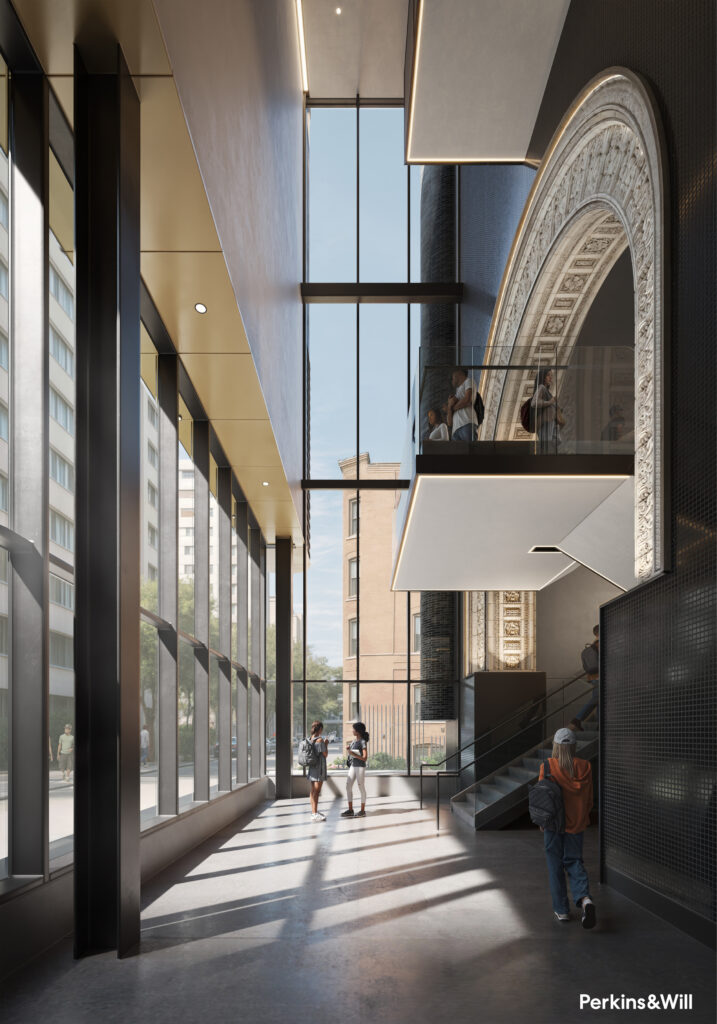
Salvaged from Matthews Arena, the iconic arch will be reassembled and integrated in the new facility’s entry. Image courtesy of Perkins&Will
Reimagining a Beloved Landmark
While the facility looks firmly forward, it also carries deep respect for the past.
One of the project’s defining moments is the careful deconstruction and relocation of the historic terracotta arch from Matthews Arena, the original entrance to the historic arena.
Rather than treating the arch as a decorative artifact, the design restores its civic role. Re-sited as a threshold into the new arena, the arch maintains its original orientation and spatial memory, connecting generations of students and fans through a familiar point of arrival.
Visible from the street through the transparent lobby, the arch continues its presence within the public realm, bridging the history of the site with the next chapter of Northeastern athletics. The gesture reflects a broader philosophy behind the project: honoring legacy while embracing transformation.
Raising the Bar for Sustainable Sports Venues
The facility aims to establish a new benchmark for sustainable sports venues.
Designed as an all-electric building pursuing both Living Building Challenge CORE Certification and ILFI Net Zero Carbon Certification, the project integrates high-performance systems and renewable energy strategies throughout.

Jennifer Williams
A hybrid ground-source and air-source heat pump system, supported by 46 geo-exchange wells, will dramatically reduce operational carbon, while a rooftop solar array contributes on-site renewable energy generation.
Water resiliency is equally embedded into the design. A 100,000-gallon cistern will collect rainwater for ice-making, irrigation and filling the rowing tanks, reducing demand on municipal infrastructure while improving stormwater management in a dense urban environment.
Together, these strategies position the Multipurpose Athletic Facility as far more than a new arena. It is a bold response to the realities of building in a dense urban environment, proving that limited land does not have to limit possibility. By stacking athletics, wellness, recreation and community into a single vertical campus, Northeastern is rethinking how sports venues function in dense cities.
Jennifer Williams is the Northeast regional practice leader for sports, recreation and entertainment projects at Perkins&Will Boston.