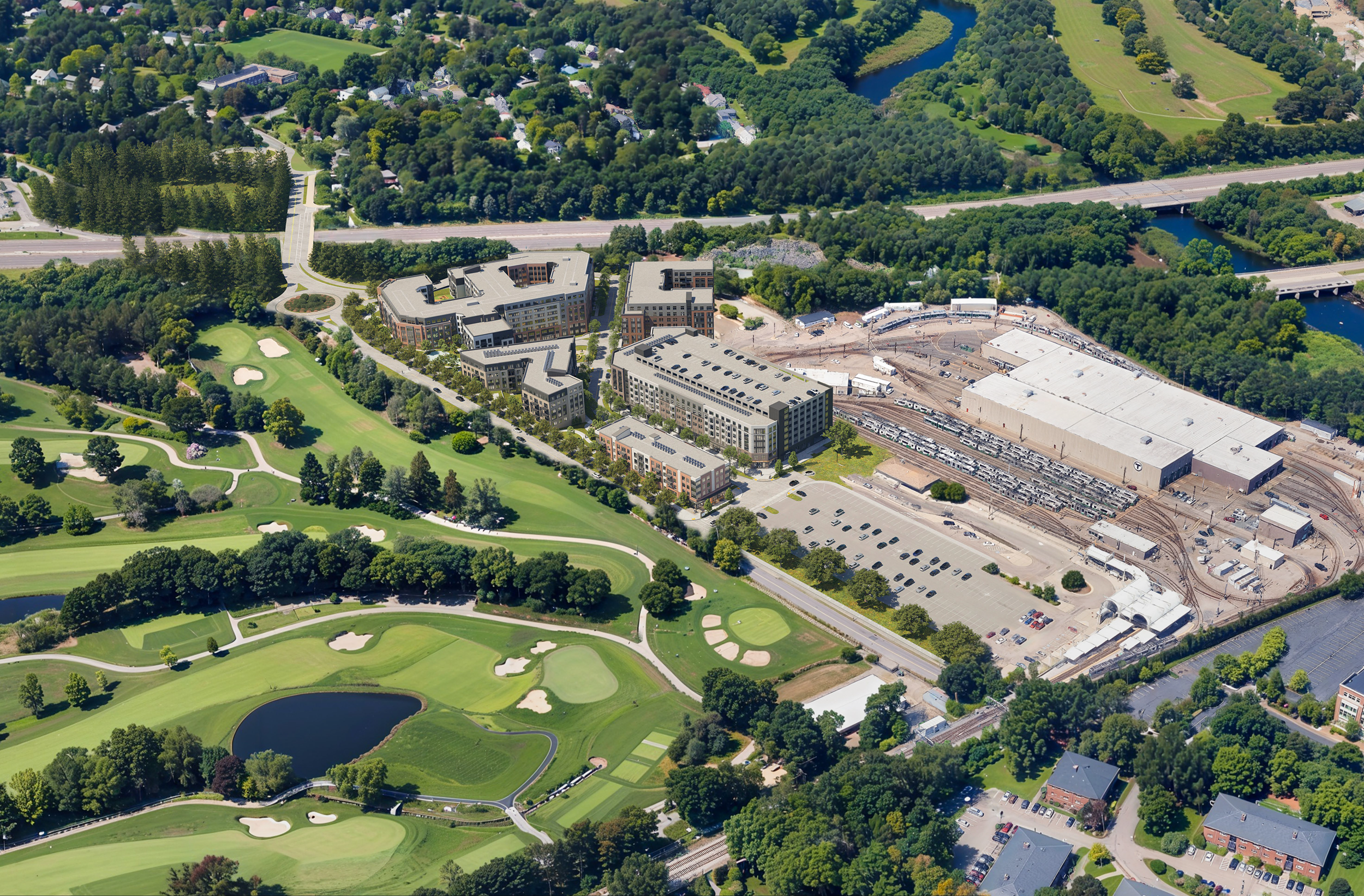
A rendering of the existing approved development plan/Image courtesy of Minno Wasko Architects and Planners
Nearly 20 years after development on the site was first proposed, Newton city councilors delivered nearly unanimous approval for 753 homes on the parking lots next to the MBTA’s Riverside station.
The plans represent proponent Mark Development’s third and smallest proposal for the Green Line parking lots since it took the lead on the project in 2018.
“It’s not a perfect plan, but maybe there is no such thing,” Councilor Randy Block, previously one of the Riverside project’s most vocal critics, said during Monday night’s City Council meeting before moving to pass the needed zoning and site plan approvals.
The project OK’d Monday replaced the hotel and lab/office component Mark Development had proposed in 2021 with more housing, upping the unit count from 550 to 753 and downsizing the retail component from about 43,000 square feet to 19,915 square feet, but keeping a large garage for development residents and MBTA commuters.
A 1.69-acre part of the Riverside parking lots closest to the train station will stay undeveloped. The community benefits package includes $3.5 million for neighborhood improvements, $1.5 million for municipal building and playground improvements and $30,000 for a study of a noise barrier between Route 128 and Deforest Road, a residential neighborhood.
While the new version’s lower traffic impacts appeared to have won over some Newton city councilors, Mark Development’s decision to remove the lab space – and its significantly higher property tax revenues – in the face of serious market headwinds generated the only two “no” votes on the 24-member City Council Monday.
“It’s been a long road. this project, I’m supporting it for two reasons: number one, it provides more housing than any of the other iterations we’ve seen. we hear daily the need we have for more housing and affordable housing, which there will be a significant number of units,” Councilor Leonard J. Gentile told his colleagues
A significant commercial component would have generated significantly more traffic than homes, he added, something he characterized as the biggest community concern about the project.
“We can’t keep approving project after project with minimal amounts of commercial and expect to get anything different. Once it’s built on, we’re not going to get this space back and it feels like we’re looking at short-term interests when we should be looking at the long-term fiscal sustainability of the city,” said Councilor Julia Malakie
Malakie said she’d “rather wait” for market conditions to change to bring more commercial development to the site. Councilor John Oliver joined her in voting against the Riverside project’s special permit application, citing similar concerns.
Newton officials have sparred over three Proposition 2 1/2 overrides in 2023 to pay for school building projects, and boost the city’s and the school district’s operating budget.

Image courtesy of Mino Wasko Architecture and Planning