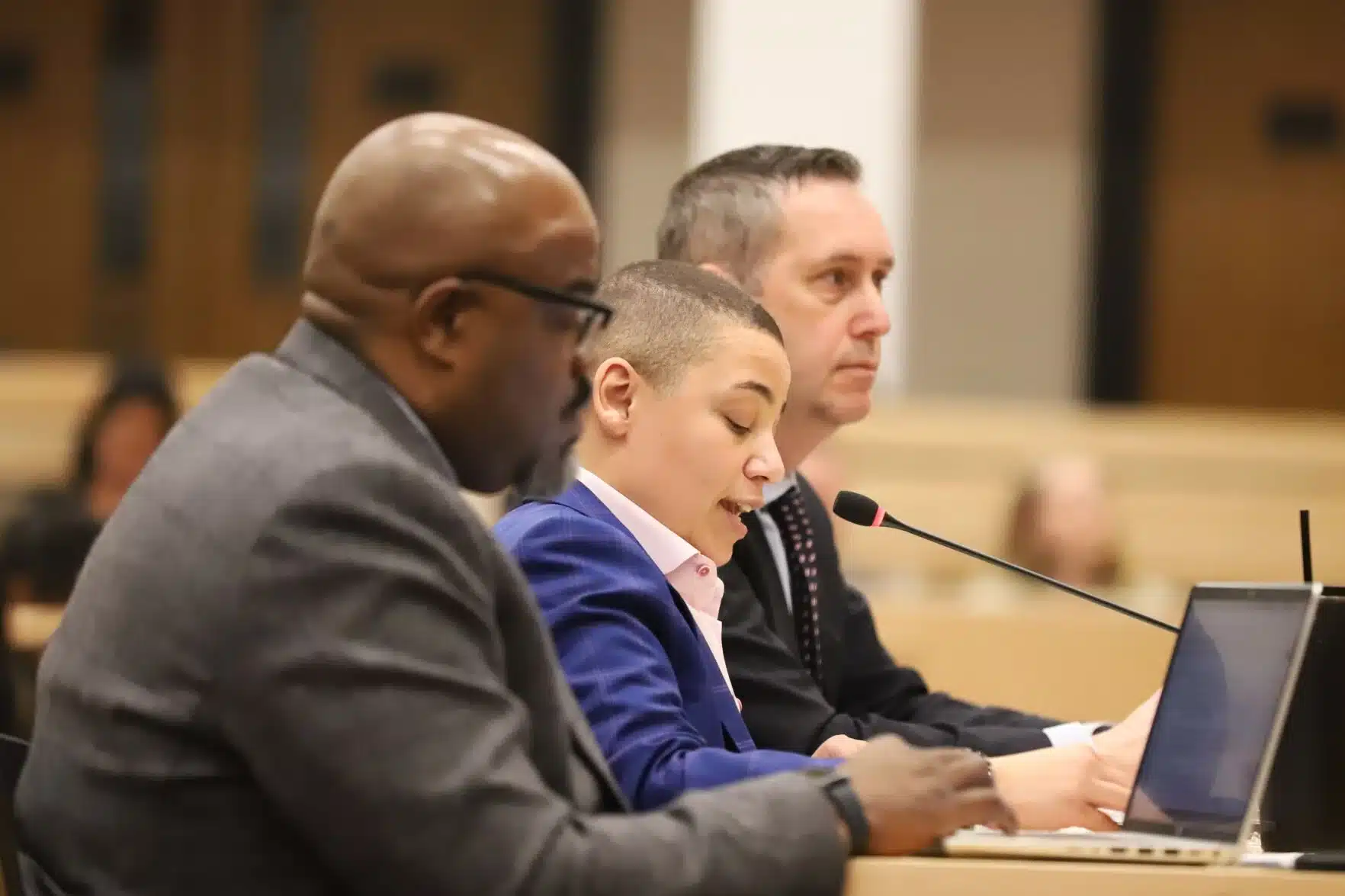
Education Secretary Patrick Tutwiler, Transportation Secretary Monica Tibbits-Nutt and Administration and Finance Secretary Matthew Gorzkowicz testify before the Joint Ways and Means Committees during a budget hearing on Thursday April 3, 2025. Photo by Sam Drysdale | State House News Service
Lawmakers will need to reconcile questions about the right balance for income surtax spending, in more way than one, when they take up Gov. Maura Healey’s proposal to deploy about $1.3 billion in unspent revenue from the new levy on wealthy households.
When legislators gathered Thursday to review Healey’s plan (H 55), a pair of western Massachusetts lawmakers voiced frustration that the transportation spending in the bill skews heavily toward the MBTA, contending the split is not “fair” to residents outside the Boston-based transit agency’s service area.
Democrat Sen. Jo Comerford of Northampton and Republican Rep. Todd Smola of Warren each pressed administration officials about the roughly $780 million allocated for the T in the bill, contrasted with significantly smaller balances available for regional transit authorities and microtransit in less populous areas.
“When this proposal came out, we all in western Massachusetts heard from people that this didn’t look like equity or anything close to equity,” Smola said at a Joint Ways and Means Committee public hearing in Boston. “We’ve tossed that term around loosely, but these numbers are tough.”
“This decision was made at the ballot,” he added about the surtax, which voters approved for education and transportation investments. “I accept that, and I think we all have to accept that, but the breakdown of these funds is a really, really difficult pill for a lot of people to swallow in other parts of the state.”
T Facing Budget Cliff
MBTA funding accounts for more than half of the balance in Healey’s bill. The money would help replenish the T’s savings, which the agency drained last year to sustain a hiring blitz, and workforce and safety spending.
Healey’s fiscal 2026 annual budget also seeks to use new surtax dollars to significantly boost state aid for the agency, aiming to mostly close the massive budget gap the MBTA faces starting July 1.
Administration and Finance Secretary Matthew Gorzkowicz told lawmakers the supplemental budget “does look disproportionately unfair to western Mass.” on its own, but he urged them to weigh it alongside the annual budget and a five-year, $1.5 billion Chapter 90 bill (H 53).
Those three legislative vehicles combine to form a broader transportation funding plan that Healey deputies have estimated would inject $8 billion over the next decade.
“You should be able to go back to western Mass. with a lot of confidence in what we’re proposing here. Out of an $8 billion transportation plan, nearly $5.6 billion of it is outside of the MBTA. Only 25% of that plan is really going towards the MBTA,” Gorzkowicz said, soon adding, “The vast majority of the proposal, when taken holistically across all the items that we filed, is a very thoughtful plan.”
Regional Equity Demanded
Comerford contended, however, that even when combining surtax spending on transportation in the supplemental and annual budgets, the vast majority of dollars would go to the T instead of the state’s 15 regional transit authorities that serve other communities.
“With this as it is, I think I can’t go home and say this, that we have a commitment through Fair Share dollars, which our voters in western Massachusetts campaigned hard for — I just don’t think it’s super fair currently,” she said.
Comerford also referenced another earmark the T has long enjoyed.
“In western Massachusetts, we’re aware that we pay a penny of our sales tax for the MBTA, and most of my people will never ride it,” she said.
Transportation Secretary Monica Tibbits-Nutt told Comerford that administration officials “want to be having this conversation over the next fiscal year” about grant programs, funding and technical assistance for RTAs.
“But Secretary, if we wait a year, we will be yet one more year behind with no service in these towns that are declining population at a pretty significant rate,” Comerford replied.
Education Vying for Surtax Funds
Healey proposed using a much larger chunk of the one-time pot — about $857.5 million — on transportation, leaving $462.5 million for education investments that range from early education and care, the special education circuit breaker reserve and career technical education grants.
Officials have said they believe the skew in that measure will balance out prior surtax spending, which has leaned more toward education. That idea already has the support of top House Democrats.
“Given that many of the worthy programs that have been funded in the annual budget process have been in the education sector, it is entirely appropriate that the majority of these one-time funds in this round be spent in the transportation sector of our economy,” House Ways and Means Committee Chair Aaron Michlewitz of Boston said at the start of Thursday’s hearing. “When the Fair Share amendment was pitched to the voters of the commonwealth in 2022, it was presented to be distributed evenly between education and transportation funding. This supplemental budget will allow us to fulfill that commitment.”
It’s not clear if Senate Democrats agree with the approach. Michlewitz’s counterpart, Sen. Michael Rodrigues of Westport made no mention in his opening remarks of supporting — or opposing — a more transportation-heavy approach. He called for the money to be spent “in a regional, equitable manner.”
A spokesperson for Senate President Karen Spilka of Ashland did not directly answer when asked if she supports the idea of directing more of the one-time surtax money toward transportation.
“Investing in education and transportation is critical if we want to continue to make Massachusetts a great place to live and work,” spokesperson Gray Milkowski said. “The Senate President will continue to hear from members and residents from around the state about the needs in both areas, and ensure the Senate’s version of the surtax supplemental budget appropriately balances investments in each.”
During the hearing, Sen. Paul Feeney asked Mass. Taxpayers Foundation President Doug Howgate whether the state ought to start thinking about new revenue sources.
Howgate responded by pointing at rates of growth in revenues and spending.
“Pick whatever revenue structure you want, pick whatever tax rates you want — they’re going to grow, if you’re lucky, at 3 to 4 percent a year. And one of the challenges we’re facing now in MassHealth, challenges we’re facing in a number of areas of spending, is that the spending is growing by more than 3 or 4 percent a year. And to me, that’s a structural issue that is going to require a lot of hard conversations for all of us about how to get our arms around those cost growth factors,” he said.